
Title
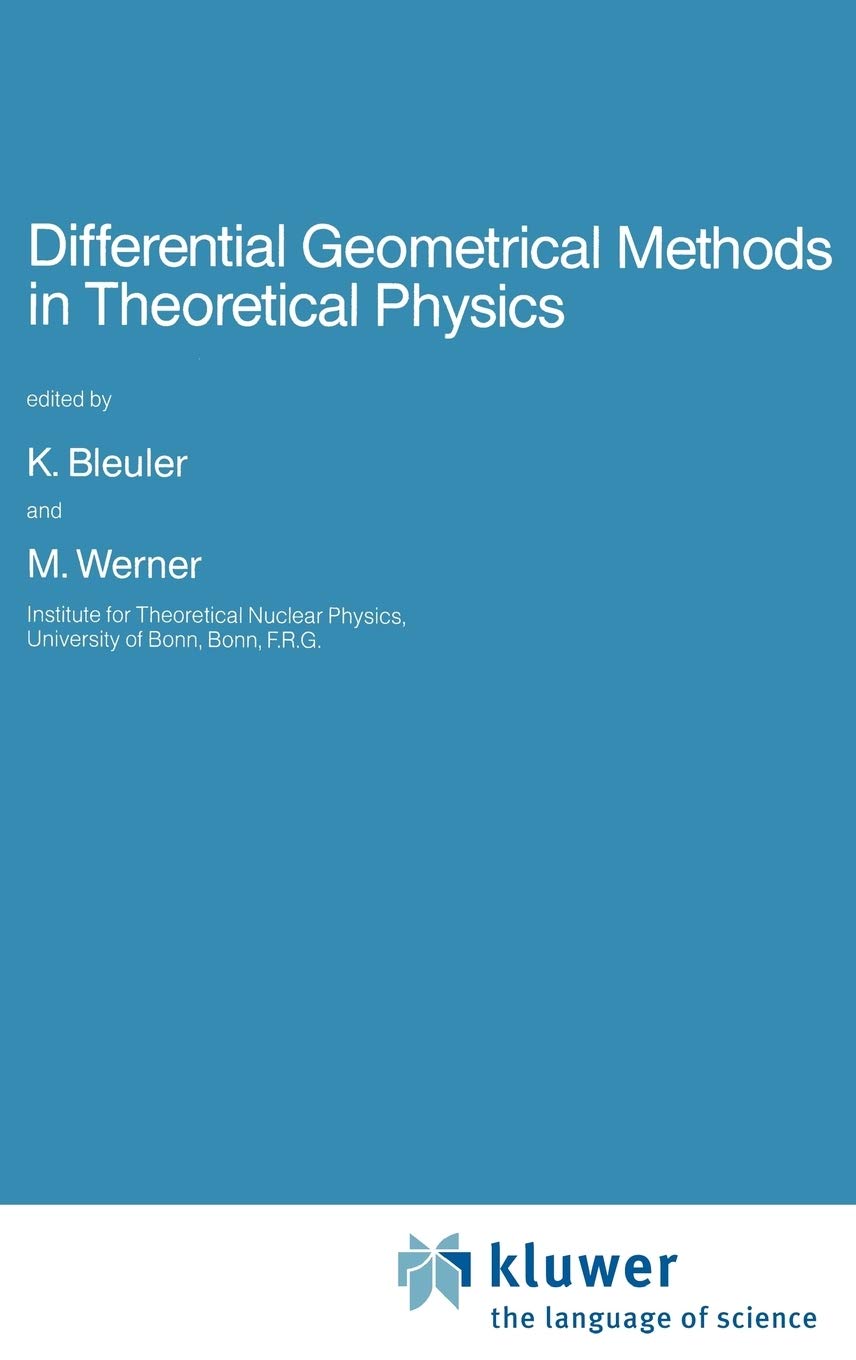
Differential Geometrical Methods in Theoretical Physics (Nato Science Series C:, 250),Used
Sold by Ergodebooks, an authorized reseller.
Returns accepted within 30 days | support@ergodebooks.com
Shipping Information
- Free Standard Shipping — United States only
- Processing Time: 3–5 business days
- Estimated Delivery: 6–10 business days after dispatch
- Double-boxed, fully insured & discreetly packaged
- Tracking number sent via email once dispatched
Returns & Refund
Returns accepted within 30 days of delivery.
Damaged or Defective Item
Free return shipping + replacement or full refund
Wrong Item Received
Free return shipping + replacement or full refund
Change of Mind
Return shipping at customer's expense · 25% restocking fee applies
Payment Option

Review Anybody ... will find in this book a lot of new original information and inspiration for further research.' Class Quantum Grav, 7, 1990 Product Description After almost half a century of existence the main question about quantum field theory seems still to be: what does it really describe? and not yet: does it provide a good description of nature? J. A. Swieca Ever since quantum field theory has been applied to strong int actions, physicists have tried to obtain a nonperturbative und standing. Dispersion theoretic sum rules, the Smatrix bootstrap, the dual models (and their reformulation in string language) and s the conformal bootstrap of the 70 are prominent cornerstones on this thorny path. Furthermore instantons and topological solitons have shed some light on the nonperturbati ve vacuum structure respectively on the existence of nonperturbative 'charge' s tors. To these attempts an additional one was recently added', which is yet not easily describable in terms of one 'catch phrase'. Dif rent from previous attempts, it is almost entirely based on new noncommutative algebraic structures: 'exchange algebras' whose 'structure constants' are braid matrices which generate a ho morphism of the infini te (inducti ve limi t) Artin braid group Boo into a von Neumann algebra. Mathematically there is a close 2 relation to recent work of Jones Its physical origin is the resul t of a subtle analysis of Ei nstein causality expressed in terms of local commutati vi ty of spaceli ke separated fields. It is most clearly recognizable in conformal invariant quantum field theories.
⚠️ WARNING (California Proposition 65):
This product may contain chemicals known to the State of California to cause cancer, birth defects, or other reproductive harm.
For more information, please visit www.P65Warnings.ca.gov.