If you have any questions, you are always welcome to contact us. We'll get back to you as soon as possible, withing 24 hours on weekdays.
Customer service
All questions about your order, return and delivery must be sent to our customer service team by e-mail at yourstore@yourdomain.com
Sale & Press
If you are interested in selling our products, need more information about our brand or wish to make a collaboration, please contact us at press@yourdomain.com
Help
If you have any questions, you are always welcome to contact us. We'll get back to you as soon as possible, withing 24 hours on weekdays.
Customer service
All questions about your order, return and delivery must be sent to our customer service team by e-mail at yourstore@yourdomain.com
Sale & Press
If you are interested in selling our products, need more information about our brand or wish to make a collaboration, please contact us at press@yourdomain.com
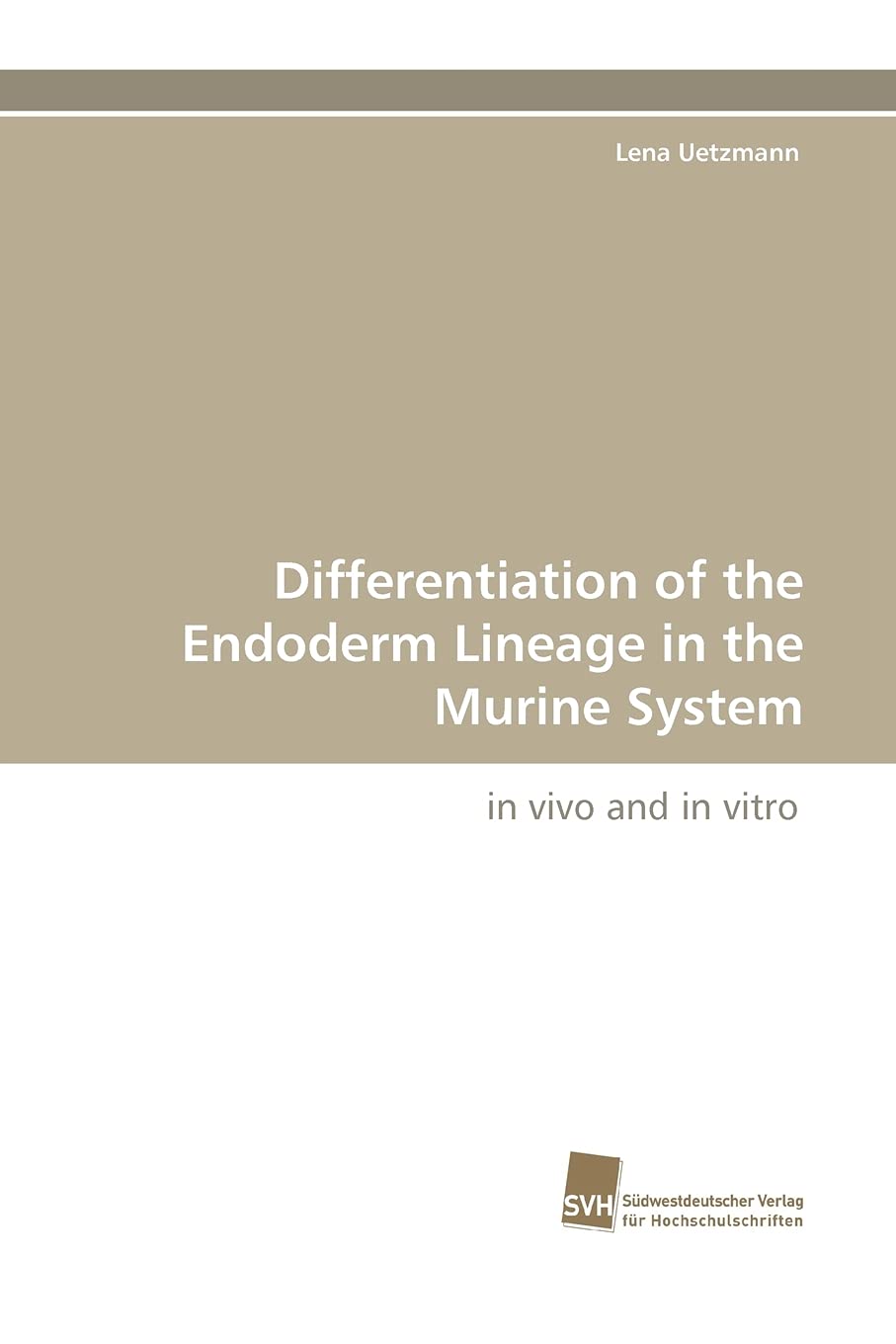
The endoderm is one of the three principle germ layers that arise during gastrulation in early embryonic development. In the course of development it gives rise to functionally diverse organs, e.g. thymus, lung, liver, pancreas, stomach and the gastrointestinal tract. The main research topic was the analysis of the endoderm differentiation in murine embryonic stem cells (ES cells) and embryos. The generation and analysis of two knockin Cre mouse lines for two endodermally expressed transcription factors are described here. The analysis comprises studies of Cre recombination pattern as well as studies regarding the influence of the Foxa2 hypomorhic mutation on metabolism. On the basis of the obtained data the existence of two different promotors could be shown and the tissuespecific expression of the resulting mRNA isoforms could be confirmed. Furthermore an in vitro endoderm differentiation system for ES cells was established and characterized. Using this system the influence of different micro RNAs (miRNAs) on ES cell differentiation was investigated. This way two miRNAs (miR335 and miR194) were identified that regulate Foxa2 translation and thereby endoderm differentiation.
⚠️ WARNING (California Proposition 65):
This product may contain chemicals known to the State of California to cause cancer,
birth defects, or other reproductive harm.
For MAP (Minimum Advertised Price) violations and Intellectual Property (IP) or Trademark concerns, please contact:
support@ergodebooks.com
⚠️ California Proposition 65 Warning: Some products sold on this website may expose you to chemicals known to the State of California to cause cancer, birth defects, or other reproductive harm. For more information, visit www.P65Warnings.ca.gov.