
Title
Digital Electronics with Arduino: Learn How To Work With Digital Electronics And Microcontrollers (English Edition),Used
Sold by Ergodebooks, an authorized reseller.
Returns accepted within 30 days | support@ergodebooks.com
Shipping Information
- Free Standard Shipping — United States only
- Processing Time: 3–5 business days
- Estimated Delivery: 6–10 business days after dispatch
- Double-boxed, fully insured & discreetly packaged
- Tracking number sent via email once dispatched
Returns & Refund
Returns accepted within 30 days of delivery.
Damaged or Defective Item
Free return shipping + replacement or full refund
Wrong Item Received
Free return shipping + replacement or full refund
Change of Mind
Return shipping at customer's expense · 25% restocking fee applies
Payment Option

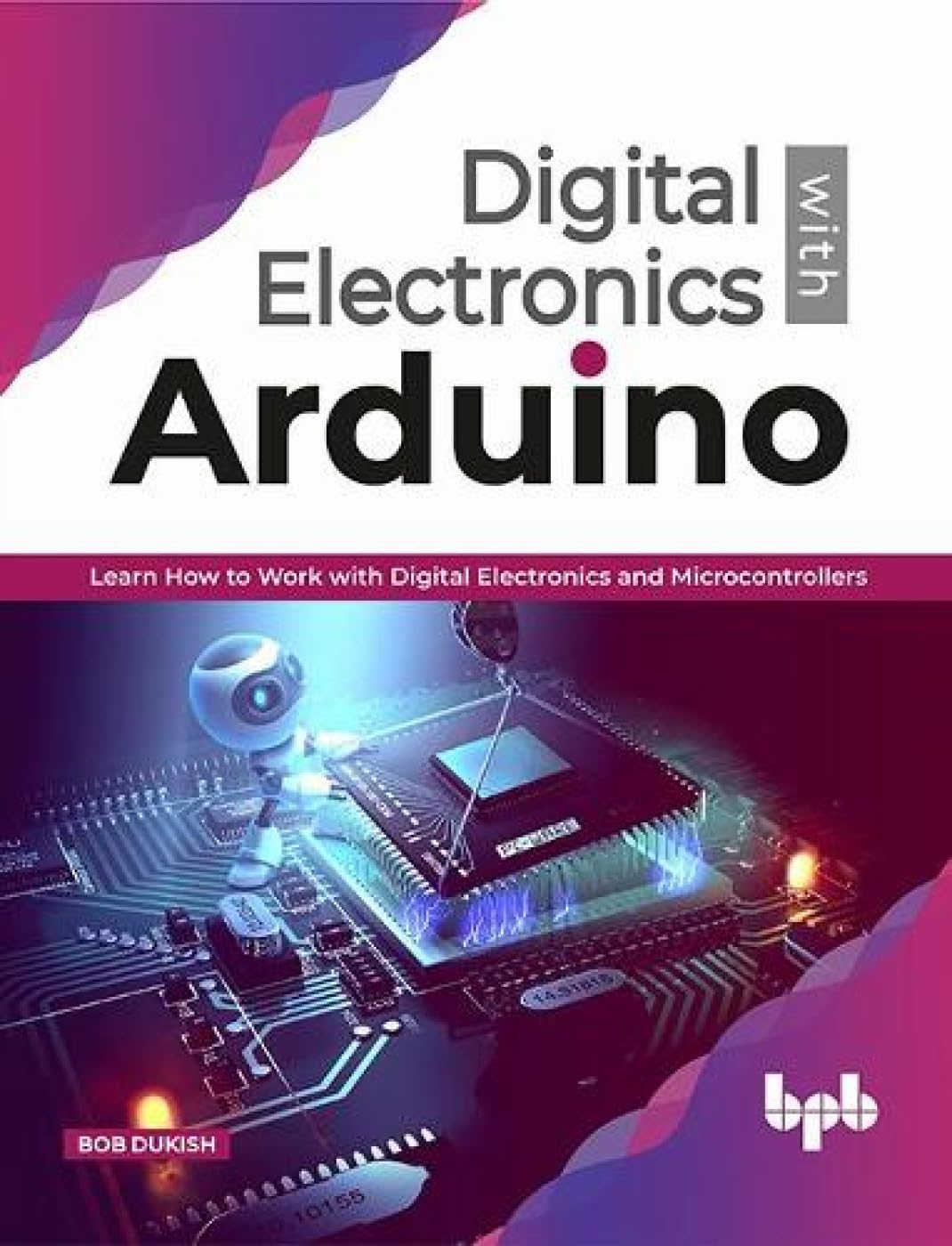
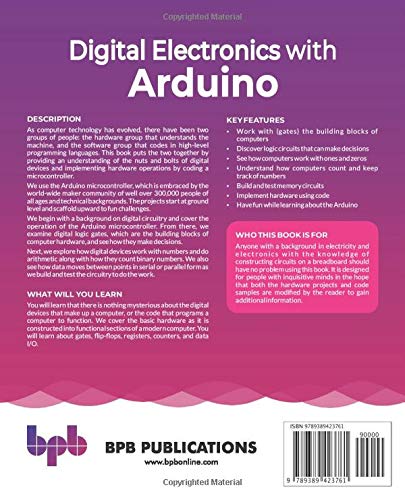
Digital Electronics with ArduinoKey Features 1. Work with (gates) the building blocks of computers 2. Discover logic circuits that can make decisions 3. See how computers work with ones and zeros 4. Understand how computers count and keep track of numbers 5. Build and test memory circuits 6. Implement hardware using code 7. Have fun while learning about the ArduinoDescriptionAs computer technology has evolved, there have been two groups of people: the hardware group that understands the machine, and the software group that codes in highlevel programming languages. This book puts the two together by providing an understanding of the nuts and bolts of digital devices and implementing hardware operations by coding a microcontroller.We use the Arduino microcontroller, which is embraced by the worldwide maker community of well over 300,000 people of all ages and technical backgrounds. The projects start at ground level and scaffold upward to fun challenges.We begin with a background on digital circuitry and cover the operation of the Arduino microcontroller. From there, we examine digital logic gates, which are the building blocks of computer hardware, and see how they make decisions.Next, we explore how digital devices work with numbers and do arithmetic along with how they count binary numbers. We also see how data moves between points in serial or parallel form as we build and test the circuitry to do the work.The topic of random number generation is explained, and we design a few simple computer games to see how this all works and have some fun. The book leads up to the reader producing a final capstone project. The format of the book is perfect for a digital electronics high school or college course, but easy enough to follow so that anyone with a basic background in DC circuits will have an enjoyable time with the many projects.What will you learnYou will learn that there is nothing mysterious about the digital devices that make up a computer, or the code that programs a computer to function. We cover the basic hardware as it is constructed into functional sections of a modern computer. You will learn about gates, flipflops, registers, counters, and data I/O.Who this book is forAnyone with a background in electricity and electronics with the knowledge of constructing circuits on a breadboard should have no problem using this book. It is designed for people with inquisitive minds in the hope that both the hardware projects and code samples are modified by the reader to gain additional information.Table of Contents1. A Bit about Arduino2. Digital Function Implementation3. Designing Functional Computer Circuits4. Memory Devices5. Registers and Numbers6. Counters7. Multiplexing and demultiplexing8. Addresses, specialized counters, and serial monitor interaction.9. Random Numbers10. Interactive I/O11. Capstone projectAbout the AuthorsBob Dukish has spent nearly 40 years working and teaching in the field of technology. After serving in the military, working as a components engineer, and running a corporation, Bob now teaches digital design classes at Kent State University. He has Associate Degrees in Avionic Systems, and in Electronic Engineering Technology, a Bachelor? Degree in Physics from Syracuse University, and Master? Degrees from Rensselaer Polytechnic Institute and Kent State University, and he is a lifelong learner.Your Blog links: http://www.dukish.comYour LinkedIn Profile: http://www.linkedin.com/in/bobdukish
⚠️ WARNING (California Proposition 65):
This product may contain chemicals known to the State of California to cause cancer, birth defects, or other reproductive harm.
For more information, please visit www.P65Warnings.ca.gov.
- Q: How many pages does the book have? A: The book has two hundred fourteen pages. This length provides an in-depth exploration of digital electronics with practical projects.
- Q: What are the dimensions of the book? A: The book measures seven point five two inches in length, zero point four nine inches in width, and nine point two five inches in height. These dimensions make it a convenient size for reading and reference.
- Q: What type of binding does this book have? A: This book is available in a paperback binding. Paperback books are lightweight and flexible, making them easy to handle.
- Q: Is this book suitable for beginners? A: Yes, this book is suitable for beginners. It is designed for readers with a basic understanding of electricity and electronics.
- Q: What will I learn from this book? A: You will learn about digital circuits, logic gates, and how to implement hardware using Arduino. The book combines theory with practical projects.
- Q: Can I use this book for a college course? A: Yes, this book is appropriate for college courses on digital electronics. It covers essential topics and provides hands-on projects to reinforce learning.
- Q: How do I care for this book? A: To care for this book, keep it in a dry environment and avoid exposing it to direct sunlight. This will help preserve its quality over time.
- Q: Are there any safety warnings regarding this book? A: No, there are no specific safety warnings for this book. It is designed for educational purposes and does not contain hazardous materials.
- Q: How should I store this book? A: Store this book upright on a shelf or in a bookcase. Ensure it is not stacked under heavy items to prevent damage.
- Q: What if the book arrives damaged? A: If the book arrives damaged, you should contact the seller for a return or replacement. Most sellers have policies in place for such issues.
- Q: Is there a warranty for this book? A: No, there is typically no warranty for books. However, you can check the seller's return policy for any guarantees.
- Q: Can I return this book if I don't like it? A: Yes, you can usually return this book if it is in new condition. Check the seller's return policy for specific details.
- Q: Is this book useful for hobbyists? A: Yes, this book is great for hobbyists interested in digital electronics and Arduino projects. It encourages creativity and experimentation.
- Q: What topics are covered in this book? A: This book covers topics such as digital circuits, memory devices, and random number generation. It includes practical projects to enhance understanding.
- Q: Who is the author of this book? A: The author of this book is Bob Dukish. He has extensive experience in technology and education, making him a credible source.
- Q: Does this book include projects? A: Yes, this book includes several projects that allow readers to apply what they learn about digital electronics and Arduino.