
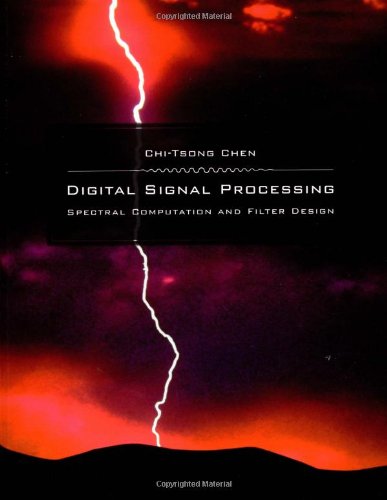
Title

Digital Signal Processing: Spectral Computation and Filter Design (The ^AOxford Series in Electrical and Computer Engineering),Used
Sold by Ergodebooks, an authorized reseller.
Returns accepted within 30 days | support@ergodebooks.com
Shipping Information
- Free Standard Shipping — United States only
- Processing Time: 3–5 business days
- Estimated Delivery: 6–10 business days after dispatch
- Double-boxed, fully insured & discreetly packaged
- Tracking number sent via email once dispatched
Returns & Refund
Returns accepted within 30 days of delivery.
Damaged or Defective Item
Free return shipping + replacement or full refund
Wrong Item Received
Free return shipping + replacement or full refund
Change of Mind
Return shipping at customer's expense · 25% restocking fee applies
Payment Option

Designed for a first course in digital signal processing, Digital Signal Processing: Spectral Computation and Filter Design covers two major topics: the computation of frequency contents of signals and the design of digital filters. While it focuses on basic ideas and procedures and covers the standard topics in the field, this unique text distinguishes itself from competing texts by extensively employing the fast Fourier transform (FFT).Part 1: Spectral Computation deals with continuoustime (CT), discretetime (DT), and digital signals; CT and DT Fourier series (frequency components); CT and DT Fourier transforms (frequency spectra); and discrete Fourier transform (DFT) and fast Fourier transform (FFT). Part 2: Digital Filter Design discusses linear timeinvariant lumped systems; ideal and practical digital filters; design of FIR digital filters; design of IIR filters; and structures of digital filters.Digital Signal Processing covers numerous topics not found in similar texts. It: Establishes a simplified version of the sampling theorem for periodic signals Uses FFT to compute frequency spectra of DT and CT signals and inverse FFT to compute DT and CT signals from their frequency spectra Employs FFT to compute the inverse ztransform Covers steadystate and transient responses of digital filters and gives an estimated time for a transient response to die out Gives a mathematical justification for using an antialiasing analog filter in digital signal processing Introduces a discrete leastsquares method to design FIR filters Presents an analog bandstop transformation that yields better results than ones generated by MATLABDigital Signal Processing features careful definitions of all terminology and a wealth of examples and problems. All numerical examples and most endofchapter problems are simple enough to be solved analytically by hand; these results can then be compared with the computergenerated solutions. MATLAB is an integral part of the text.
⚠️ WARNING (California Proposition 65):
This product may contain chemicals known to the State of California to cause cancer, birth defects, or other reproductive harm.
For more information, please visit www.P65Warnings.ca.gov.