
Title
DIMENSION ESTIMATION AND MODELS (Nonlinear Time Series and Chaos),Used
Sold by Ergodebooks, an authorized reseller.
Returns accepted within 30 days | support@ergodebooks.com
Shipping Information
- Free Standard Shipping — United States only
- Processing Time: 3–5 business days
- Estimated Delivery: 6–10 business days after dispatch
- Double-boxed, fully insured & discreetly packaged
- Tracking number sent via email once dispatched
Returns & Refund
Returns accepted within 30 days of delivery.
Damaged or Defective Item
Free return shipping + replacement or full refund
Wrong Item Received
Free return shipping + replacement or full refund
Change of Mind
Return shipping at customer's expense · 25% restocking fee applies
Payment Option

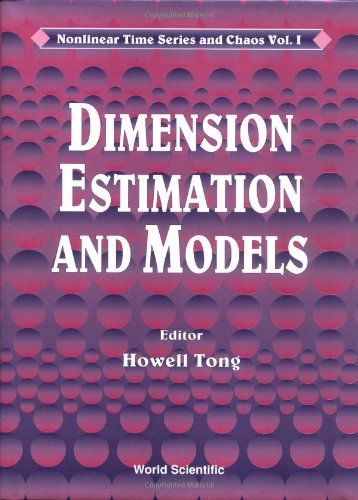
This volume is the first in the new series Nonlinear Time Series and Chaos. The general aim of the series is to provide a bridge between the two communities by inviting prominent researchers in their respective fields to give a systematic account of their chosen topics, starting at the beginning and ending with the latest state. It is hoped that researchers in both communities will find the topics relevant and thought provoking. In this volume, the first chapter, written by Professor Colleen Cutler, is a comprehensive account of the theory and estimation of fractal dimension, a topic of central importance in dynamical systems, which has recently attracted the attention of the statisticians. As it is natural to study a stochastic dynamical system within the framework of Markov chains, it is therefore relevant to study their limiting behaviour. The second chapter, written by Professor KungSik Chan, reviews some limit theorems of Markov chains and illustrates their relevance to chaos. The next three chapters are concerned with specific models. Briefly, Chapter Three by Professor Peter Lewis and Dr Bonnie Ray and Chapter Four by Professor Peter Brockwell generalise the class of selfexciting threshold autoregressive models in different directions. In Chapter Three, the new and powerful methodology of multivariate adaptive regression splines (MARS) is adapted to time series data. Its versatility is illustrated by reference to the very interesting and complex sea surface temperature data. Chapter Four exploits the greater tractability of continuoustime Markov approach to discretetime data. The approach is particularly relevant to irregularly sampled data. The concluding chapter, by Professor Pham Dinh Tuan, is likely to be the most definitive account of bilinear models in discrete time to date.
⚠️ WARNING (California Proposition 65):
This product may contain chemicals known to the State of California to cause cancer, birth defects, or other reproductive harm.
For more information, please visit www.P65Warnings.ca.gov.