If you have any questions, you are always welcome to contact us. We'll get back to you as soon as possible, withing 24 hours on weekdays.
Customer service
All questions about your order, return and delivery must be sent to our customer service team by e-mail at yourstore@yourdomain.com
Sale & Press
If you are interested in selling our products, need more information about our brand or wish to make a collaboration, please contact us at press@yourdomain.com
Help
If you have any questions, you are always welcome to contact us. We'll get back to you as soon as possible, withing 24 hours on weekdays.
Customer service
All questions about your order, return and delivery must be sent to our customer service team by e-mail at yourstore@yourdomain.com
Sale & Press
If you are interested in selling our products, need more information about our brand or wish to make a collaboration, please contact us at press@yourdomain.com
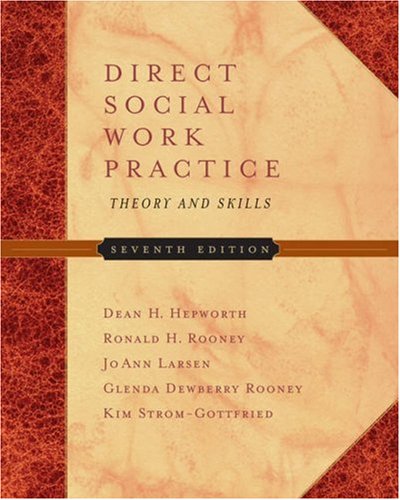
Through proven learning experiences that are as close to reallife practice as can be obtained from a book, DIRECT SOCIAL WORK PRACTICE: THEORY AND SKILLS prepares social work students for effective work in the field. Many of the case examples are drawn from social work practitioners as well as the authors' own practice situations. Long praised for its appropriate level of rigor, the book integrates the major theories and skills that direct social work practitioners need to understand and masterthus giving the book its reputation as the classic source for helping students learn direct practice skills. Consisting of four parts, the book begins by identifying the mission of social work, its values, and knowledge base. The authors then differentiate generalist from direct practice and explore roles of direct practitioners. Common elements amongst diverse theorists are then examined while key intervention strategies and various client population and practice settings are presented. Specifically, Part One provides the foundational/values and knowledge base material; Part Two is devoted to the beginning phase of the helping process; Part Three addresses the middle phase (goal attainment strategies), discussing four intervention approaches; and Part Four clarifies the termination phase of direct practice.
⚠️ WARNING (California Proposition 65):
This product may contain chemicals known to the State of California to cause cancer,
birth defects, or other reproductive harm.
For MAP (Minimum Advertised Price) violations and Intellectual Property (IP) or Trademark concerns, please contact:
support@ergodebooks.com
⚠️ California Proposition 65 Warning: Some products sold on this website may expose you to chemicals known to the State of California to cause cancer, birth defects, or other reproductive harm. For more information, visit www.P65Warnings.ca.gov.