If you have any questions, you are always welcome to contact us. We'll get back to you as soon as possible, withing 24 hours on weekdays.
Customer service
All questions about your order, return and delivery must be sent to our customer service team by e-mail at yourstore@yourdomain.com
Sale & Press
If you are interested in selling our products, need more information about our brand or wish to make a collaboration, please contact us at press@yourdomain.com
Help
If you have any questions, you are always welcome to contact us. We'll get back to you as soon as possible, withing 24 hours on weekdays.
Customer service
All questions about your order, return and delivery must be sent to our customer service team by e-mail at yourstore@yourdomain.com
Sale & Press
If you are interested in selling our products, need more information about our brand or wish to make a collaboration, please contact us at press@yourdomain.com
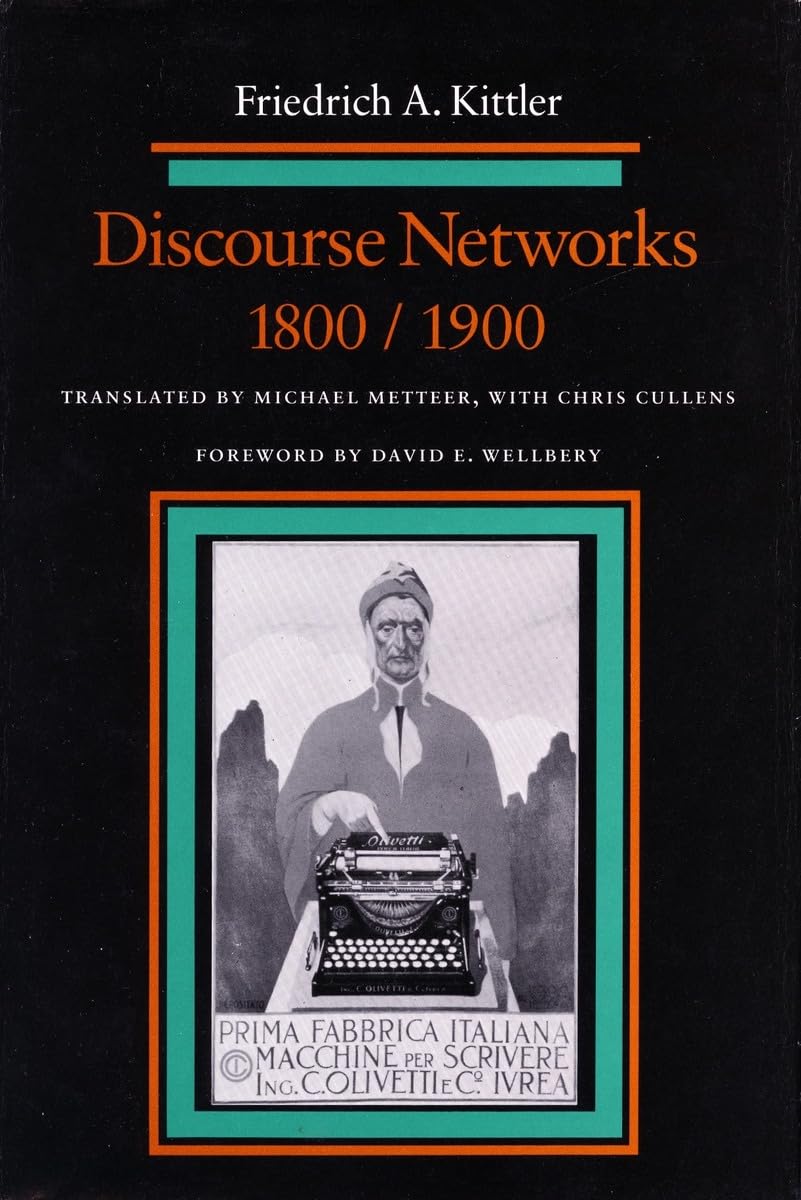
This is a highly original book about the connections between historical moment, social structure, technology, communications systems, and what is said and thought using these systems notably literature. The author focuses on the differences between 'discourse networks' in 1800 and 1900, in the process developing a new analysis of the shift from romanticism to modernism. The work might be classified as a German equivalent to the New Historicism of American literary scholars, both in the intellectual influences to which Kittler responds and in his concern to ground literature in the most concrete details of historical reality. The artful structure of the book begins with Goethe's Faust and ends with Valery's Faust. In the 1800 section, the author discusses how language was learned, the emergence of the modern university, the associated beginning of the interpretation of contemporary literature, and the canonization of literature. Among the writers and works Kittler analyzes in addition to Geothe's Faust are Schlegel, E.T.A. Hoffmann's 'The Golden Pot,' and Goethe's Tasso. The 1900 section argues that the new discourse network in which literature is situated in the modern period is characterized by new technological media film, the photograph, and the typewritten page and the crisis that these caused for literary production. Along the way, the author discusses the work of Nietzsche, Getrude Stein, Mallarme, Bram Stoker, the Surrealists, Rilke, Kafka, and Freud, among others.
⚠️ WARNING (California Proposition 65):
This product may contain chemicals known to the State of California to cause cancer,
birth defects, or other reproductive harm.
For MAP (Minimum Advertised Price) violations and Intellectual Property (IP) or Trademark concerns, please contact:
support@ergodebooks.com
⚠️ California Proposition 65 Warning: Some products sold on this website may expose you to chemicals known to the State of California to cause cancer, birth defects, or other reproductive harm. For more information, visit www.P65Warnings.ca.gov.