If you have any questions, you are always welcome to contact us. We'll get back to you as soon as possible, withing 24 hours on weekdays.
Customer service
All questions about your order, return and delivery must be sent to our customer service team by e-mail at yourstore@yourdomain.com
Sale & Press
If you are interested in selling our products, need more information about our brand or wish to make a collaboration, please contact us at press@yourdomain.com
Help
If you have any questions, you are always welcome to contact us. We'll get back to you as soon as possible, withing 24 hours on weekdays.
Customer service
All questions about your order, return and delivery must be sent to our customer service team by e-mail at yourstore@yourdomain.com
Sale & Press
If you are interested in selling our products, need more information about our brand or wish to make a collaboration, please contact us at press@yourdomain.com
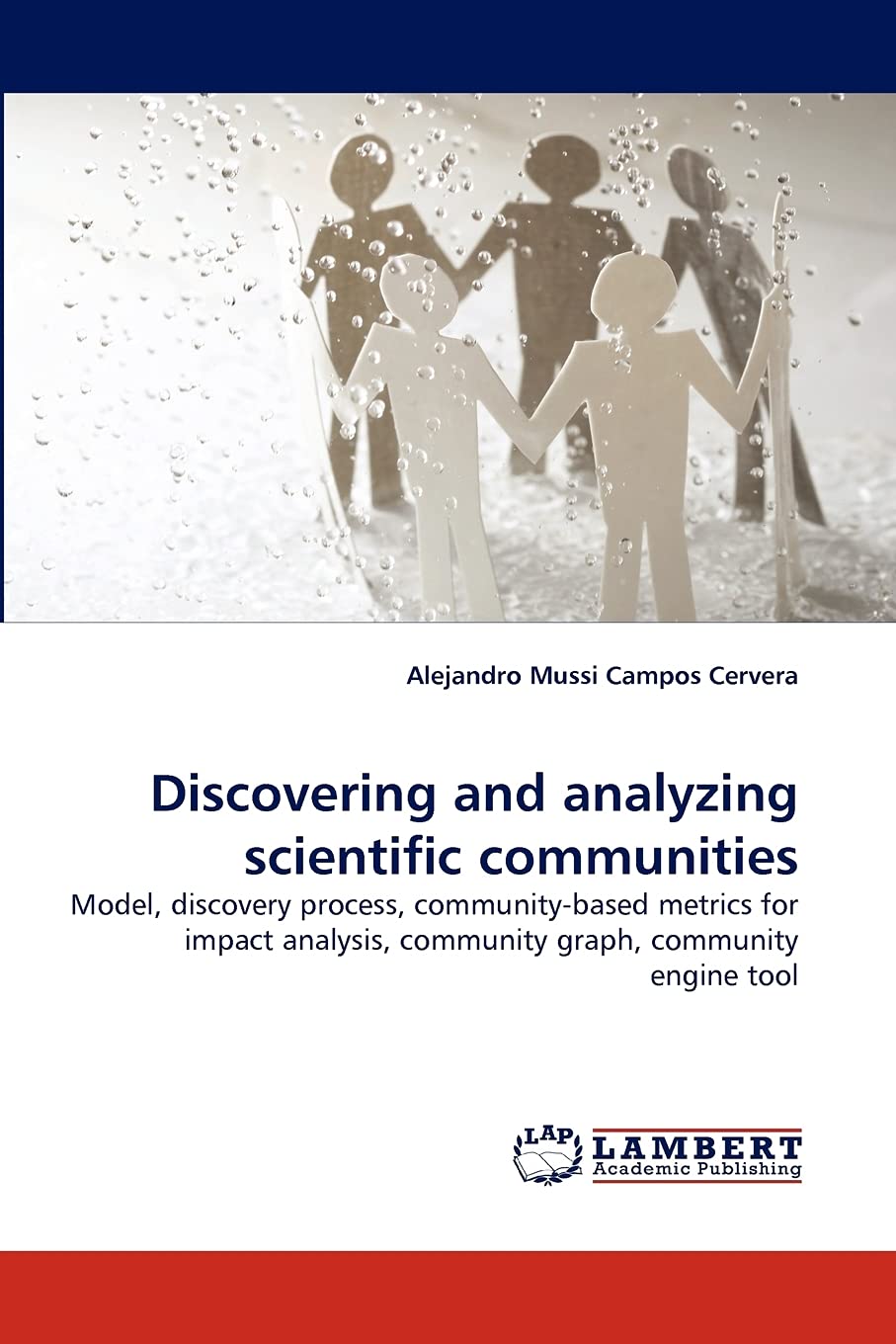
This book presents a model and a tool for discovering and analyzing scientific communities. Several approaches have been proposed to discover community structure applying clustering methods over different networks. However, most existing approaches do not allow for overlapping of communities, which are instead natural when we consider communities of scientists. The approach presented in this book combines different clustering algorithms for detecting overlapping scientific communities, based on conference publication data. Moreover, community based evaluation metrics are proposed for measuring the scientific productivity and impact of researches and researchers. The Community Engine Tool (CET) implements the algorithm and was evaluated using the DBLP dataset, which contains information on more than 12 thousand conferences. The results show that using our approach it is possible to automatically produce community structure close to humandefined classification of conferences. The approach is part of a larger research effort aimed at studying how scientific communities are born, evolve, remain healthy or become unhealthy (e.g., selfreferential), and eventually vanish.
⚠️ WARNING (California Proposition 65):
This product may contain chemicals known to the State of California to cause cancer,
birth defects, or other reproductive harm.
For MAP (Minimum Advertised Price) violations and Intellectual Property (IP) or Trademark concerns, please contact:
support@ergodebooks.com
⚠️ California Proposition 65 Warning: Some products sold on this website may expose you to chemicals known to the State of California to cause cancer, birth defects, or other reproductive harm. For more information, visit www.P65Warnings.ca.gov.