If you have any questions, you are always welcome to contact us. We'll get back to you as soon as possible, withing 24 hours on weekdays.
Customer service
All questions about your order, return and delivery must be sent to our customer service team by e-mail at yourstore@yourdomain.com
Sale & Press
If you are interested in selling our products, need more information about our brand or wish to make a collaboration, please contact us at press@yourdomain.com
Help
If you have any questions, you are always welcome to contact us. We'll get back to you as soon as possible, withing 24 hours on weekdays.
Customer service
All questions about your order, return and delivery must be sent to our customer service team by e-mail at yourstore@yourdomain.com
Sale & Press
If you are interested in selling our products, need more information about our brand or wish to make a collaboration, please contact us at press@yourdomain.com
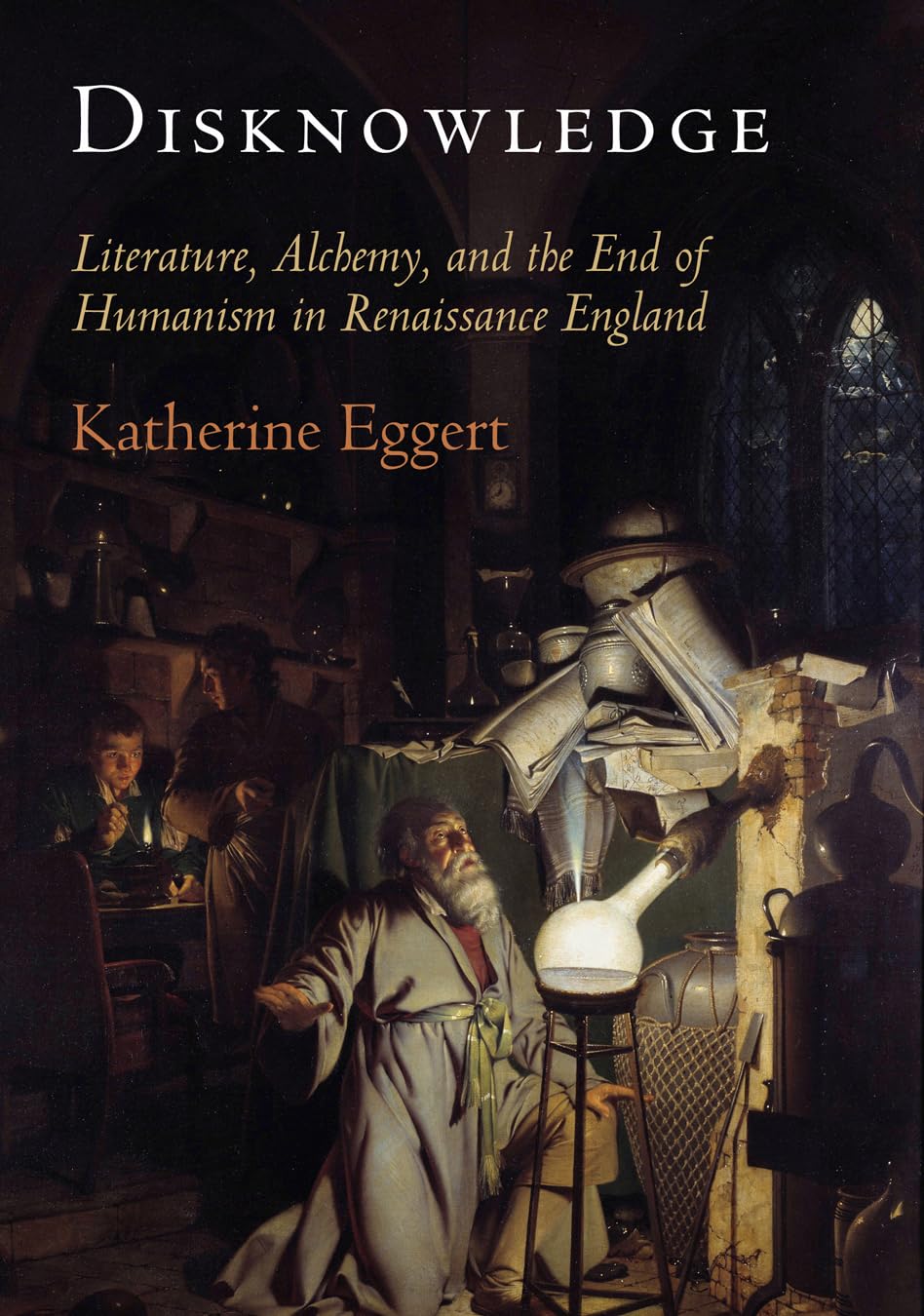
Disknowledge': knowing something isn't true, but believing it anyway. In Disknowledge: Literature, Alchemy, and the End of Humanism in Renaissance England, Katherine Eggert explores the crumbling state of learning in the sixteenth and seventeenth centuries. Even as the shortcomings of Renaissance humanism became plain to see, many intellectuals of the age had little choice but to treat their familiar knowledge systems as though they still held. Humanism thus came to share the status of alchemy: a way of thinking simultaneously productive and suspect, reasonable and wrongheaded.Eggert argues that English writers used alchemy to signal how to avoid or camouflage pressing but discomfiting topics in an age of rapid intellectual change. Disknowledge describes how John Donne, George Herbert, Henry Vaughan, John Dee, Christopher Marlowe, William Harvey, Helkiah Crooke, Edmund Spenser, and William Shakespeare used alchemical imagery, rhetoric, and habits of thought to shunt aside three difficult questions: how theories of matter shared their physics with Roman Catholic transubstantiation; how Christian Hermeticism depended on Jewish Kabbalah; and how new anatomical learning acknowledged women's role in human reproduction. Disknowledge further shows how Shakespeare, Ben Jonson, and Margaret Cavendish used the language of alchemy to castigate humanism for its blind spots and to invent a new, posthumanist mode of knowledge: writing fiction.Covering a wide range of authors and topics, Disknowledge is the first book to analyze how English Renaissance literature employed alchemy to probe the nature and limits of learning. The concept of disknowledgewillfully adhering to something we know is wrongresonates across literary and cultural studies as an urgent issue of our own era.
⚠️ WARNING (California Proposition 65):
This product may contain chemicals known to the State of California to cause cancer,
birth defects, or other reproductive harm.
<div class="dynamic-checkout__content" id="dynamic-checkout-cart" data-shopify="dynamic-checkout-cart"> <shopify-accelerated-checkout-cart wallet-configs="[{"name":"shop_pay","wallet_params":{"shopId":73758048501,"merchantName":"Ergodebooks","personalized":true}},{"name":"amazon_pay","wallet_params":{"checkoutLanguage":"en_US","ledgerCurrency":"USD","placement":"Cart","sandbox":false,"merchantId":"A1G1ZY975O1T6J","productType":"PayAndShip","design":"C0002"}},{"name":"paypal","wallet_params":{"shopId":73758048501,"countryCode":"US","merchantName":"Ergodebooks","phoneRequired":true,"companyRequired":false,"shippingType":"shipping","shopifyPaymentsEnabled":true,"hasManagedSellingPlanState":false,"requiresBillingAgreement":false,"merchantId":"L873BZSC9NMQS","sdkUrl":"https://www.paypal.com/sdk/js?components=buttons\u0026commit=false\u0026currency=USD\u0026locale=en_US\u0026client-id=AbasDhzlU0HbpiStJiN1KRJ_cNJJ7xYBip7JJoMO0GQpLi8ePNgdbLXkC7_KMeyTg8tnAKW4WKrh9qmf\u0026merchant-id=L873BZSC9NMQS\u0026intent=authorize"}}]" access-token="c0f52a66b386e9fa5c0ab4c2febc737c" buyer-country="US" buyer-locale="en" buyer-currency="USD" shop-id="73758048501" cart-id="657f76a0573908d9b3c29c1c782adcb1" > <div class="wallet-button-wrapper"> <ul class='wallet-cart-grid wallet-cart-grid--skeleton' role="list" data-shopify-buttoncontainer="true"> <li data-testid='grid-cell' class='wallet-cart-button-container'><div class='wallet-cart-button wallet-cart-button__skeleton' role='button' disabled aria-hidden='true'> </div></li><li data-testid='grid-cell' class='wallet-cart-button-container'><div class='wallet-cart-button wallet-cart-button__skeleton' role='button' disabled aria-hidden='true'> </div></li><li data-testid='grid-cell' class='wallet-cart-button-container'><div class='wallet-cart-button wallet-cart-button__skeleton' role='button' disabled aria-hidden='true'> </div></li> </ul> </div> </shopify-accelerated-checkout-cart> <small id="shopify-buyer-consent" class="hidden" aria-hidden="true" data-consent-type="subscription"> One or more of the items in your cart is a recurring or deferred purchase. By continuing, I agree to the <span id="shopify-subscription-policy-button">cancellation policy</span> and authorize you to charge my payment method at the prices, frequency and dates listed on this page until my order is fulfilled or I cancel, if permitted. </small> </div>
Stay in the know
Subscribe to our newsletter and stay updated on latest offers, discounts and events near you.
For MAP (Minimum Advertised Price) violations, please contact:
map@ergode.com
For Intellectual Property (IP) or Trademark concerns, please contact:
ip@ergode.com
⚠️ California Proposition 65 Warning: Some products sold on this website may expose you to chemicals known to the State of California to cause cancer, birth defects, or other reproductive harm. For more information, visit www.P65Warnings.ca.gov.