
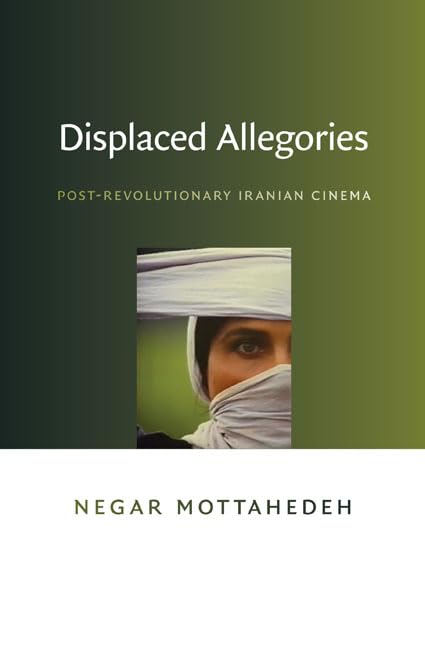
Title
Displaced Allegories: Postrevolutionary Iranian Cinema,Used
Sold by Ergodebooks, an authorized reseller.
Returns accepted within 30 days | support@ergodebooks.com
Shipping Information
- Free Standard Shipping — United States only
- Processing Time: 3–5 business days
- Estimated Delivery: 6–10 business days after dispatch
- Double-boxed, fully insured & discreetly packaged
- Tracking number sent via email once dispatched
Returns & Refund
Returns accepted within 30 days of delivery.
Damaged or Defective Item
Free return shipping + replacement or full refund
Wrong Item Received
Free return shipping + replacement or full refund
Change of Mind
Return shipping at customer's expense · 25% restocking fee applies
Payment Option

Following the 1979 Iranian Revolution, Irans film industry, in conforming to the Islamic Republics system of modesty, had to ensure that women onscreen were veiled from the view of men. This prevented Iranian filmmakers from making use of the desiring gaze, a staple cinematic system of looking. In Displaced Allegories Negar Mottahedeh shows that postRevolutionary Iranian filmmakers were forced to create a new visual language for conveying meaning to audiences. She argues that the Iranian film industry found creative ground not in the negation of government regulations but in the cameras adoption of the modest, averted gaze. In the process, the filmic techniques and cinematic technologies were gendered as feminine and the national cinema was produced as a womans cinema.Mottahedeh asserts that, in response to the prohibitions against the desiring look, a new narrative cinema emerged as the displaced allegory of the constraints on the postRevolutionary Iranian film industry. Allegorical commentary was not developed in the explicit content of cinematic narratives but through formal innovations. Offering close readings of the work of the nationally popular and internationally renowned Iranian auteurs Bahram Bayzai, Abbas Kiarostami, and Mohsen Makhmalbaf, Mottahedeh illuminates the formal codes and conventions of postRevolutionary Iranian films. She insists that such analyses of cinemas visual codes and conventions are crucial to the study of international film. As Mottahedeh points out, the discipline of film studies has traditionally seen film as a medium that communicates globally because of its dependence on a (Hollywood) visual language assumed to be universal and legible across national boundaries. Displaced Allegories demonstrates that visual language is not necessarily universal; it is sometimes deeply informed by national culture and politics.
⚠️ WARNING (California Proposition 65):
This product may contain chemicals known to the State of California to cause cancer, birth defects, or other reproductive harm.
For more information, please visit www.P65Warnings.ca.gov.