If you have any questions, you are always welcome to contact us. We'll get back to you as soon as possible, withing 24 hours on weekdays.
Customer service
All questions about your order, return and delivery must be sent to our customer service team by e-mail at yourstore@yourdomain.com
Sale & Press
If you are interested in selling our products, need more information about our brand or wish to make a collaboration, please contact us at press@yourdomain.com
Help
If you have any questions, you are always welcome to contact us. We'll get back to you as soon as possible, withing 24 hours on weekdays.
Customer service
All questions about your order, return and delivery must be sent to our customer service team by e-mail at yourstore@yourdomain.com
Sale & Press
If you are interested in selling our products, need more information about our brand or wish to make a collaboration, please contact us at press@yourdomain.com
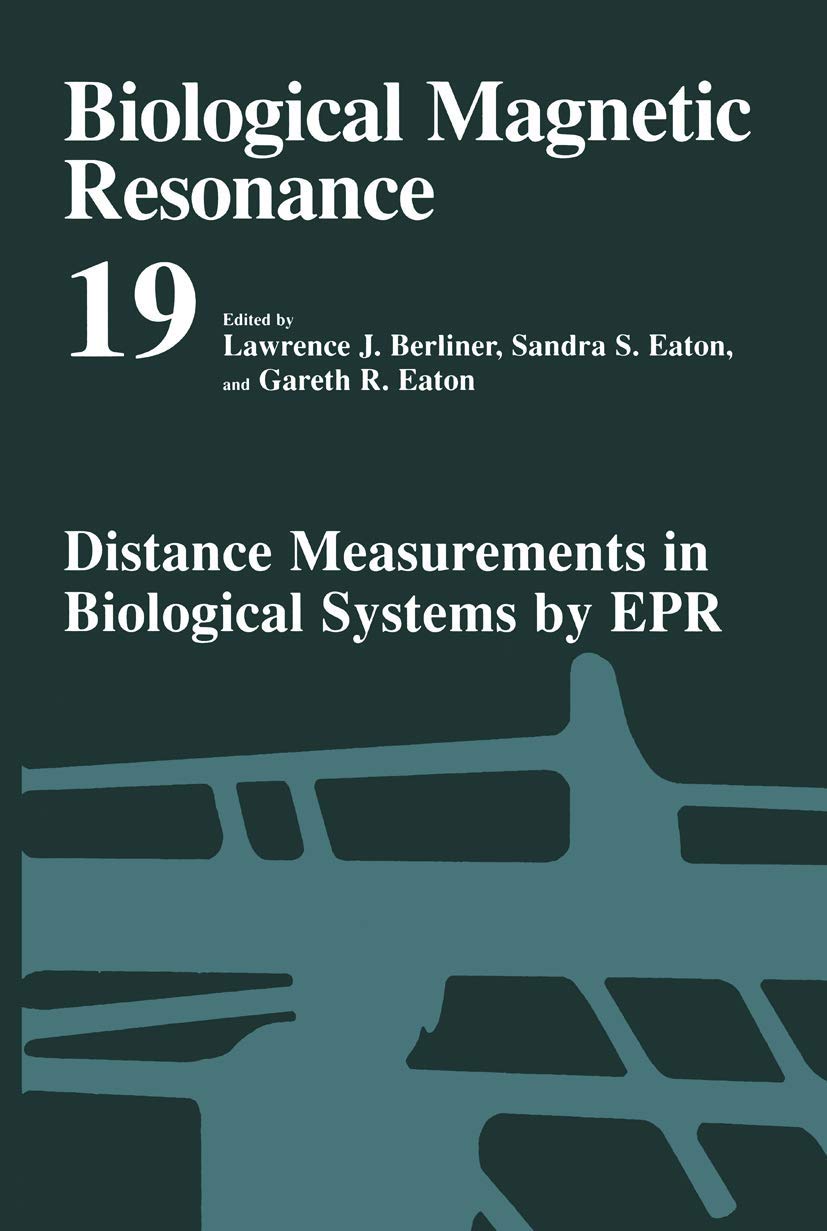
Distance measurements in biological systems by EPR The foundation for understanding function and dynamics of biological systems is knowledge of their structure. Many experimental methodologies are used for determination of structure, each with special utility. Volumes in this series on Biological Magnetic Resonance emphasize the methods that involve magnetic resonance. This volume seeks to provide a critical evaluation of EPR methods for determining the distances between two unpaired electrons. The editors invited the authors to make this a very practical book, with specific numerical examples of how experimental data is worked up to produce a distance estimate, and realistic assessments of uncertainties and of the range of applicability, along with examples of the power of the technique to answer biological problems. The first chapter is an overview, by two of the editors, of EPR methods to determine distances, with a focus on the range of applicability. The next chapter, also by the Batons, reviews what is known about electron spin relaxation times that are needed in estimating distances between spins or in selecting appropriate temperatures for particular experiments. Albert Beth and Eric Hustedt describe the information about spinspin interaction that one can obtain by simulating CW EPR line shapes of nitroxyl radicals. The information in fluid solution CW EPR spectra of dualspin labeled proteins is illustrated by Hassane Mchaourab and Eduardo Perozo.
⚠️ WARNING (California Proposition 65):
This product may contain chemicals known to the State of California to cause cancer,
birth defects, or other reproductive harm.
For MAP (Minimum Advertised Price) violations and Intellectual Property (IP) or Trademark concerns, please contact:
support@ergodebooks.com
⚠️ California Proposition 65 Warning: Some products sold on this website may expose you to chemicals known to the State of California to cause cancer, birth defects, or other reproductive harm. For more information, visit www.P65Warnings.ca.gov.