
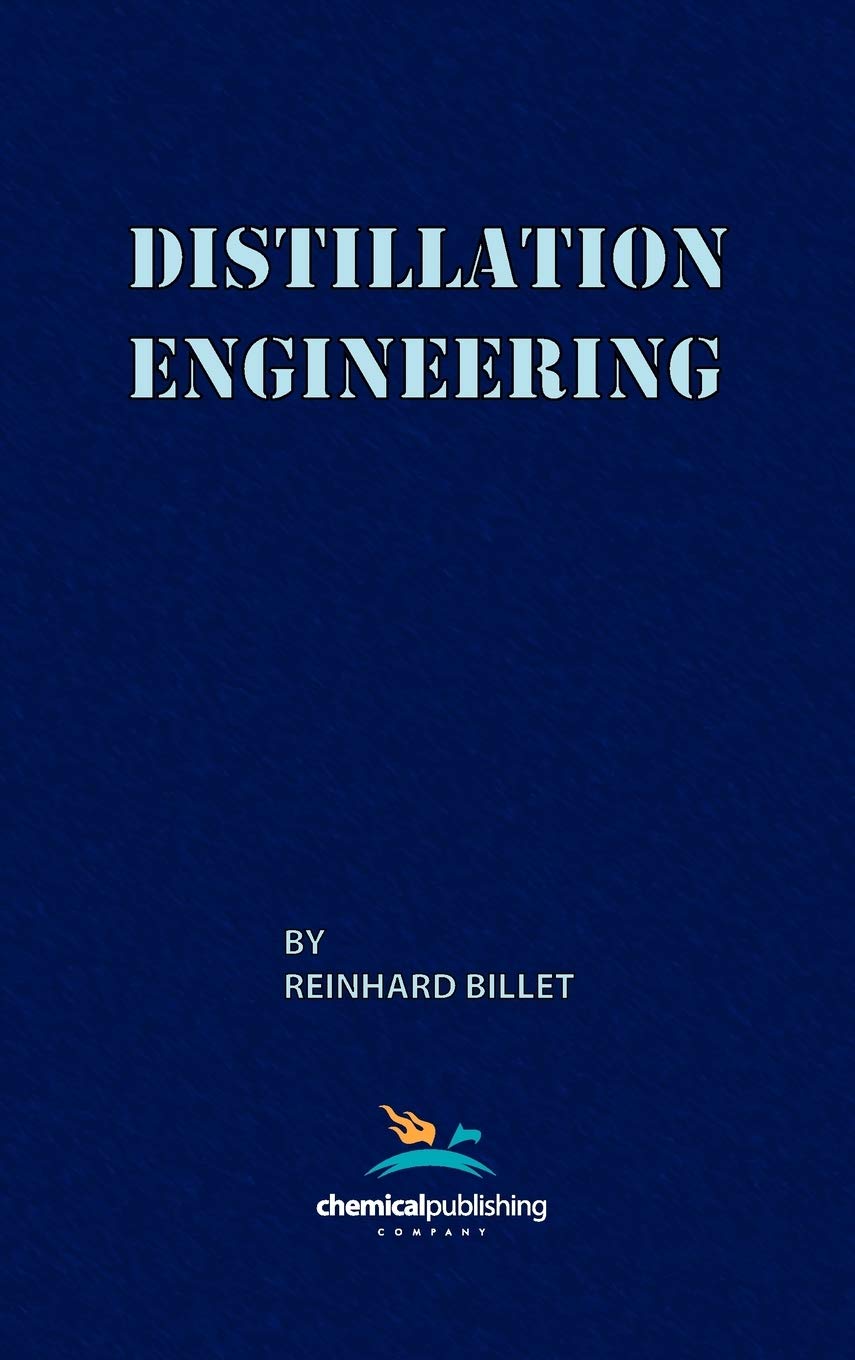
Title


Distillation Engineering-new
Sold by Ergodebooks, an authorized reseller.
Returns accepted within 30 days | support@ergodebooks.com
Shipping Information
- Free Standard Shipping — United States only
- Processing Time: 3–5 business days
- Estimated Delivery: 6–10 business days after dispatch
- Double-boxed, fully insured & discreetly packaged
- Tracking number sent via email once dispatched
Returns & Refund
Returns accepted within 30 days of delivery.
Damaged or Defective Item
Free return shipping + replacement or full refund
Wrong Item Received
Free return shipping + replacement or full refund
Change of Mind
Return shipping at customer's expense · 25% restocking fee applies
Payment Option

Partial Table Of Contents I. The Thermal Separation Of Liquids Ii. Thermodynamics Of Mixtures 1. Definitions And Relationships A. Separability Of A Liquid Mixture B. Partial Pressures In Vapor Mixtures C. Evaporation Of Liquid Mixtures 2. Types Of Mixtures A. Ideal Binary Mixtures B. Nonideal Binary Mixtures C. Ideal Multicomponent Mixtures D. Nonideal Multicomponent Mixtures Iii. Continuous Rectifiers 1. Mode Of Operations 2. Operating Lines A. Enrichment Line B. The Stripping Line 3. Stepwise Separation In Rectifiers A. Theoretical Plates For Separation Of Binaries B. The Reflux Ratio In The Separation Of Binaries C. Multicomponent Mixtures 4. Column Diameter And Column Throughput 5. Heat Requirements Iv. The Batch Still 1. Operation 2. Operating Line And Separation Steps 3. Column Diameter, Column Throughput, And Heat Requirements 4. Time For Separation And Related Variables At Constant Product Concentration A. Molar Vapor Load Constant In Time B. Heat Requirement Constant In Time 5. Separation Time For Variable Heating Area V. The Semicontinuous Still 1. Operation 2. Finding The Operating Lines, The Separation Steps, The Column Load, The Column: Size, And The Heat Demand Vi. Engineering Data, Optimization Of Costs, And Selection Of Column Internals 1. General A. Packing Types B. Plates And Trays 2. Designs And Functions A. Packed Towers B. Plate Columns 3. Evaluation Of Rectifying Columns And Best Mode Of Operation A. Evaluating And Calculations, Separating Effect, Pressure Loss, Load, Specific Column Volume, And Specific Column Cost B. Numerical Evaluation For Packed Towers C. Quantitative Evaluation For Platetype Columns D. Packed Columns Versus Tray Columnsoperational Features And Cost E. Special Designs For Vacuum Operation 4. Tests Of Fullsize Tower Internals Vii. Optimum Separation 1. Optimization Of Simple Columns A. The Theory And Its Application B. Quantitative Evaluation 2. Optimization Of Multiple Columns A. Duplex Columns: Number Of Theoretical Steps, Reflux Ratios, And Vapor Loads B. Vapor Loads Of Multiple Columns Subdivided Because Of Limited Height C. Optimizing Duplex Rectifiers For Minimum Pressure Loss 3. Optimum Operation Of Combined Columns Of Different Types Under Special Consideration A. Parallel Arrangement B. Series Arrangement 4. Specialized Operations A. Specialized Hookups And Their Calculation B. Rectification In Straight Stripping Columns C. Rectification In Straight Enriching Columns D. Direct Heating Of Columns E. Saving Heat In Rectification Viii. Detail Planning Of Separating Columns 1. General Viewpoints In The Selection Of Column Types 2. Packed Columns F. Maximum Loads For Metallic; Pallring And Raschig Ring Columns 3. Special Packings 4. Platetype Columns 5. Pressure Losses In Rectification Columns Ix. Partial Distillation 1. Separation Of Liquids By Continuous Partial Distillation 2. Separation Of Liquids By Discontinuous Partial Distillation X. Partial Condensation 1. Partial Condensation In Dephlegmators 2. Partial Countercurrent Direct Condensation In Columns Xi. Laboratory Columns And Pilot Plants 1. Distillation Columns With Miniature Size Packing 2. Transferring Data Gained From Semiindustrial Units To Fullscale Xii. Distillation In Fine And High Vacuum 1. Molecular Distillation 2. Thinfilm Distillation 3. Mechanism Of Separation Xiii. Components Of A Separation Plant J. Internal Components 2. Heat Exchangers 3. Pumps 4. Measuring And Controls Xiv. Use Of Computers Xv. Distillation And Environmental Protection Xvi. Outlook Bibliography Symbols And Units Glossary Index
⚠️ WARNING (California Proposition 65):
This product may contain chemicals known to the State of California to cause cancer, birth defects, or other reproductive harm.
For more information, please visit www.P65Warnings.ca.gov.
- Q: How many pages does 'Distillation Engineering' have? A: This book has five hundred nineteen pages. It provides a comprehensive overview of distillation processes and engineering principles.
- Q: What is the binding type of 'Distillation Engineering'? A: The book is bound in hardcover. This ensures durability and longevity, making it suitable for library use or personal collections.
- Q: Who is the author of 'Distillation Engineering'? A: The author is Reinhard Billet. He brings extensive expertise in distillation and separation technologies.
- Q: What is the size of 'Distillation Engineering'? A: The dimensions are six inches in length, one point thirty-one inches in width, and nine point zero two inches in height. This size makes it portable for study.
- Q: What subjects does 'Distillation Engineering' cover? A: It covers thermal separation of liquids, thermodynamics of mixtures, and optimization of column designs. The book includes advanced concepts and practical applications.
- Q: How do I use 'Distillation Engineering' for my studies? A: You can use this book as a reference for distillation processes and engineering studies. It's suitable for students and professionals looking to deepen their understanding.
- Q: Is 'Distillation Engineering' suitable for beginners? A: Yes, it is suitable for beginners in the field of chemical engineering. The book systematically introduces complex concepts in an understandable manner.
- Q: Can I use 'Distillation Engineering' for practical applications? A: Yes, it includes practical applications of distillation processes. The content is designed to bridge theoretical knowledge with real-world engineering challenges.
- Q: How can I keep 'Distillation Engineering' in good condition? A: Store the book in a cool, dry place, and avoid direct sunlight. Regular cleaning of the cover and pages can help maintain its appearance.
- Q: Is 'Distillation Engineering' safe for all readers? A: Yes, it is safe for all readers, including students and professionals. The content is educational and focused on engineering principles.
- Q: What if I receive a damaged copy of 'Distillation Engineering'? A: You should contact the seller for a return or exchange. Most sellers have policies in place to address such issues.
- Q: Does 'Distillation Engineering' have a warranty? A: Typically, books do not come with warranties. However, check the seller's return policy for any guarantees on the book's condition.
- Q: Where can I find additional resources related to 'Distillation Engineering'? A: You can find additional resources in academic libraries or online databases. Many universities also provide access to related research materials.
- Q: Is there a glossary included in 'Distillation Engineering'? A: Yes, the book includes a glossary. This is helpful for understanding technical terms and concepts related to distillation.
- Q: What makes 'Distillation Engineering' a good choice for professionals? A: It offers in-depth analysis and optimization techniques that are valuable for professionals in the chemical engineering field. The practical examples enhance its applicability.
- Q: Can I find illustrations or diagrams in 'Distillation Engineering'? A: Yes, the book includes illustrations and diagrams. These visual aids help clarify complex concepts and improve comprehension.