
Title

Distributed Computing By Oblivious Mobile Robots (Synthesis Lectures On Distributed Computing Theory, 10)
Sold by Ergodebooks, an authorized reseller.
Returns accepted within 30 days | support@ergodebooks.com
Shipping Information
- Free Standard Shipping — United States only
- Processing Time: 3–5 business days
- Estimated Delivery: 6–10 business days after dispatch
- Double-boxed, fully insured & discreetly packaged
- Tracking number sent via email once dispatched
Returns & Refund
Returns accepted within 30 days of delivery.
Damaged or Defective Item
Free return shipping + replacement or full refund
Wrong Item Received
Free return shipping + replacement or full refund
Change of Mind
Return shipping at customer's expense · 25% restocking fee applies
Payment Option

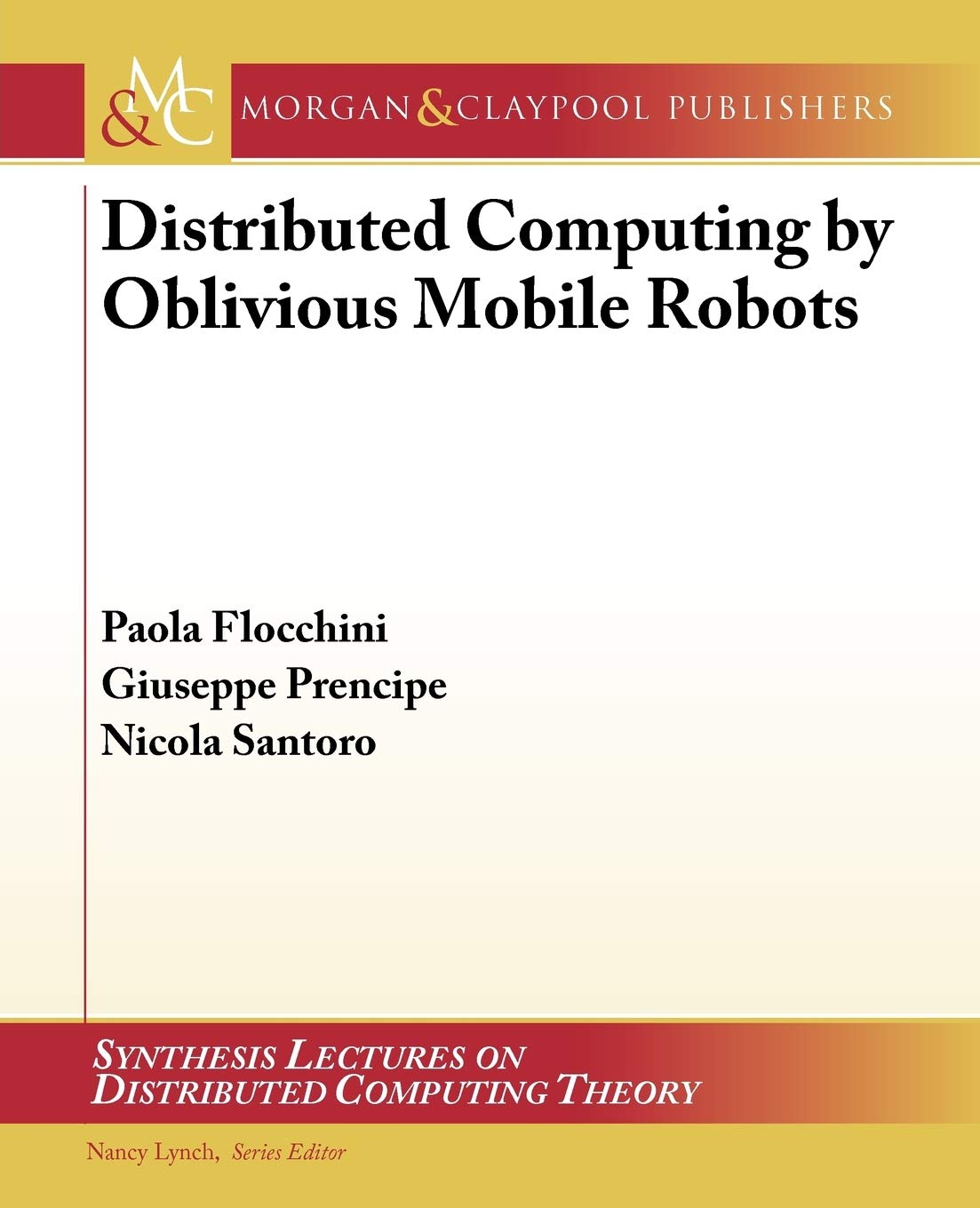
The Study Of What Can Be Computed By A Team Of Autonomous Mobile Robots, Originally Started In Robotics And Ai, Has Become Increasingly Popular In Theoretical Computer Science (Especially In Distributed Computing), Where It Is Now An Integral Part Of The Investigations On Computability By Mobile Entities. The Robots Are Identical Computational Entities Located And Able To Move In A Spatial Universe; They Operate Without Explicit Communication And Are Usually Unable To Remember The Past; They Are Extremely Simple, With Limited Resources, And Individually Quite Weak. However, Collectively The Robots Are Capable Of Performing Complex Tasks, And Form A System With Desirable Faulttolerant And Selfstabilizing Properties. The Research Has Been Concerned With The Computational Aspects Of Such Systems. In Particular, The Focus Has Been On The Minimal Capabilities That The Robots Should Have In Order To Solve A Problem.This Book Focuses On The Recent Algorithmic Results In The Field Of Distributed Computing By Oblivious Mobile Robots (Unable To Remember The Past). After Introducing The Computational Model With Its Nuances, We Focus On Basic Coordination Problems: Pattern Formation, Gathering, Scattering, Leader Election, As Well As On Dynamic Tasks Such As Flocking. For Each Of These Problems, We Provide A Snapshot Of The State Of The Art, Reviewing The Existing Algorithmic Results. In Doing So, We Outline Solution Techniques, And We Analyze The Impact Of The Different Assumptions On The Robots' Computability Power.Table Of Contents: Introduction / Computational Models / Gathering And Convergence / Pattern Formation / Scatterings And Coverings / Flocking / Other Directions
⚠️ WARNING (California Proposition 65):
This product may contain chemicals known to the State of California to cause cancer, birth defects, or other reproductive harm.
For more information, please visit www.P65Warnings.ca.gov.
- Q: What is the main focus of 'Distributed Computing by Oblivious Mobile Robots'? A: This book primarily focuses on the computational capabilities of autonomous mobile robots, particularly in the context of distributed computing and algorithmic results related to robots that cannot remember past actions.
- Q: Who is the author of the book? A: The book is authored by Paola Flocchini, a recognized expert in the field of distributed computing theory.
- Q: What topics are covered in the book? A: The book covers various topics including computational models, gathering and convergence, pattern formation, scattering and coverings, flocking, and other directions in distributed computing by mobile robots.
- Q: How many pages does the book contain? A: The book contains a total of 186 pages, providing a comprehensive exploration of its subject matter.
- Q: What is the publication date of this book? A: The book was published on August 28, 2012.
- Q: Is this book suitable for beginners in distributed computing? A: Yes, the book introduces fundamental concepts and gradually delves into more complex topics, making it suitable for readers with varying levels of background knowledge.
- Q: What type of binding does the book have? A: The book is available in paperback binding, which is lightweight and convenient for handling.
- Q: What condition is the used book in? A: The used book is described as being in good condition, indicating it has been well maintained.
- Q: Are there practical examples included in the book? A: Yes, the book provides algorithmic results and outlines solution techniques for various coordination problems faced by mobile robots, offering practical insights into the field.
- Q: What is the target audience for this book? A: The target audience includes students, researchers, and professionals interested in theoretical computer science, distributed computing, and robotics.