
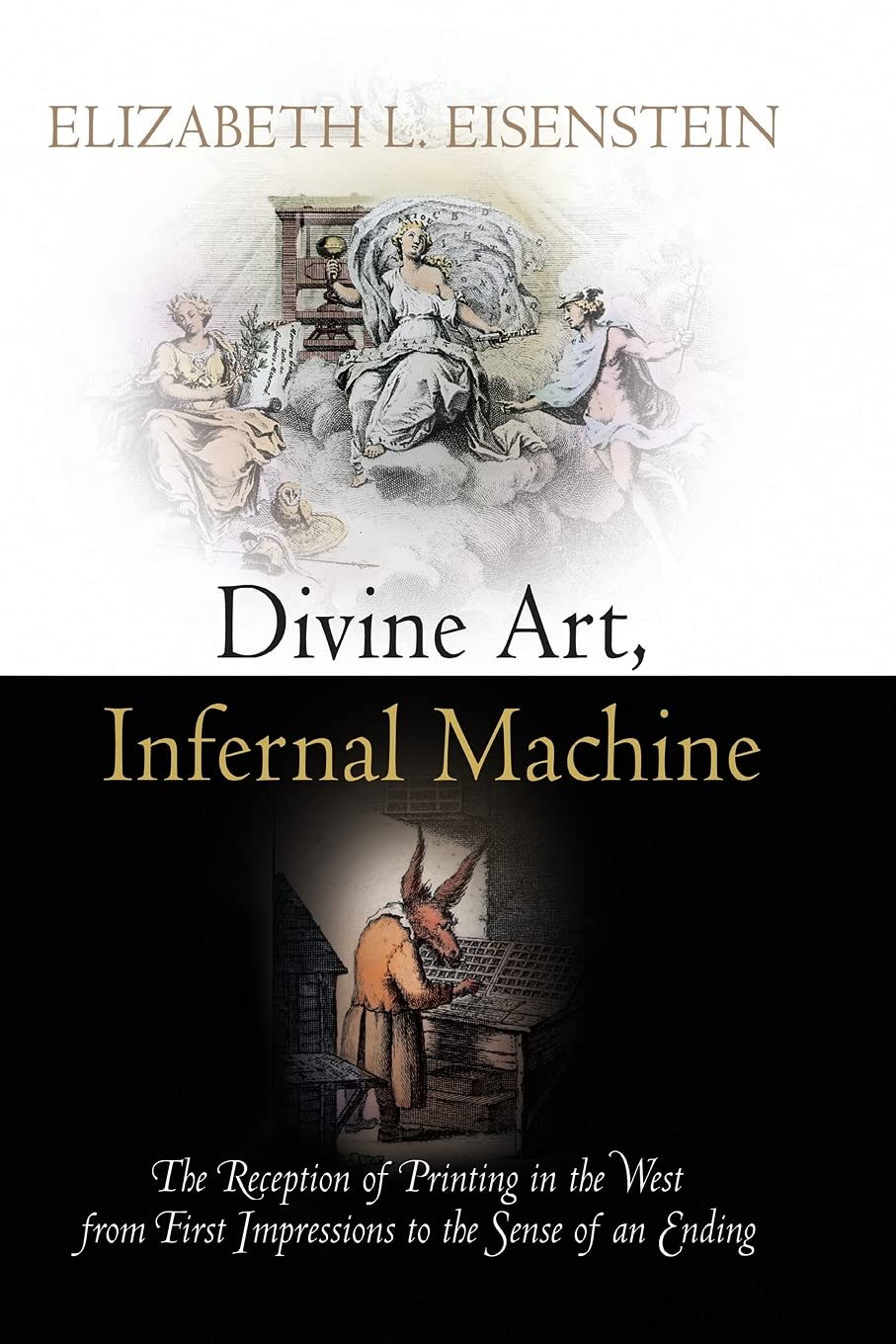
Title
Divine Art, Infernal Machine: The Reception of Printing in the West from First Impressions to the Sense of an Ending (Material T,Used
Sold by Ergodebooks, an authorized reseller.
Returns accepted within 30 days | support@ergodebooks.com
Shipping Information
- Free Standard Shipping — United States only
- Processing Time: 3–5 business days
- Estimated Delivery: 6–10 business days after dispatch
- Double-boxed, fully insured & discreetly packaged
- Tracking number sent via email once dispatched
Returns & Refund
Returns accepted within 30 days of delivery.
Damaged or Defective Item
Free return shipping + replacement or full refund
Wrong Item Received
Free return shipping + replacement or full refund
Change of Mind
Return shipping at customer's expense · 25% restocking fee applies
Payment Option

There is a longstanding confusion of Johann Fust, Gutenberg's onetime business partner, with the notorious Doctor Faustus. The association is not surprising to Elizabeth L. Eisenstein, for from its very early days the printing press was viewed by some as black magic. For the most part, however, it was welcomed as a "divine art" by Western churchmen and statesmen. Sixteenthcentury Lutherans hailed it for emancipating Germans from papal rule, and seventeenthcentury English radicals viewed it as a weapon against bishops and kings. While an early colonial governor of Virginia thanked God for the absence of printing in his colony, a century later, revolutionaries on both sides of the Atlantic paid tribute to Gutenberg for setting in motion an irreversible movement that undermined the rule of priests and kings. Yet scholars continued to praise printing as a peaceful art. They celebrated the advancement of learning while expressing concern about information overload.In Divine Art, Infernal Machine, Eisenstein, author of the hugely influential The Printing Press as an Agent of Change, has written a magisterial and highly readable account of five centuries of ambivalent attitudes toward printing and printers. Once again, she makes a compelling case for the ways in which technological developments and cultural shifts are intimately related. Always keeping an eye on the present, she recalls how, in the nineteenth century, the steam press was seen both as a giant engine of progress and as signaling the end of a golden age. Predictions that the newspaper would supersede the book proved to be false, and Eisenstein is equally skeptical of pronouncements of the supersession of print by the digital.The use of print has always entailed ambivalence about serving the muses as opposed to profiting from the marketing of commodities. Somewhat newer is the tension between the perceived need to preserve an everincreasing mass of texts against the very real space and resource constraints of bricksandmortar libraries. Whatever the multimedia future may hold, Eisenstein notes, our attitudes toward print will never be monolithic. For now, however, reports of its death are greatly exaggerated.
⚠️ WARNING (California Proposition 65):
This product may contain chemicals known to the State of California to cause cancer, birth defects, or other reproductive harm.
For more information, please visit www.P65Warnings.ca.gov.