
Title
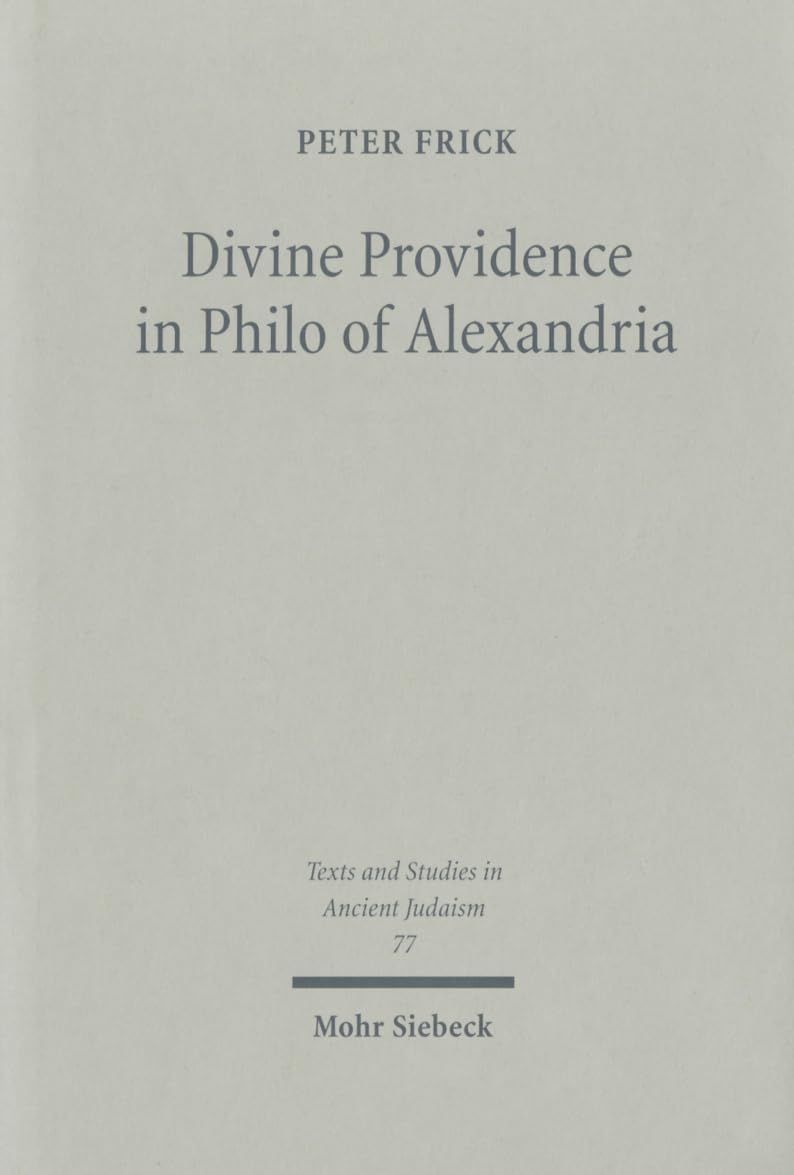
Divine Providence in Philo of Alexandria (Texts and Studies in Ancient Judaism),New
Sold by Ergodebooks, an authorized reseller.
Returns accepted within 30 days | support@ergodebooks.com
Shipping Information
- Free Standard Shipping — United States only
- Processing Time: 3–5 business days
- Estimated Delivery: 6–10 business days after dispatch
- Double-boxed, fully insured & discreetly packaged
- Tracking number sent via email once dispatched
Returns & Refund
Returns accepted within 30 days of delivery.
Damaged or Defective Item
Free return shipping + replacement or full refund
Wrong Item Received
Free return shipping + replacement or full refund
Change of Mind
Return shipping at customer's expense · 25% restocking fee applies
Payment Option

In his study Peter Frick starts with the examination of the theocentric structure of Philo's thought as outlined in the important passage De Opificio Mundi 1712 where Philo correlates the idea of providence with his concept of God and the theory of creation. On this basis, any adequate understanding of providence in Philo must begin with the correlation between the formal aspects of the Philonic concept of God, especially the idea of God's transcendence, and Philo's conceptualization of the idea of providence in light of these formal aspects. In particular, the issue is how Philo can predicate that God is provident in nature, although God cannot be apprehended in his essence. Moreover, Philo explains the immanence of God in the cosmos in terms of the Logos and the divine powers, one of which he specifically characterizes as the providential power. Both the aspects of divine transcendence and immanence cohere in Philo's theory of creation. He conceives of the role of providence in cosmological matters as being responsible for the design, administration and continuous existence of the created universe. Two further issues, the questions of astral fatalism and theodicy, are critically important for a thorough understanding of Philo's conception of divine providence. Philo rejects the assumption implied in astral fatalism that the stars are transcendent divinities and thus have causal powers over human affairs. And he rejects astral fatalism because it renders absurd the notion of moral responsibility. Concerning the question of theodicy, Philo proceeds from the Platonic premise that God is not the cause for evil in any way. For him, the existence of moral evil exonerates God and his providence as the cause for evil and anchors the blame in the person.
⚠️ WARNING (California Proposition 65):
This product may contain chemicals known to the State of California to cause cancer, birth defects, or other reproductive harm.
For more information, please visit www.P65Warnings.ca.gov.