If you have any questions, you are always welcome to contact us. We'll get back to you as soon as possible, withing 24 hours on weekdays.
Customer service
All questions about your order, return and delivery must be sent to our customer service team by e-mail at yourstore@yourdomain.com
Sale & Press
If you are interested in selling our products, need more information about our brand or wish to make a collaboration, please contact us at press@yourdomain.com
Help
If you have any questions, you are always welcome to contact us. We'll get back to you as soon as possible, withing 24 hours on weekdays.
Customer service
All questions about your order, return and delivery must be sent to our customer service team by e-mail at yourstore@yourdomain.com
Sale & Press
If you are interested in selling our products, need more information about our brand or wish to make a collaboration, please contact us at press@yourdomain.com
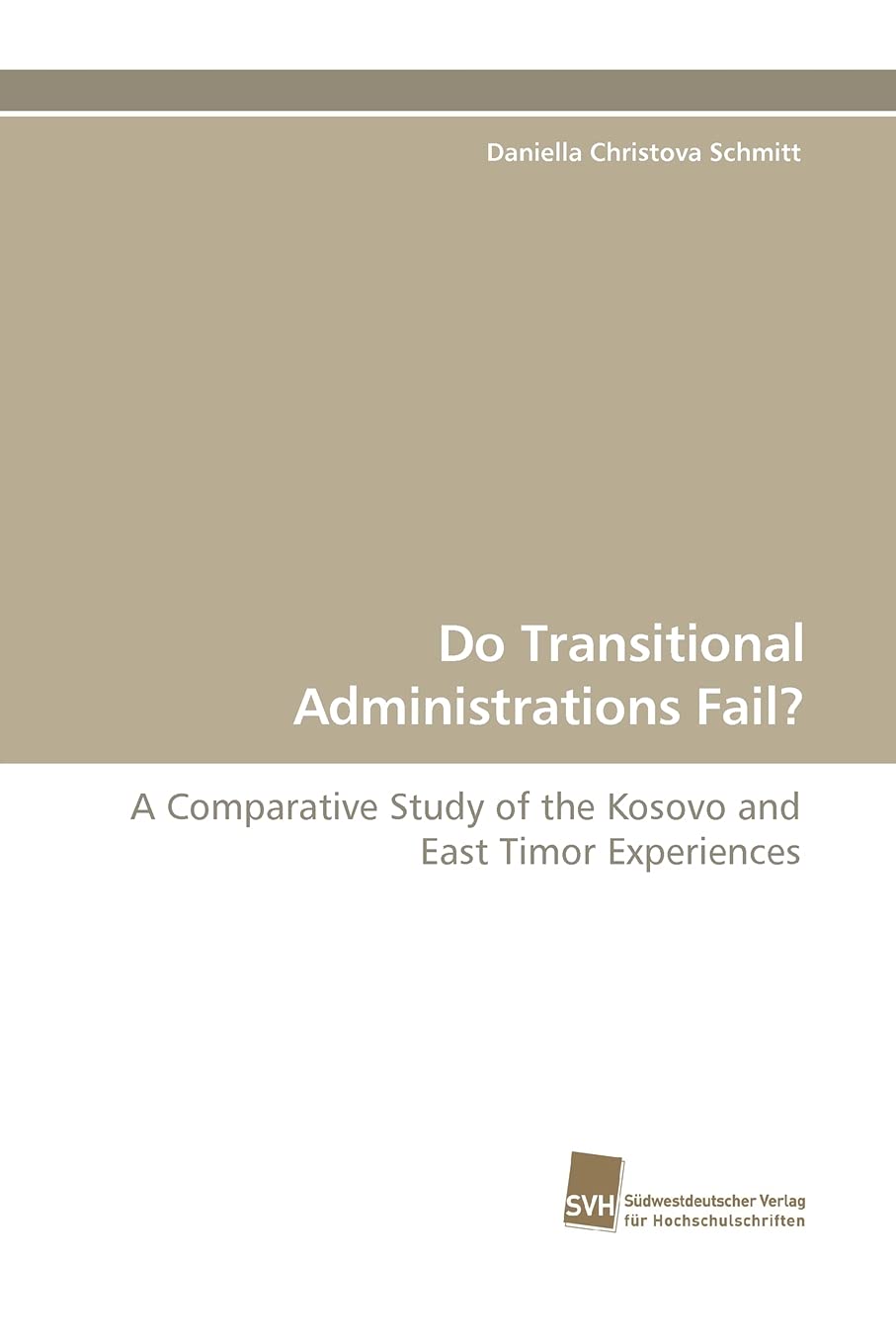
This book analyses the question of whether international peacebuilding efforts in weak, failed or failing states via United Nations Transitional Administrations (UN TAs) are successful. As successful are deemed those TAs that manage to hand over power to the local population and achieve local ownership. By comparing the United Nations Interim Administration Mission in Kosovo (UNMIK, 1999 ) with the United Nations Transitional Administration Mission in East Timor (UNTAET, 1999 2002), it is proposed that TAs tend to be more successful, when conflicting ethnic interests are low, when there are higher levels of local participation in the transitional structures and when more benchmarks (as stipulated by the international peacebuilders) are achieved. The success of a transitional administration is viewed as an interplay between local, national and international factors, which together determine the Space for Local Ownership of Peacebuilding (SLOP). The SLOP model not only reflects the complexity of contemporary peacebuilding, but replaces the overused dichotomy of success/failure in peacebuilding with the notion of stages of success.
⚠️ WARNING (California Proposition 65):
This product may contain chemicals known to the State of California to cause cancer,
birth defects, or other reproductive harm.
For MAP (Minimum Advertised Price) violations and Intellectual Property (IP) or Trademark concerns, please contact:
support@ergodebooks.com
⚠️ California Proposition 65 Warning: Some products sold on this website may expose you to chemicals known to the State of California to cause cancer, birth defects, or other reproductive harm. For more information, visit www.P65Warnings.ca.gov.