If you have any questions, you are always welcome to contact us. We'll get back to you as soon as possible, withing 24 hours on weekdays.
Customer service
All questions about your order, return and delivery must be sent to our customer service team by e-mail at yourstore@yourdomain.com
Sale & Press
If you are interested in selling our products, need more information about our brand or wish to make a collaboration, please contact us at press@yourdomain.com
Help
If you have any questions, you are always welcome to contact us. We'll get back to you as soon as possible, withing 24 hours on weekdays.
Customer service
All questions about your order, return and delivery must be sent to our customer service team by e-mail at yourstore@yourdomain.com
Sale & Press
If you are interested in selling our products, need more information about our brand or wish to make a collaboration, please contact us at press@yourdomain.com
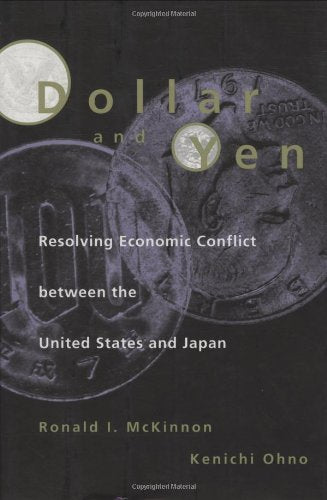
Dollar and Yen analyzes the friction between the United States and Japan from the viewpoint of exchange rate economics.From the mid1950s to the early 1990s, Japan grew faster than any other major industrial economy, displacing the United States in dominance of worldwide manufacturing markets. In the 1970s and 1980s, many books appeared linking the apparent decline of the United States in the world economy to unfair Japanese practices that closed the Japanese market to a wide range of foreign goods. Dollar and Yen analyzes the friction between the United States and Japan from the viewpoint of exchange rate economics. The authors argue against the prevailing view that the trade imbalance should be corrected by dollar depreciation, saying that adjustment through the exchange rate is both ineffective and costly. Stepping outside the traditional dichotomy between international trade and international finance, they link the yen's tremendous appreciation from 1971 to mid1995 to mercantile pressure from the United States arising from trade tensions between the two countries. Although sometimes resisted by the Bank of Japan, this yen appreciation nevertheless forced unwanted deflation on the Japanese economy after 1985resulting in two major recessions (endaka fukyos). The authors argue for relaxing commercial tensions between the two countries, and for limiting future economic downturns, by combining a commercial compact for mutual trade liberalization with a monetary accord for stabilizing the yendollar exchange rate.
⚠️ WARNING (California Proposition 65):
This product may contain chemicals known to the State of California to cause cancer,
birth defects, or other reproductive harm.
For MAP (Minimum Advertised Price) violations and Intellectual Property (IP) or Trademark concerns, please contact:
support@ergodebooks.com
⚠️ California Proposition 65 Warning: Some products sold on this website may expose you to chemicals known to the State of California to cause cancer, birth defects, or other reproductive harm. For more information, visit www.P65Warnings.ca.gov.