
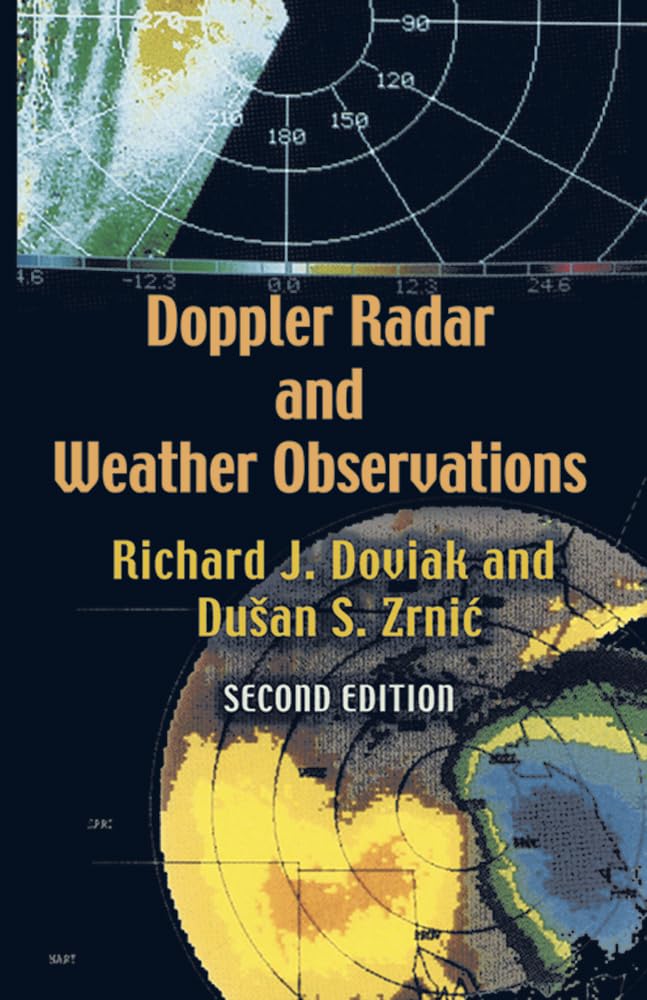
Title
Doppler Radar And Weather Observations: Second Edition (Dover Books On Engineering)
Sold by Ergodebooks, an authorized reseller.
Returns accepted within 30 days | support@ergodebooks.com
Shipping Information
- Free Standard Shipping — United States only
- Processing Time: 3–5 business days
- Estimated Delivery: 6–10 business days after dispatch
- Double-boxed, fully insured & discreetly packaged
- Tracking number sent via email once dispatched
Returns & Refund
Returns accepted within 30 days of delivery.
Damaged or Defective Item
Free return shipping + replacement or full refund
Wrong Item Received
Free return shipping + replacement or full refund
Change of Mind
Return shipping at customer's expense · 25% restocking fee applies
Payment Option

This Book Reviews The Principles Of Doppler Radar And Emphasizes The Quantitative Measurement Of Meteorological Parameters. It Illustrates The Relation Of Doppler Radar Data And Images To Atmospheric Phenomena Such As Tornadoes, Microbursts, Waves, Turbulence, Density Currents, Hurricanes, And Lightning.Geared Toward Upperlevel Undergraduates And Graduate Students, This Text Was Written By Two Scientists At The National Severe Storms Laboratory In Norman, Oklahoma, A Division Of The National Oceanic And Atmospheric Administration. Topics Include Electromagnetic Waves And Propagation, Weather Signals And Their Doppler Spectra, Weather Signal Processing, Measurements Of Precipitation And Turbulence, And Observations Of Winds And Storms As Well As Fair Weather. Radar Images And Photographs Of Weather Phenomena Highlight The Text.
⚠️ WARNING (California Proposition 65):
This product may contain chemicals known to the State of California to cause cancer, birth defects, or other reproductive harm.
For more information, please visit www.P65Warnings.ca.gov.
- Q: How many pages does this book have? A: This book has five hundred ninety-two pages. It provides a comprehensive review of Doppler radar principles and weather observations.
- Q: What is the binding type of this book? A: The binding type is paperback. This makes it flexible and easy to carry for students and professionals alike.
- Q: What are the dimensions of this book? A: The dimensions are five point six inches in length, one point fifteen inches in width, and eight point forty-eight inches in height. These dimensions make it a convenient size for reading.
- Q: Who is the author of this book? A: The author is Richard J. Doviak. He is known for his expertise in the field of meteorology.
- Q: What topics are covered in this book? A: The book covers topics like Doppler radar data, atmospheric phenomena, and weather signal processing. It is designed for upper-level undergraduate and graduate students.
- Q: Is this book suitable for beginners in meteorology? A: No, this book is geared toward upper-level undergraduate and graduate students. It assumes a certain level of prior knowledge in meteorology.
- Q: How can I apply the knowledge from this book to real-life situations? A: You can apply the knowledge to understand weather patterns and phenomena like tornadoes and hurricanes. It provides insights into quantitative measurements of meteorological parameters.
- Q: Is there a specific reading level required for this book? A: Yes, it is intended for upper-level undergraduates and graduate students. A foundational understanding of meteorology is recommended.
- Q: How should I store this book to keep it in good condition? A: Store the book in a cool, dry place away from direct sunlight. This helps preserve its binding and pages.
- Q: Can I clean this book if it gets dirty? A: Yes, you can gently wipe the cover with a damp cloth. Avoid getting water on the pages to prevent damage.
- Q: What if I receive a damaged book? A: If you receive a damaged book, you should contact customer support for a return or exchange. They will guide you through the process.
- Q: Is there a warranty for this book? A: No, books typically do not come with a warranty. However, check the retailer's return policy for any specific guarantees.
- Q: How does this book compare to other meteorology texts? A: This book focuses specifically on Doppler radar and quantitative measurement, making it unique among general meteorology texts. It emphasizes practical applications.
- Q: Is this book relevant for professionals in meteorology? A: Yes, it is relevant for professionals as it covers advanced topics in Doppler radar technology and weather observations.
- Q: What should I do if I have further questions about this book? A: You can reach out to the publisher or consult online resources for more information. There are often forums and discussion groups for deeper insights.