If you have any questions, you are always welcome to contact us. We'll get back to you as soon as possible, withing 24 hours on weekdays.
Customer service
All questions about your order, return and delivery must be sent to our customer service team by e-mail at yourstore@yourdomain.com
Sale & Press
If you are interested in selling our products, need more information about our brand or wish to make a collaboration, please contact us at press@yourdomain.com
Help
If you have any questions, you are always welcome to contact us. We'll get back to you as soon as possible, withing 24 hours on weekdays.
Customer service
All questions about your order, return and delivery must be sent to our customer service team by e-mail at yourstore@yourdomain.com
Sale & Press
If you are interested in selling our products, need more information about our brand or wish to make a collaboration, please contact us at press@yourdomain.com
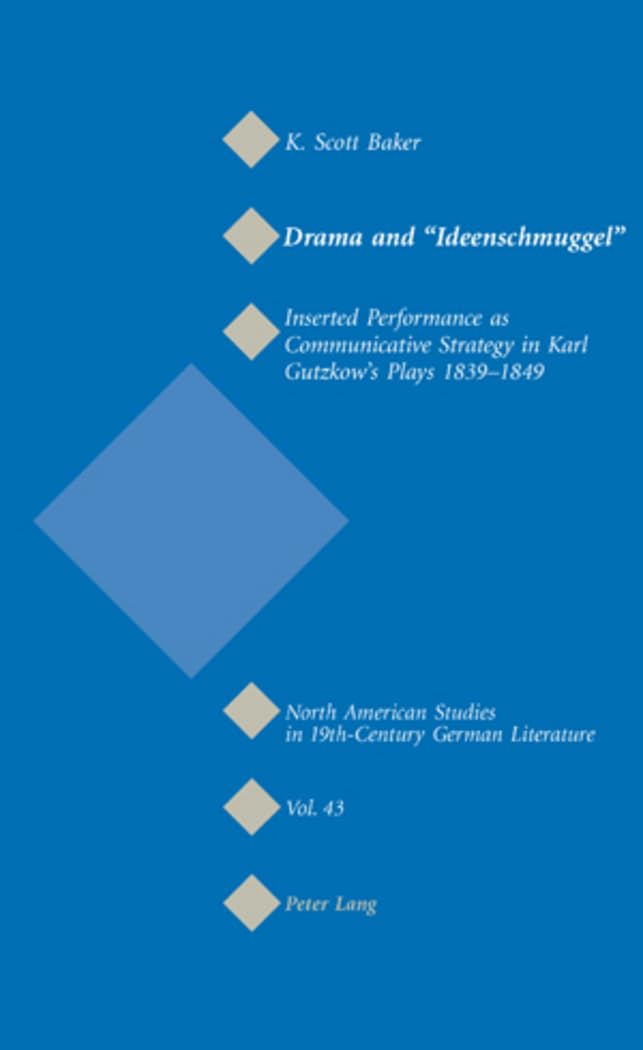
This monograph details Gutzkows recurring use of performancewithintheplay as a means of encouraging an active, political response by the audience. He incorporates an internal audience viewing a performance on stage in order to model an ideal of dramatic reception for the audiences of his own play. Gutzkow structures the narrative contextualization of these performances as reflections of specific issues in the German states of the Vormrz. Beginning with an overview of theoretical and literary texts from the 1830s, this study traces Gutzkows transferral of selfreflexive structures from his novels of this decade into his first staged play, Richard Savage (1839), and on through Das Urbild des Tartffe (1844) and Uriel Acosta (1845). It concludes by portraying Der Knigsleutnant (1849) as a transitional work that shows Gutzkows decision to return to the novel as a consequence of the failure of his plays to attain the reception he intended. By using the coherency of the communicated message instead of fealty to aesthetic norms as the evaluative criteria for discussing Gutzkows plays, the book exposes an innovative mode of specifically literary social criticism in these works that complements their traditional assessment as documentation of the cultural history of Liberalism in this period.
⚠️ WARNING (California Proposition 65):
This product may contain chemicals known to the State of California to cause cancer,
birth defects, or other reproductive harm.
For MAP (Minimum Advertised Price) violations and Intellectual Property (IP) or Trademark concerns, please contact:
support@ergodebooks.com
⚠️ California Proposition 65 Warning: Some products sold on this website may expose you to chemicals known to the State of California to cause cancer, birth defects, or other reproductive harm. For more information, visit www.P65Warnings.ca.gov.