
Title
Drift into Failure,Used
Sold by Ergodebooks, an authorized reseller.
Returns accepted within 30 days | support@ergodebooks.com
Shipping Information
- Free Standard Shipping — United States only
- Processing Time: 3–5 business days
- Estimated Delivery: 6–10 business days after dispatch
- Double-boxed, fully insured & discreetly packaged
- Tracking number sent via email once dispatched
Returns & Refund
Returns accepted within 30 days of delivery.
Damaged or Defective Item
Free return shipping + replacement or full refund
Wrong Item Received
Free return shipping + replacement or full refund
Change of Mind
Return shipping at customer's expense · 25% restocking fee applies
Payment Option

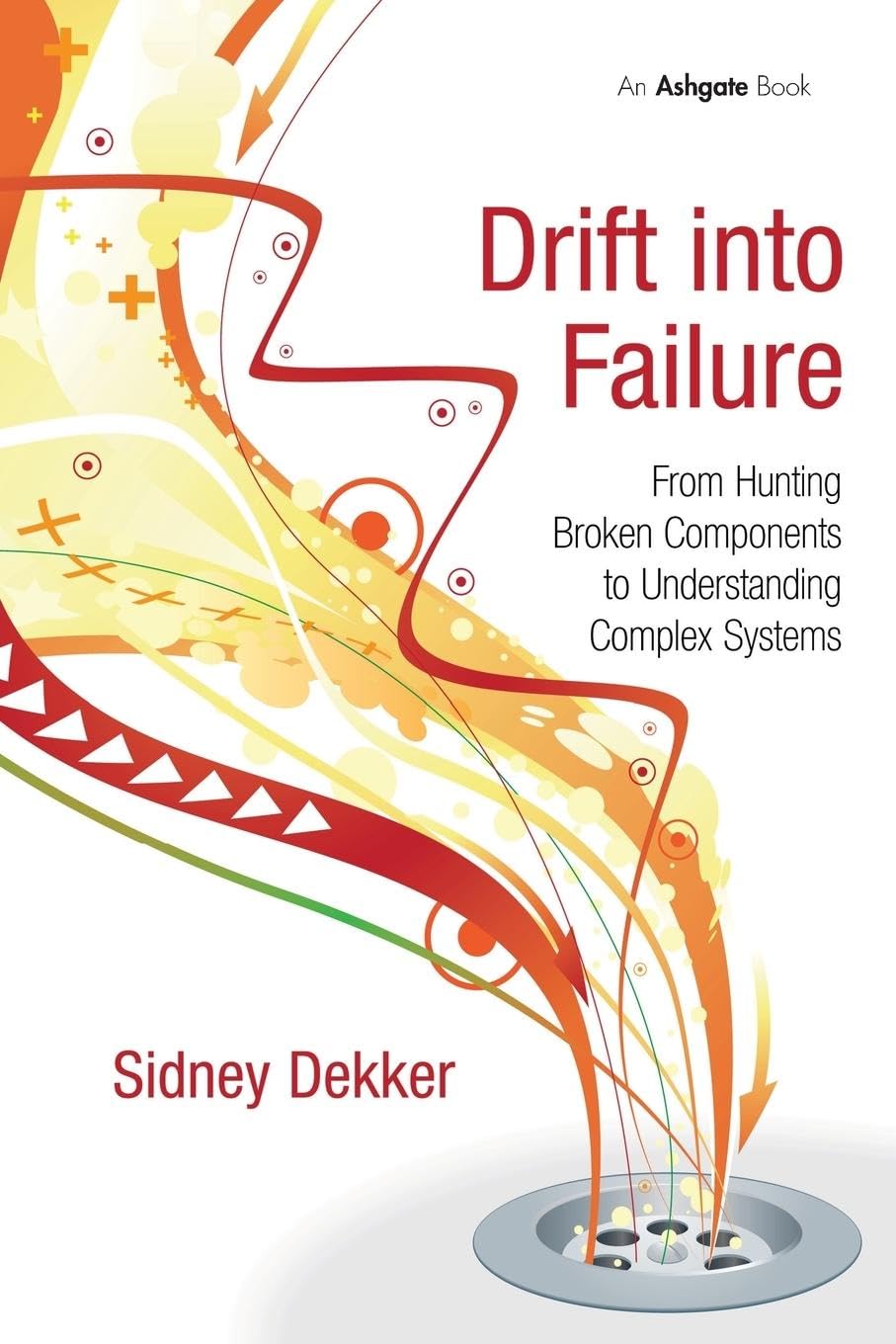
What does the collapse of subprime lending have in common with a broken jackscrew in an airliner?s tailplane? Or the oil spill disaster in the Gulf of Mexico with the burnup of Space Shuttle Columbia? These were systems that drifted into failure. While pursuing success in a dynamic, complex environment with limited resources and multiple goal conflicts, a succession of small, everyday decisions eventually produced breakdowns on a massive scale. We have trouble grasping the complexity and normality that gives rise to such large events. We hunt for broken parts, fixable properties, people we can hold accountable. Our analyses of complex system breakdowns remain depressingly linear, depressingly componential imprisoned in the space of ideas once defined by Newton and Descartes. The growth of complexity in society has outpaced our understanding of how complex systems work and fail. Our technologies have gotten ahead of our theories. We are able to build things deepsea oil rigs, jackscrews, collateralized debt obligations whose properties we understand in isolation. But in competitive, regulated societies, their connections proliferate, their interactions and interdependencies multiply, their complexities mushroom. This book explores complexity theory and systems thinking to understand better how complex systems drift into failure. It studies sensitive dependence on initial conditions, unruly technology, tipping points, diversity and finds that failure emerges opportunistically, nonrandomly, from the very webs of relationships that breed success and that are supposed to protect organizations from disaster. It develops a vocabulary that allows us to harness complexity and find new ways of managing drift.
⚠️ WARNING (California Proposition 65):
This product may contain chemicals known to the State of California to cause cancer, birth defects, or other reproductive harm.
For more information, please visit www.P65Warnings.ca.gov.
- Q: What is the main theme of 'Drift into Failure'? A: 'Drift into Failure' explores the concept of complex systems that unexpectedly fail due to a series of small, everyday decisions. It examines how these failures can arise from the very relationships and complexities that contribute to success.
- Q: Who is the author of 'Drift into Failure'? A: The author of 'Drift into Failure' is Sidney Dekker, who is known for his expertise in safety science and systems thinking.
- Q: What categories does this book fall under? A: 'Drift into Failure' is categorized under Environmental Economics, making it relevant for readers interested in the intersection of economic systems and environmental challenges.
- Q: When was 'Drift into Failure' published? A: 'Drift into Failure' was published on February 28, 2011, and has a release date of December 16, 2018, for its updated edition.
- Q: How many pages are in the book? A: 'Drift into Failure' contains 234 pages, offering an in-depth exploration of complex systems and their failures.
- Q: What type of binding does this book have? A: 'Drift into Failure' is available in a paperback binding, making it a versatile and portable option for readers.
- Q: What is the condition of the book? A: 'Drift into Failure' is in new condition, ensuring that readers receive a pristine copy.
- Q: Does this book provide practical insights on managing complex systems? A: Yes, 'Drift into Failure' develops a vocabulary and framework that helps readers understand and manage the complexities that lead to failure in systems.
- Q: Is 'Drift into Failure' suitable for professionals in safety and risk management? A: Absolutely, 'Drift into Failure' is highly relevant for professionals in safety and risk management, as it provides valuable insights into how failures can be anticipated and managed.
- Q: Can 'Drift into Failure' help improve decision-making in complex environments? A: Yes, the book offers critical insights into decision-making processes within complex environments, helping readers recognize the implications of their choices on system stability.