If you have any questions, you are always welcome to contact us. We'll get back to you as soon as possible, withing 24 hours on weekdays.
Customer service
All questions about your order, return and delivery must be sent to our customer service team by e-mail at yourstore@yourdomain.com
Sale & Press
If you are interested in selling our products, need more information about our brand or wish to make a collaboration, please contact us at press@yourdomain.com
Help
If you have any questions, you are always welcome to contact us. We'll get back to you as soon as possible, withing 24 hours on weekdays.
Customer service
All questions about your order, return and delivery must be sent to our customer service team by e-mail at yourstore@yourdomain.com
Sale & Press
If you are interested in selling our products, need more information about our brand or wish to make a collaboration, please contact us at press@yourdomain.com
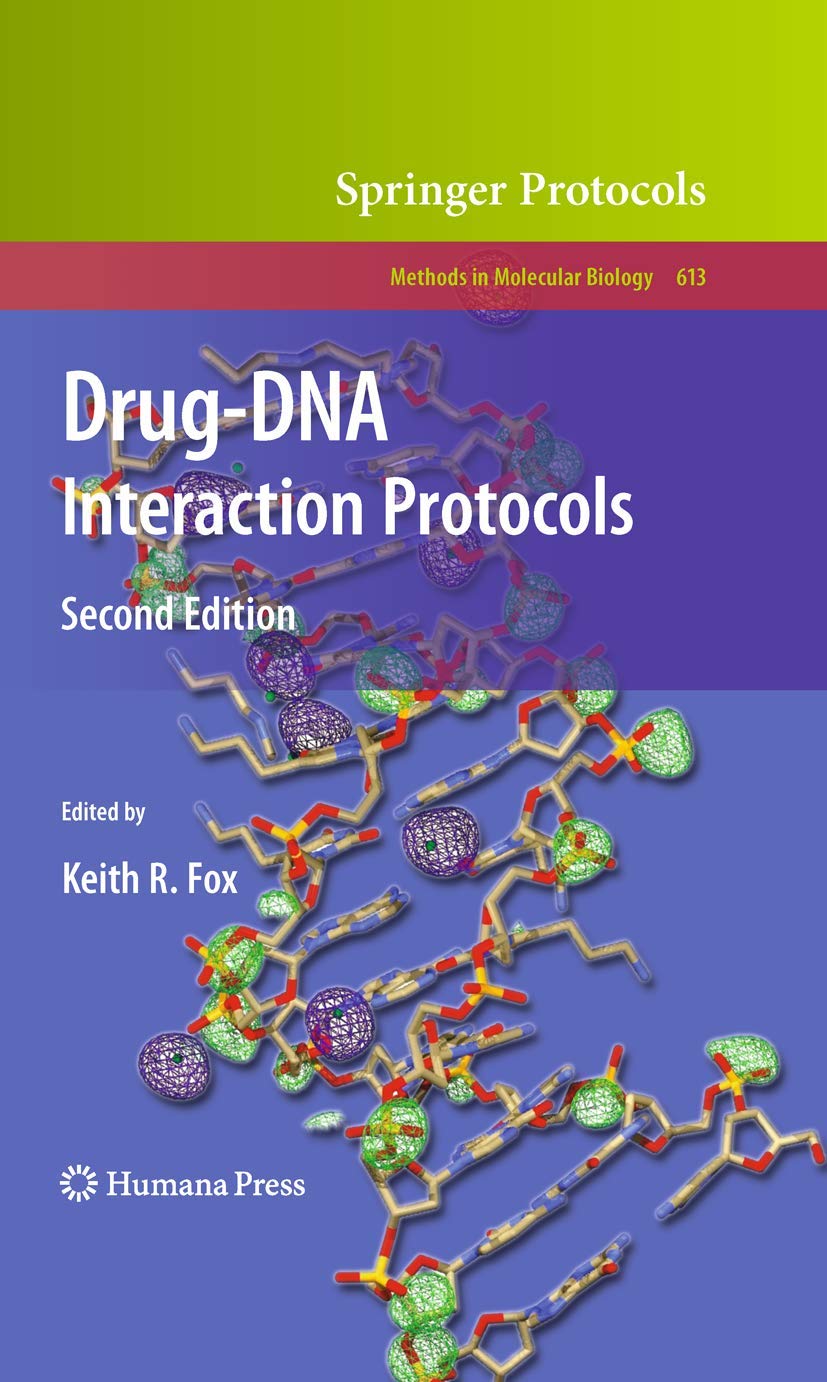
DNA has been known to be the cellular target for many cytotoxic anticancer agents for several decades. The knowledge of its structure in atomic detail and the ease with which DNA fragments (both synthetic oligonucleotides and natural sequences) can be prepared and manipulated has aided the design of compounds that bind to it with improved sel tivity. On the basis of this information, new generations of sequence reading compounds (including triplex forming oligonucleotides and minor groove binding ligands) have been prepared, which have the potential for targeting specifc DNA sequences as antigene agents. Within the last 10 years, it has also become apparent that the familiar DNA duplex is not the only structure that can be targeted by DNAbinding ligands and there has been increased interest in triplex and quadruplex structures as drug targets, as well as protein DNA complexes, such as those with nucleosomes or topoisomerases. Each of these advances has required the availability and development of an arsenal of techniques for probing the interactions in both qualitative and quantitative terms. This v ume of Methods in Molecular Biology brings together several techniques that are currently useful for examining these interactions. Some of these are updates on ones that were included in the earlier volume (Methods in Molecular Biology 90), published 12 years ago, while others are new.
⚠️ WARNING (California Proposition 65):
This product may contain chemicals known to the State of California to cause cancer,
birth defects, or other reproductive harm.
For MAP (Minimum Advertised Price) violations and Intellectual Property (IP) or Trademark concerns, please contact:
support@ergodebooks.com
⚠️ California Proposition 65 Warning: Some products sold on this website may expose you to chemicals known to the State of California to cause cancer, birth defects, or other reproductive harm. For more information, visit www.P65Warnings.ca.gov.