
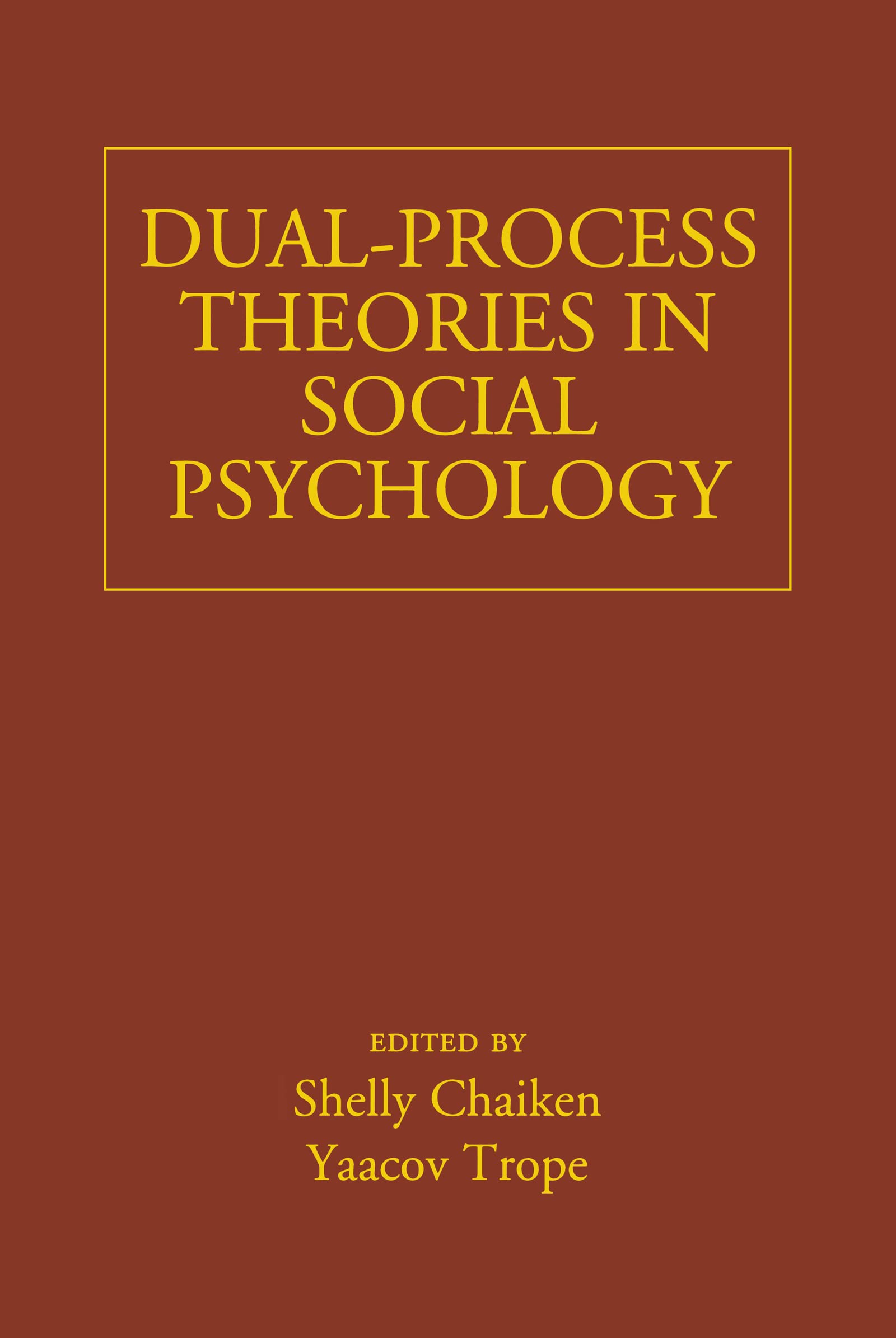
Title
DualProcess Theories in Social Psychology,New
Sold by Ergodebooks, an authorized reseller.
Returns accepted within 30 days | support@ergodebooks.com
Shipping Information
- Free Standard Shipping — United States only
- Processing Time: 3–5 business days
- Estimated Delivery: 6–10 business days after dispatch
- Double-boxed, fully insured & discreetly packaged
- Tracking number sent via email once dispatched
Returns & Refund
Returns accepted within 30 days of delivery.
Damaged or Defective Item
Free return shipping + replacement or full refund
Wrong Item Received
Free return shipping + replacement or full refund
Change of Mind
Return shipping at customer's expense · 25% restocking fee applies
Payment Option

This informative volume presents the first comprehensive review of research and theory on dualprocess models of social information processing. These models distinguish between qualitatively different modes of information processing in making decisions and solving problems (e.g., associative versus rulebased, controlled versus uncontrolled, and affective versus cognitive modes). Leading contributors review the basic assumptions of these approaches and review the ways they have been applied and tested in such areas as attitudes, stereotyping, person perception, memory, and judgment. Also examined are the relationships between different sets of processing modes, the factors that determine their utilization, and how they work in combination to affect responses to social information.
⚠️ WARNING (California Proposition 65):
This product may contain chemicals known to the State of California to cause cancer, birth defects, or other reproductive harm.
For more information, please visit www.P65Warnings.ca.gov.
- Q: What is the main focus of 'Dual-Process Theories in Social Psychology'? A: The book presents a comprehensive review of research on dual-process models of social information processing, distinguishing between different modes of information processing, such as associative versus rule-based approaches.
- Q: Who is the author of this book? A: The author of 'Dual-Process Theories in Social Psychology' is Shelly Chaiken.
- Q: What year was this book published? A: The book was published on February 19, 1999.
- Q: What condition is the book in? A: The book is listed as 'Used Book in Good Condition'.
- Q: How many pages does this book contain? A: The book contains 657 pages.
- Q: What is the binding type of this book? A: This book is bound in hardcover.
- Q: What topics does the book cover? A: The book covers topics such as attitudes, stereotyping, person perception, memory, and judgment, while examining the relationships between different processing modes.
- Q: Is there a specific edition of this book? A: Yes, this book is the first edition.
- Q: What is the significance of dual-process theories in psychology? A: Dual-process theories are significant as they provide frameworks for understanding how people process information and make decisions, influencing various psychological domains.
- Q: Can this book be beneficial for students studying psychology? A: Yes, the book is beneficial for students as it offers in-depth insights into dual-process theories and their applications in social psychology.