
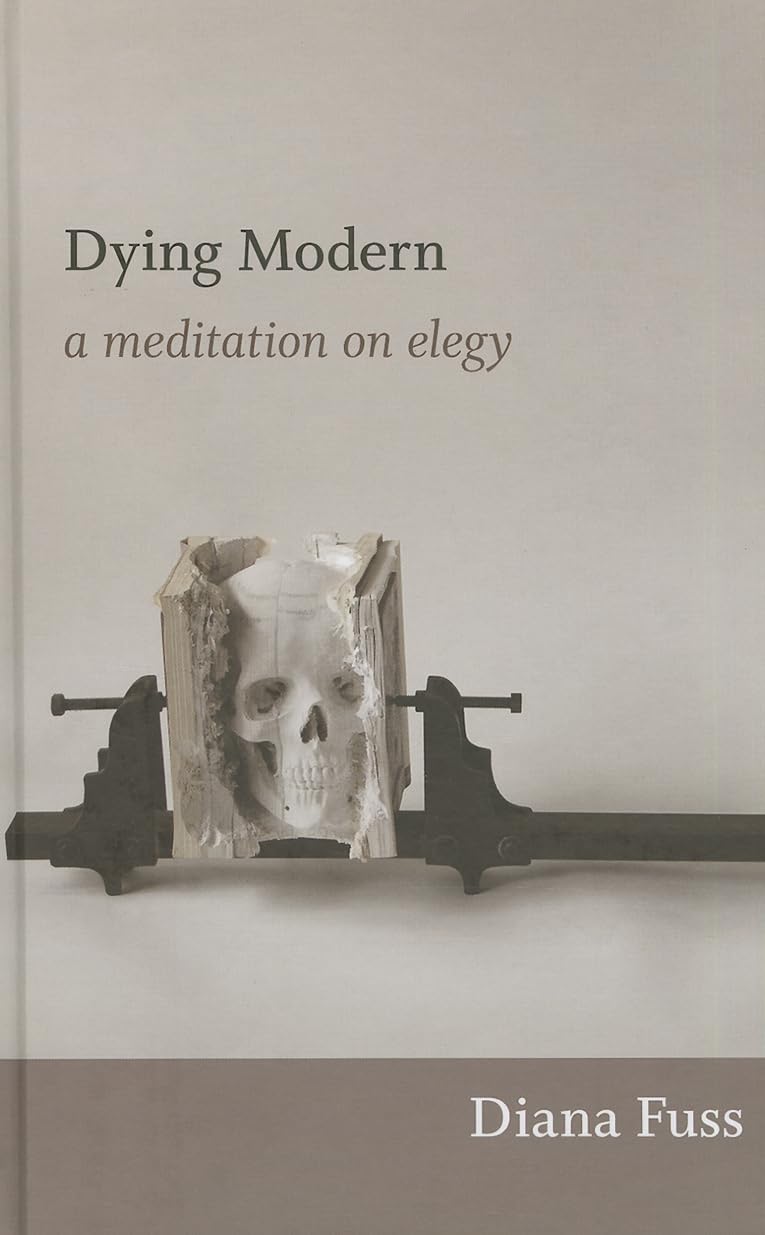
Title
Dying Modern: A Meditation on Elegy,Used
Sold by Ergodebooks, an authorized reseller.
Returns accepted within 30 days | support@ergodebooks.com
Shipping Information
- Free Standard Shipping — United States only
- Processing Time: 3–5 business days
- Estimated Delivery: 6–10 business days after dispatch
- Double-boxed, fully insured & discreetly packaged
- Tracking number sent via email once dispatched
Returns & Refund
Returns accepted within 30 days of delivery.
Damaged or Defective Item
Free return shipping + replacement or full refund
Wrong Item Received
Free return shipping + replacement or full refund
Change of Mind
Return shipping at customer's expense · 25% restocking fee applies
Payment Option

Product Description In Dying Modern, one of our foremost literary critics inspires new ways to read, write, and talk about poetry. Diana Fuss does so by identifying three distinct but largely unrecognized voices within the wellstudied genre of the elegy: the dying voice, the reviving voice, and the surviving voice. Through her deft readings of modern poetry, Fuss unveils the dramatic within the elegiac: the dying diva who relishes a great deathbed scene, the speaking corpse who fancies a good haunting, and the departing lover who delights in a dramatic exit. Focusing primarily on American and British poetry written during the past two centuries, Fuss maintains that poetry can still offer genuine ethical compensation, even for the deep wounds and shocking banalities of modern death. As dying, loss, and grief become ever more thoroughly obscured from public view, the dead start chattering away in verse. Through bold, original interpretations of littleknown works, as well as canonical poems by writers such as Emily Dickinson, Randall Jarrell, Elizabeth Bishop, Richard Wright, and Sylvia Plath, Fuss explores modern poetry's fascination with pre and postmortem speech, pondering the literary desire to make death speak in the face of its cultural silencing. Review [Fuss] approaches variations on the form of elegy with such complexity and acumen, and provides much insight into the complexities of our relation to death and the enigma of our simultaneous proximity and avoidance. These are things, after all, about which it can be almost impossible to talk. Diana Arterian Los Angeles Review of Books[An] elegant meditation. . . . Even Fuss admits that she is surprised that her little book on elegy . . . [which] I thought was about dyig quietly evolved into a book about surviving. It is a pleasure to be surprised alongside her. Sally Connolly TLSThis book is an erudite, beautifully written study of them. If youre a lover of Emily Dickinsons work or that of Randall Jarrell, Elizabeth Bishop, or Richard Wilbur, you will want to read this book. If you teach literary criticism or simply love poetry, you will want to read Fusss book. Superb book. Hope Leman Critical MarginsIn a luminous, beautifully considered study of the modern elegy, Fuss (Princeton) demonstrates the ways that poets have creatively imagined modes of talking about the dead...Highly recommended. D. A. Henningfeld Choice[Fuss] argues persuasively for the continued value of the consolatory elegy and examines the ethical dimentions of the modern elegy.... [A] concise, insightful, meditative book. Barbara Kelly Emily Dickinson International Society Bulletin'An exceptionally lively, often glitteringly witty essay on the vagaries, contents, and discontents of nineteenth and twentiethcentury elegy, a genrewhose fate, in England and America, has been radically disrupted and even, sometimes, deformed by the cultural fate of modern death itself.' Sandra Gilbert Literature and Medicine Review 'Diana Fuss's exceptional meditative essay, Dying Modern, is a subtle Keatsian inquiry into the irresolvable, and therefore generative, tensions between genre and mode, and between historical contingency and the constancy of ethical commitments.' Max Cavitch, author of American Elegy: The Poetry of Mourning from the Puritans to Whitman About the Author Diana Fuss is Louis W. Fairchild '24 Professor of English at Princeton University. She is the author of The Sense of an Interior: Four Writers and the Rooms that Shaped Them, winner of the James Russell Lowell Prize; Identification Papers; and Essentially Speaking. She is the editor of Human, All Too Human; Pink Freud; and Inside/Out.
⚠️ WARNING (California Proposition 65):
This product may contain chemicals known to the State of California to cause cancer, birth defects, or other reproductive harm.
For more information, please visit www.P65Warnings.ca.gov.