
Title
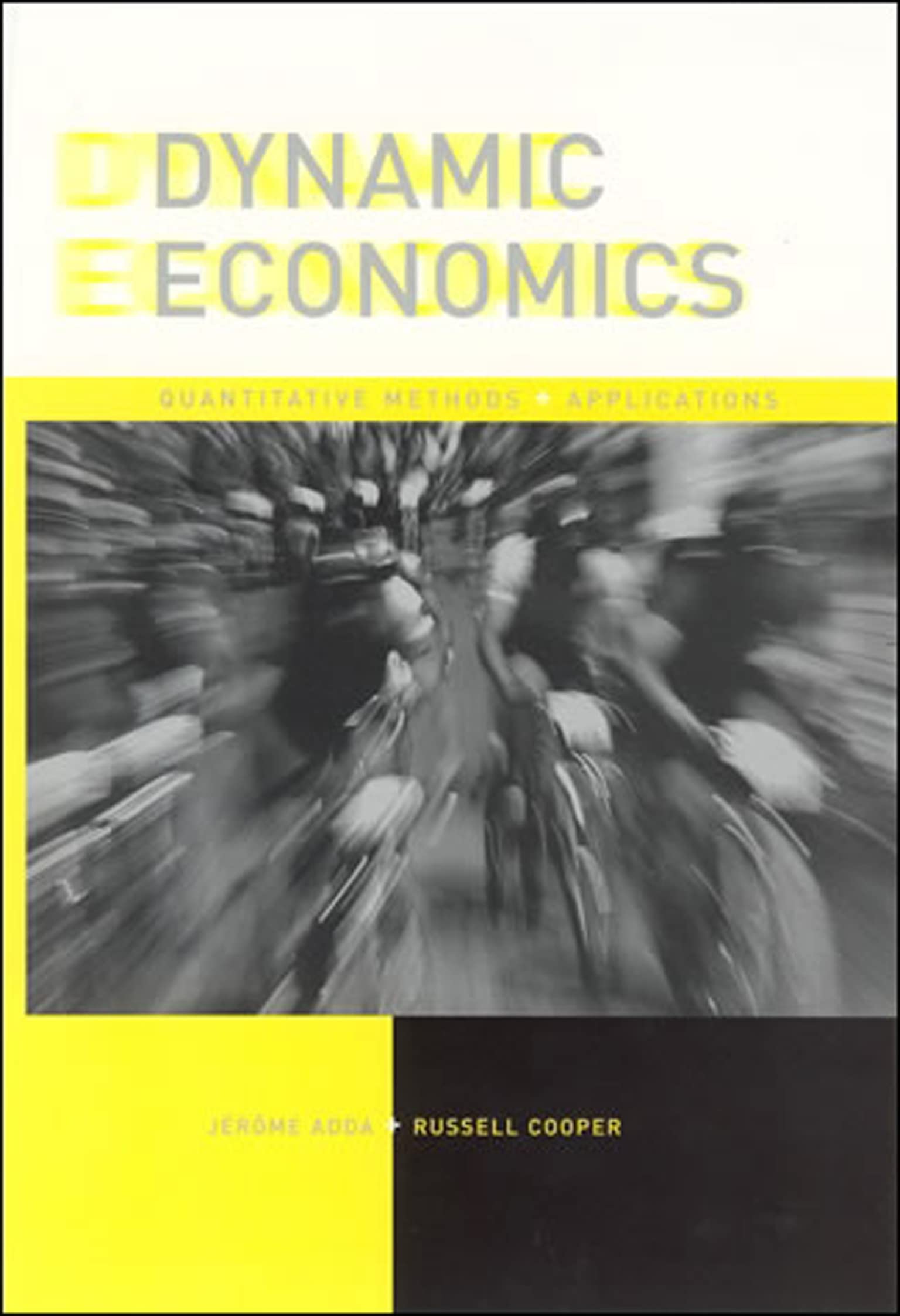
Dynamic Economics: Quantitative Methods and Applications (Mit Press),Used
Sold by Ergodebooks, an authorized reseller.
Returns accepted within 30 days | support@ergodebooks.com
Shipping Information
- Free Standard Shipping — United States only
- Processing Time: 3–5 business days
- Estimated Delivery: 6–10 business days after dispatch
- Double-boxed, fully insured & discreetly packaged
- Tracking number sent via email once dispatched
Returns & Refund
Returns accepted within 30 days of delivery.
Damaged or Defective Item
Free return shipping + replacement or full refund
Wrong Item Received
Free return shipping + replacement or full refund
Change of Mind
Return shipping at customer's expense · 25% restocking fee applies
Payment Option

An integrated approach to the empirical application of dynamic optimization programming models, for students and researchers.This book is an effective, concise text for students and researchers that combines the tools of dynamic programming with numerical techniques and simulationbased econometric methods. Doing so, it bridges the traditional gap between theoretical and empirical research and offers an integrated framework for studying applied problems in macroeconomics and microeconomics.In part I the authors first review the formal theory of dynamic optimization; they then present the numerical tools and econometric techniques necessary to evaluate the theoretical models. In language accessible to a reader with a limited background in econometrics, they explain most of the methods used in applied dynamic research today, from the estimation of probability in a coin flip to a complicated nonlinear stochastic structural model. These econometric techniques provide the final link between the dynamic programming problem and data. Part II is devoted to the application of dynamic programming to specific areas of applied economics, including the study of business cycles, consumption, and investment behavior. In each instance the authors present the specific optimization problem as a dynamic programming problem, characterize the optimal policy functions, estimate the parameters, and use models for policy evaluation.The original contribution of Dynamic Economics: Quantitative Methods and Applications lies in the integrated approach to the empirical application of dynamic optimization programming models. This integration shows that empirical applications actually complement the underlying theory of optimization, while dynamic programming problems provide needed structure for estimation and policy evaluation.
⚠️ WARNING (California Proposition 65):
This product may contain chemicals known to the State of California to cause cancer, birth defects, or other reproductive harm.
For more information, please visit www.P65Warnings.ca.gov.