If you have any questions, you are always welcome to contact us. We'll get back to you as soon as possible, withing 24 hours on weekdays.
Customer service
All questions about your order, return and delivery must be sent to our customer service team by e-mail at yourstore@yourdomain.com
Sale & Press
If you are interested in selling our products, need more information about our brand or wish to make a collaboration, please contact us at press@yourdomain.com
Help
If you have any questions, you are always welcome to contact us. We'll get back to you as soon as possible, withing 24 hours on weekdays.
Customer service
All questions about your order, return and delivery must be sent to our customer service team by e-mail at yourstore@yourdomain.com
Sale & Press
If you are interested in selling our products, need more information about our brand or wish to make a collaboration, please contact us at press@yourdomain.com
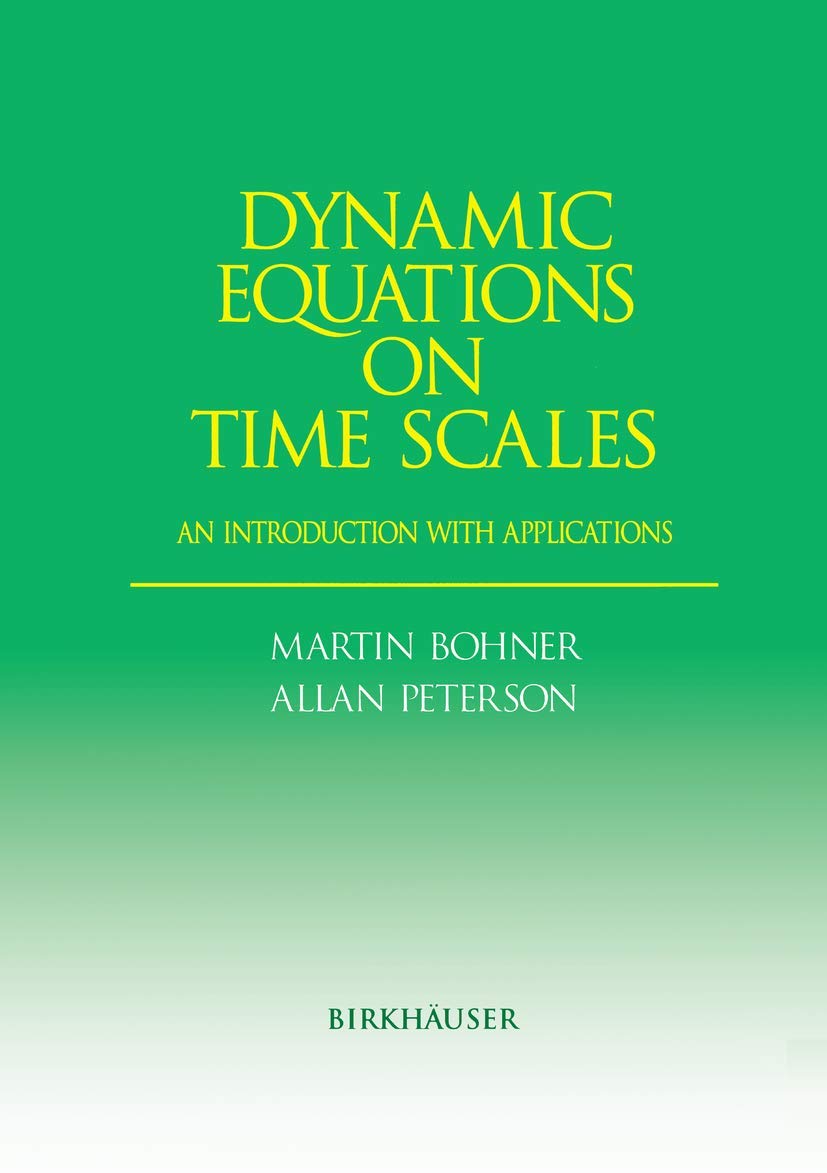
On becoming familiar with difference equations and their close re lation to differential equations, I was in hopes that the theory of difference equations could be brought completely abreast with that for ordinary differential equations. [HUGH L. TURRITTIN, My Mathematical Expectations, Springer Lecture Notes 312 (page 10), 1973] A major task of mathematics today is to harmonize the continuous and the discrete, to include them in one comprehensive mathematics, and to eliminate obscurity from both. [E. T. BELL, Men of Mathematics, Simon and Schuster, New York (page 13/14), 1937] The theory of time scales, which has recently received a lot of attention, was introduced by Stefan Hilger in his PhD thesis [159] in 1988 (supervised by Bernd Aulbach) in order to unify continuous and discrete analysis. This book is an intro duction to the study of dynamic equations on time scales. Many results concerning differential equations carryover quite easily to corresponding results for difference equations, while other results seem to be completely different in nature from their continuous counterparts. The study of dynamic equations on time scales reveals such discrepancies, and helps avoid proving results twice, once for differential equa tions and once for difference equations. The general idea is to prove a result for a dynamic equation where the domain of the unknown function is a socalled time scale, which is an arbitrary nonempty closed subset of the reals.
⚠️ WARNING (California Proposition 65):
This product may contain chemicals known to the State of California to cause cancer,
birth defects, or other reproductive harm.
For MAP (Minimum Advertised Price) violations and Intellectual Property (IP) or Trademark concerns, please contact:
support@ergodebooks.com
⚠️ California Proposition 65 Warning: Some products sold on this website may expose you to chemicals known to the State of California to cause cancer, birth defects, or other reproductive harm. For more information, visit www.P65Warnings.ca.gov.