
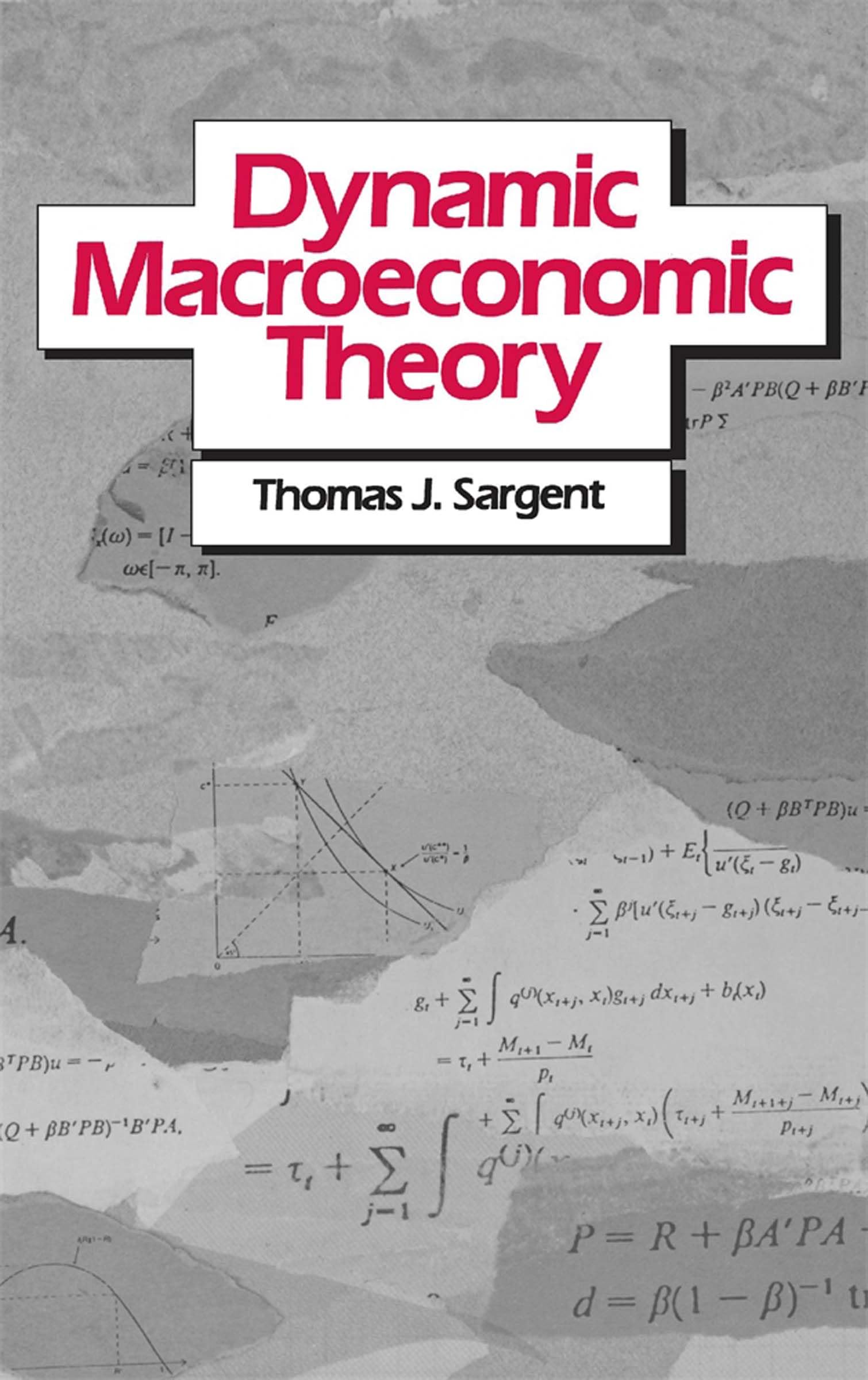
Title
Dynamic Macroeconomic Theory,New
Sold by Ergodebooks, an authorized reseller.
Returns accepted within 30 days | support@ergodebooks.com
Shipping Information
- Free Standard Shipping — United States only
- Processing Time: 3–5 business days
- Estimated Delivery: 6–10 business days after dispatch
- Double-boxed, fully insured & discreetly packaged
- Tracking number sent via email once dispatched
Returns & Refund
Returns accepted within 30 days of delivery.
Damaged or Defective Item
Free return shipping + replacement or full refund
Wrong Item Received
Free return shipping + replacement or full refund
Change of Mind
Return shipping at customer's expense · 25% restocking fee applies
Payment Option

The tasks of macroeconomics are to interpret observations on economic aggregates in terms of the motivations and constraints of economic agents and to predict the consequences of alternative hypothetical ways of administering government economic policy. General equilibrium models form a convenient context for analyzing such alternative government policies. In the past ten years, the strengths of general equilibrium models and the corresponding deficiencies of Keynesian and monetarist models of the 1960s have induced macroeconomists to begin applying general equilibrium models.This book describes some general equilibrium models that are dynamic, that have been built to help interpret timeseries of observations of economic aggregates and to predict the consequences of alternative government interventions. The first part of the book describes dynamic programming, search theory, and real dynamic capital pricing models. Among the applications are stochastic optimal growth models, matching models, arbitrage pricing theories, and theories of interest rates, stock prices, and options. The remaining parts of the book are devoted to issues in monetary theory; currencyinutilityfunction models, cashinadvance models, Townsend turnpike models, and overlapping generations models are all used to study a set of common issues. By putting these models to work on concrete problems in exercises offered throughout the text, Thomas Sargent provides insights into the strengths and weaknesses of these models of money. An appendix on functional analysis shows the unity that underlies the mathematics used in disparate areas of rational expectations economics.This book on dynamic equilibrium macroeconomics is suitable for graduatelevel courses; a companion book, Exercises in Dynamic Macroeconomic Theory, provides answers to the exercises and is also available from Harvard University Press.
⚠️ WARNING (California Proposition 65):
This product may contain chemicals known to the State of California to cause cancer, birth defects, or other reproductive harm.
For more information, please visit www.P65Warnings.ca.gov.
- Q: How many pages does this book have? A: This book has three hundred eighty-four pages. It provides a comprehensive exploration of dynamic macroeconomic theories and models.
- Q: What is the binding type of this book? A: This book is a hardcover edition. The hardcover provides durability for frequent use in academic settings.
- Q: What are the dimensions of this book? A: The dimensions of this book are six inches in length, one point two inches in width, and nine point twenty-five inches in height. These dimensions make it suitable for standard bookshelf storage.
- Q: What is the main subject of this book? A: The main subject of this book is dynamic macroeconomic theory. It focuses on general equilibrium models and their applications to government policy.
- Q: Who is the author of this book? A: The author of this book is Thomas J. Sargent. He is well-known for his contributions to macroeconomic theory.
- Q: Is this book suitable for beginners? A: This book is suitable for graduate-level courses. It assumes prior knowledge of macroeconomic concepts and may be challenging for beginners.
- Q: What themes are explored in this book? A: This book explores themes such as dynamic programming, search theory, and monetary theory. It also discusses various government interventions in the economy.
- Q: Can this book be used for self-study? A: Yes, this book can be used for self-study. It includes exercises that allow readers to apply the concepts learned throughout the text.
- Q: Is there a companion book available? A: Yes, there is a companion book titled 'Exercises in Dynamic Macroeconomic Theory.' It provides answers to the exercises found in this book.
- Q: How should I care for this book? A: To care for this book, store it in a cool, dry place away from direct sunlight. Avoid placing heavy objects on top of it to preserve its condition.
- Q: Is this book in good condition? A: Yes, this book is described as a used book in good condition. It has been well-maintained for continued use.
- Q: What if my book arrives damaged? A: If your book arrives damaged, you should contact the seller for a return or exchange. Most sellers have policies in place for damaged items.
- Q: What materials were used in the book's cover? A: The cover of this book is made from durable cardboard, typical for hardcover editions. This material helps protect the pages inside.
- Q: Are there illustrations in this book? A: No, this book does not contain illustrations. It focuses on theoretical concepts and models rather than visual representations.
- Q: Can this book help me with economic policy analysis? A: Yes, this book provides insights into analyzing government economic policy using general equilibrium models. It is a valuable resource for policy analysis.