
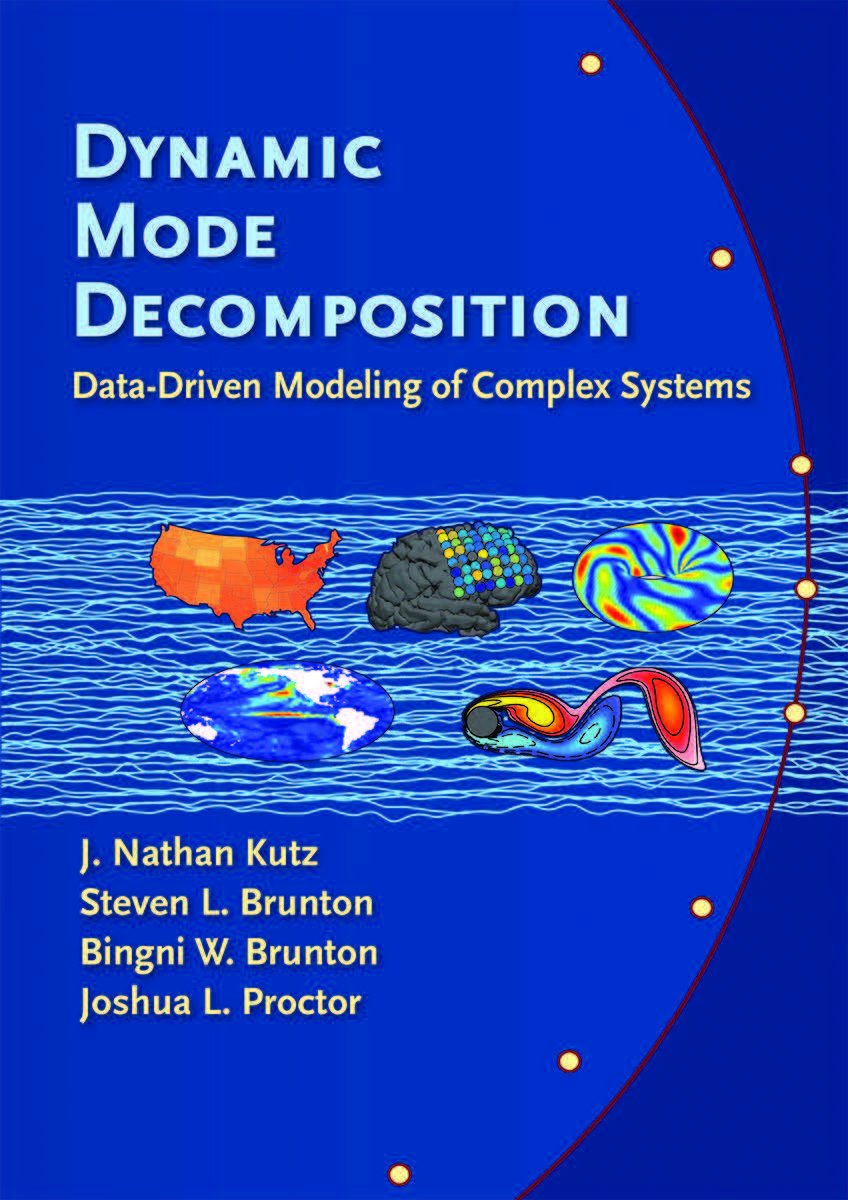
Title
Dynamic Mode Decomposition: DataDriven Modeling of Complex Systems,Used
Sold by Ergodebooks, an authorized reseller.
Returns accepted within 30 days | support@ergodebooks.com
Shipping Information
- Free Standard Shipping — United States only
- Processing Time: 3–5 business days
- Estimated Delivery: 6–10 business days after dispatch
- Double-boxed, fully insured & discreetly packaged
- Tracking number sent via email once dispatched
Returns & Refund
Returns accepted within 30 days of delivery.
Damaged or Defective Item
Free return shipping + replacement or full refund
Wrong Item Received
Free return shipping + replacement or full refund
Change of Mind
Return shipping at customer's expense · 25% restocking fee applies
Payment Option

Datadriven dynamical systems is a burgeoning fieldit connects how measurements of nonlinear dynamical systems and/or complex systems can be used with wellestablished methods in dynamical systems theory. This is a critically important new direction because the governing equations of many problems under consideration by practitioners in various scientific fields are not typically known. Thus, using data alone to help derive, in an optimal sense, the best dynamical system representation of a given application allows for important new insights. The recently developed dynamic mode decomposition (DMD) is an innovative tool for integrating data with dynamical systems theory. The DMD has deep connections with traditional dynamical systems theory and many recent innovations in compressed sensing and machine learning.Dynamic Mode Decomposition: DataDriven Modeling of Complex Systems, the first book to address the DMD algorithm, presents a pedagogical and comprehensive approach to all aspects of DMD currently developed or under development; blends theoretical development, example codes, and applications to showcase the theory and its many innovations and uses; highlights the numerous innovations around the DMD algorithm and demonstrates its efficacy using example problems from engineering and the physical and biological sciences; and provides extensive MATLAB code, data for intuitive examples of key methods, and graphical presentations.Audience: The core audience for this book is engineers and applied mathematicians working in the physical and biological sciences. It can be used in courses that integrate data analysis with dynamical systems.Contents: Contents; Preface; Notations; Acronyms; Chapter 1: Dynamic Mode Decomposition: An Introduction; Chapter 2: Fluid Dynamics; Chapter 3: Koopman Analysis; Chapter 4: Video Processing; Chapter 5: Multiresolution DMD; Chapter 6: DMD with Control; Chapter 7: Delay Coordinates, ERA, and Hidden Markov Models; Chapter 8: Noise and Power; Chapter 9: Sparsity and DMD; Chapter 10: DMD on Nonlinear Observables; Chapter 11: Epidemiology; Chapter 12: Neuroscience; Chapter 13: Financial Trading; Glossary; Bibliography; Index.
⚠️ WARNING (California Proposition 65):
This product may contain chemicals known to the State of California to cause cancer, birth defects, or other reproductive harm.
For more information, please visit www.P65Warnings.ca.gov.
- Q: What is the main focus of the book 'Dynamic Mode Decomposition: Data-Driven Modeling of Complex Systems'? A: The book focuses on dynamic mode decomposition (DMD), a data-driven technique used for modeling complex systems, particularly in the context of nonlinear dynamical systems.
- Q: Who is the target audience for this book? A: The target audience includes engineers and applied mathematicians working in the physical and biological sciences, as well as students in courses that integrate data analysis with dynamical systems.
- Q: What are some key topics covered in the book? A: Key topics include fluid dynamics, Koopman analysis, multiresolution DMD, DMD with control, and applications in fields such as epidemiology and neuroscience.
- Q: Does the book provide practical examples and code? A: Yes, the book includes extensive MATLAB code, data for intuitive examples, and various applications to demonstrate the DMD theory and its innovations.
- Q: What is the publication date of 'Dynamic Mode Decomposition'? A: The book was published on November 23, 2016.
- Q: How many pages does the book contain? A: The book contains 250 pages.
- Q: Is the book available in different formats? A: The book is available in paperback format.
- Q: What unique insights does DMD provide for complex systems? A: DMD offers a way to derive optimal dynamical system representations using data, which can lead to new insights in various scientific fields.
- Q: Are there any prerequisites for understanding the content of this book? A: A basic understanding of dynamical systems theory and familiarity with data analysis methods would be beneficial for readers.
- Q: What are the benefits of using the DMD approach as discussed in the book? A: The DMD approach allows for the integration of data with traditional dynamical systems theory, enhancing the ability to analyze and model complex systems effectively.