If you have any questions, you are always welcome to contact us. We'll get back to you as soon as possible, withing 24 hours on weekdays.
Customer service
All questions about your order, return and delivery must be sent to our customer service team by e-mail at yourstore@yourdomain.com
Sale & Press
If you are interested in selling our products, need more information about our brand or wish to make a collaboration, please contact us at press@yourdomain.com
Help
If you have any questions, you are always welcome to contact us. We'll get back to you as soon as possible, withing 24 hours on weekdays.
Customer service
All questions about your order, return and delivery must be sent to our customer service team by e-mail at yourstore@yourdomain.com
Sale & Press
If you are interested in selling our products, need more information about our brand or wish to make a collaboration, please contact us at press@yourdomain.com
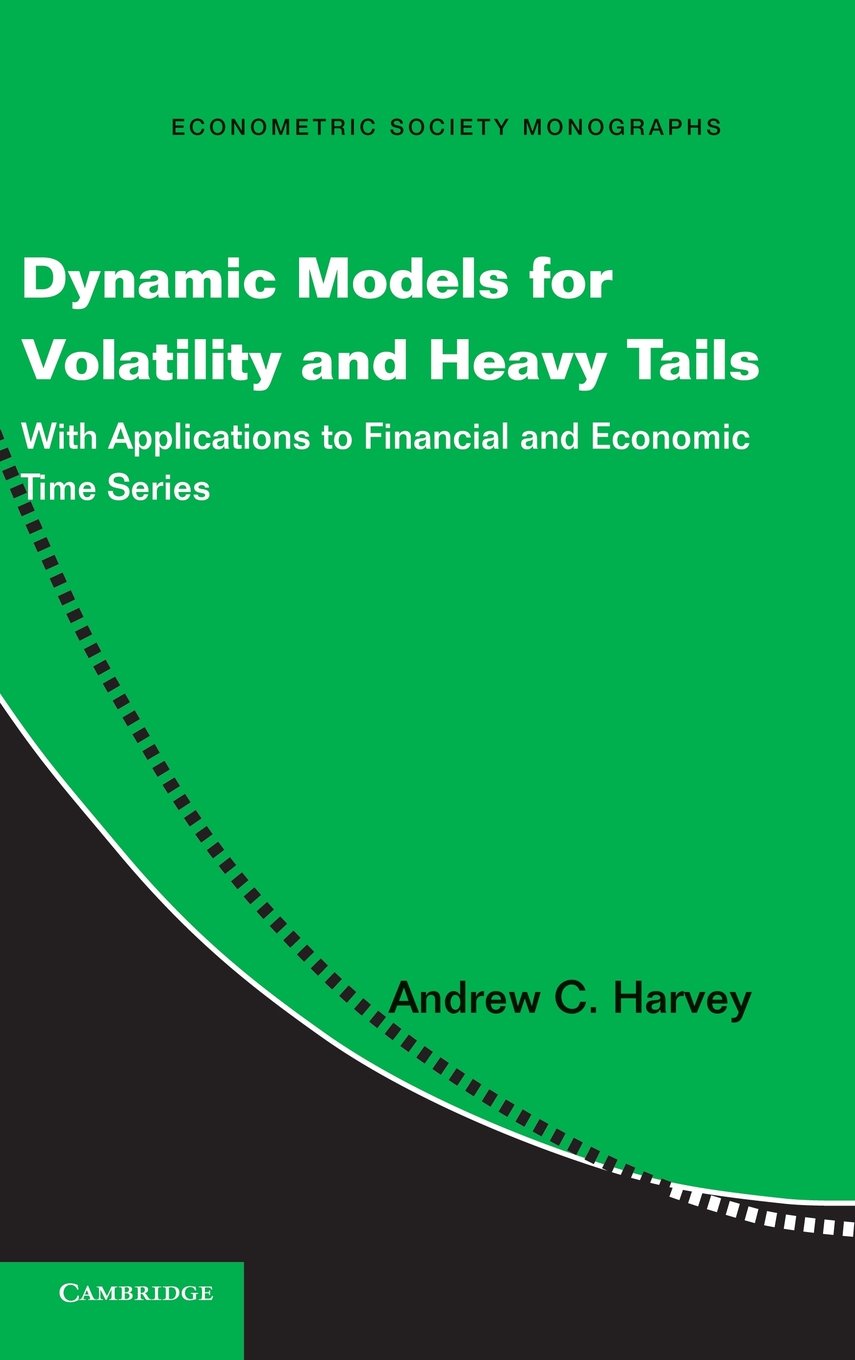
The volatility of financial returns changes over time and, for the last thirty years, Generalized Autoregressive Conditional Heteroscedasticity (GARCH) models have provided the principal means of analyzing, modeling, and monitoring such changes. Taking into account that financial returns typically exhibit heavy tails that is, extreme values can occur from time to time Andrew Harvey's new book shows how a small but radical change in the way GARCH models are formulated leads to a resolution of many of the theoretical problems inherent in the statistical theory. The approach can also be applied to other aspects of volatility, such as those arising from data on the range of returns and the time between trades. Furthermore, the more general class of Dynamic Conditional Score models extends to robust modeling of outliers in the levels of time series and to the treatment of timevarying relationships. As such, there are applications not only to financial data but also to macroeconomic time series and to time series in other disciplines. The statistical theory draws on basic principles of maximum likelihood estimation and, by doing so, leads to an elegant and unified treatment of nonlinear timeseries modeling. The practical value of the proposed models is illustrated by fitting them to real data sets.
⚠️ WARNING (California Proposition 65):
This product may contain chemicals known to the State of California to cause cancer,
birth defects, or other reproductive harm.
For MAP (Minimum Advertised Price) violations and Intellectual Property (IP) or Trademark concerns, please contact:
support@ergodebooks.com
⚠️ California Proposition 65 Warning: Some products sold on this website may expose you to chemicals known to the State of California to cause cancer, birth defects, or other reproductive harm. For more information, visit www.P65Warnings.ca.gov.