
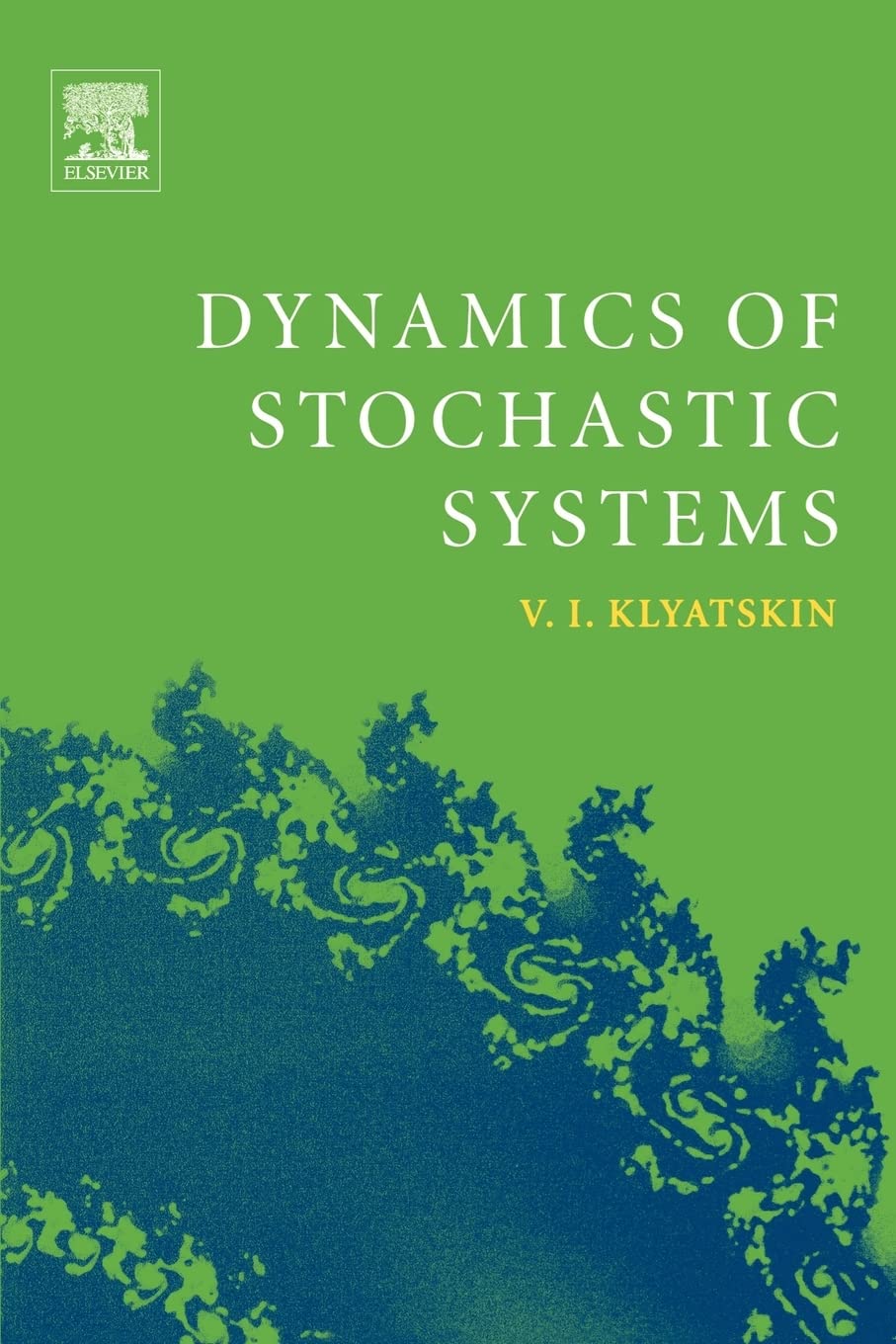
Title
Dynamics Of Stochastic Systems
Sold by Ergodebooks, an authorized reseller.
Returns accepted within 30 days | support@ergodebooks.com
Shipping Information
- Free Standard Shipping — United States only
- Processing Time: 3–5 business days
- Estimated Delivery: 6–10 business days after dispatch
- Double-boxed, fully insured & discreetly packaged
- Tracking number sent via email once dispatched
Returns & Refund
Returns accepted within 30 days of delivery.
Damaged or Defective Item
Free return shipping + replacement or full refund
Wrong Item Received
Free return shipping + replacement or full refund
Change of Mind
Return shipping at customer's expense · 25% restocking fee applies
Payment Option

Fluctuating parameters appear in a variety of physical systems and phenomena. They typically come either as random forces/sources, or advecting velocities, or media (material) parameters, like refraction index, conductivity, diffusivity, etc. The well known example of Brownian particle suspended in fluid and subjected to random molecular bombardment laid the foundation for modern stochastic calculus and statistical physics. Other important examples include turbulent transport and diffusion of particletracers (pollutants), or continuous densities (''oil slicks''), wave propagation and scattering in randomly inhomogeneous media, for instance light or sound propagating in the turbulent atmosphere.Such models naturally render to statistical description, where the input parameters and solutions are expressed by random processes and fields.The fundamental problem of stochastic dynamics is to identify the essential characteristics of system (its state and evolution), and relate those to the input parameters of the system and initial data.This raises a host of challenging mathematical issues. One could rarely solve such systems exactly (or approximately) in a closed analytic form, and their solutions depend in a complicated implicit manner on the initialboundary data, forcing and system's (media) parameters . In mathematical terms such solution becomes a complicated 'nonlinear functional' of random fields and processes.Part I gives mathematical formulation for the basic physical models of transport, diffusion, propagation and develops some analytic tools.Part II sets up and applies the techniques of variational calculus and stochastic analysis, like FokkerPlank equation to those models, to produce exact or approximate solutions, or in worst case numeric procedures. The exposition is motivated and demonstrated with numerous examples.Part III takes up issues for the coherent phenomena in stochastic dynamical systems, described by ordinary and partial differential equations, like wave propagation in randomly layered media (localization), turbulent advection of passive tracers (clustering).Each chapter is appended with problems the reader to solve by himself (herself), which will be a good training for independent investigations.
⚠️ WARNING (California Proposition 65):
This product may contain chemicals known to the State of California to cause cancer, birth defects, or other reproductive harm.
For more information, please visit www.P65Warnings.ca.gov.