
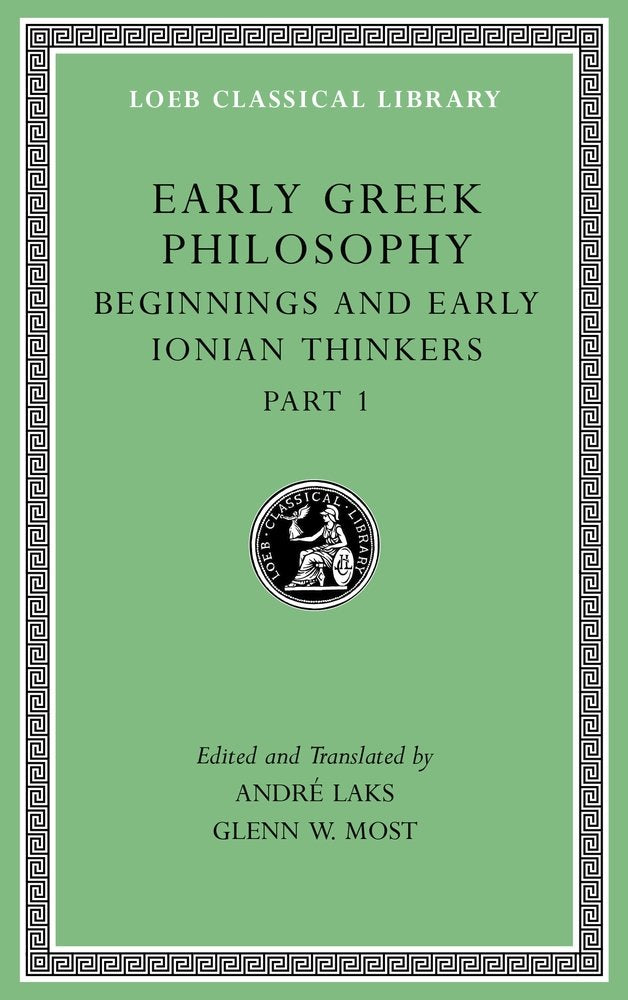
Title
Early Greek Philosophy, Volume II: Beginnings and Early Ionian Thinkers, Part 1 (Loeb Classical Library),New
Sold by Ergodebooks, an authorized reseller.
Returns accepted within 30 days | support@ergodebooks.com
Shipping Information
- Free Standard Shipping — United States only
- Processing Time: 3–5 business days
- Estimated Delivery: 6–10 business days after dispatch
- Double-boxed, fully insured & discreetly packaged
- Tracking number sent via email once dispatched
Returns & Refund
Returns accepted within 30 days of delivery.
Damaged or Defective Item
Free return shipping + replacement or full refund
Wrong Item Received
Free return shipping + replacement or full refund
Change of Mind
Return shipping at customer's expense · 25% restocking fee applies
Payment Option

A major new edition of the socalled Presocratics.The fragments and testimonia of the early Greek philosophers (often labeled the Presocratics) have always been not only a fundamental source for understanding archaic Greek culture and ancient philosophy but also a perennially fresh resource that has stimulated Western thought until the present day. This new systematic conception and presentation of the evidence differs in three ways from Hermann Dielss groundbreaking work, as well as from later editions: it renders explicit the materials thematic organization; it includes a selection from such related bodies of evidence as archaic poetry, classical drama, and the Hippocratic corpus; and it presents an overview of the reception of these thinkers until the end of antiquity.Volume I contains introductory and reference materials essential for using all other parts of the edition.Volume II presents preliminary chapters on ancient doxography, the cosmological and moral background, and includes the early Ionian thinkers Pherecydes, Thales, Anaximander, and Anaximenes.Volume III includes the early Ionian thinkers Xenophanes and Heraclitus.Volume IV presents Pythagoras and the Pythagorean School, including Hippasus, Philolaus, Eurytus, Archytas, Hicetas, and Ecphantus, along with chapters on doctrines not attributed by name and reception.Volume V includes the western Greek thinkers Parmenides, Zeno, Melissus, Empedocles, Alcmaeon, and Hippo.Volume Vi includes the later Ionian and Athenian thinkers Anaxagoras, Archelaus, and Diogenes of Apollonia, along with chapters on early Greek medicine and the Derveni Papyrus.Volume VII includes the atomists Leucippus and Democritus.Volume VIII includes the socalled sophists Protagoras, Gorgias, Prodicus, Thrasymachus, and Hippias, along with testimonia relating to the life, views, and argumentative style of Socrates.Volume IX includes the socalled sophists Antiphon, Lycophron, and Xeniades, along with the Anonymous of Iamblichus, the Dissoi Logoi, a chapter on characterizations of the sophists as a group, and an appendix on philosophy and philosophers in Greek drama.
⚠️ WARNING (California Proposition 65):
This product may contain chemicals known to the State of California to cause cancer, birth defects, or other reproductive harm.
For more information, please visit www.P65Warnings.ca.gov.
- Q: What is the main focus of 'Early Greek Philosophy, Volume II'? A: The book primarily focuses on the early Ionian thinkers and provides a systematic presentation of the fragments and testimonia of early Greek philosophers, exploring their contributions to ancient philosophy and culture.
- Q: Who is the author of this volume? A: The author of 'Early Greek Philosophy, Volume II' is André Laks.
- Q: What is included in the book's content? A: This volume includes preliminary chapters on ancient doxography, a cosmological and moral background, and discussions of early Ionian thinkers such as Pherecydes, Thales, Anaximander, and Anaximenes.
- Q: Is this edition illustrated? A: Yes, this edition of 'Early Greek Philosophy, Volume II' is illustrated.
- Q: How many pages does this book have? A: The book contains a total of 400 pages.
- Q: What type of binding does the book have? A: The book is bound in hardcover.
- Q: When was 'Early Greek Philosophy, Volume II' published? A: The book was published on October 31, 2016.
- Q: What is the condition of the book? A: The item is in new condition.
- Q: What is the significance of the early Greek philosophers discussed in this book? A: The early Greek philosophers, often referred to as Presocratics, are significant as they provide foundational insights into ancient Greek culture and philosophy, influencing Western thought throughout history.
- Q: How does this volume differ from previous editions? A: This edition differs from earlier works by offering a thematic organization of the material, including related evidence from archaic poetry and classical drama, and an overview of the reception of these thinkers up to the end of antiquity.