
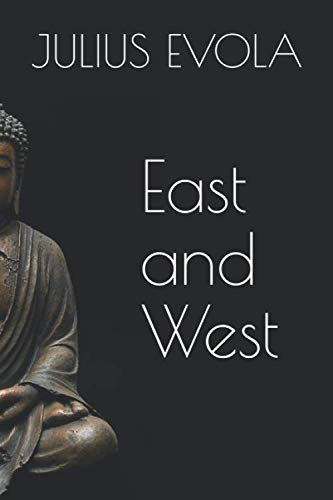
Title
East And West
Sold by Ergodebooks, an authorized reseller.
Returns accepted within 30 days | support@ergodebooks.com
Shipping Information
- Free Standard Shipping — United States only
- Processing Time: 3–5 business days
- Estimated Delivery: 6–10 business days after dispatch
- Double-boxed, fully insured & discreetly packaged
- Tracking number sent via email once dispatched
Returns & Refund
Returns accepted within 30 days of delivery.
Damaged or Defective Item
Free return shipping + replacement or full refund
Wrong Item Received
Free return shipping + replacement or full refund
Change of Mind
Return shipping at customer's expense · 25% restocking fee applies
Payment Option

Julius Evolas Interest In The Eastern Doctrines Dates Back To The Beginning Of His Intellectual Life. His Knowledge Of Philosophy And Of Japanese, Chinese, And Indian Spirituality Was Deep, Thanks To His Ability To Synthesize And Compare Aspects Of Various Western And Eastern Traditions, To Identify Common Issues And Differences Among Them, And To A Thorough Intuitio Intellectualis That Allowed Him To Get To The Root Of These Traditions And Explain To Modern Men What Could Be Learned From Them, Without Treating Them As So Many Superficial, New Age Fashions. With Profound But Clear Writing That Goes Beyond The Limits Of Excessive Specialization, Evola Shows How Similar Doctrines, Philosophies, And Methodologies Were Interpreted In The West And The East: Tantrism, Zen, Buddhism, Yoga, Vednta, The Doctrines Of Svdharma And Hara, And The Relationship Between Eastern Philosophies And Western Philosophers Like Gunon, Eckhart, Schelling, And Heidegger.Praise For Julius Evolai Have Read Julius Evola And I Continue To Read Him . . . He Is What He Is. But, He Sees. Henry De Montherlantevola Is One Of The Most Interesting Minds Of The [World] War Generation. He Has A Really Astounding Knowledge At His Disposal. Mircea Eliade
⚠️ WARNING (California Proposition 65):
This product may contain chemicals known to the State of California to cause cancer, birth defects, or other reproductive harm.
For more information, please visit www.P65Warnings.ca.gov.
- Q: What is the size of the book 'East and West'? A: The book 'East and West' measures six inches in length, zero point four seven inches in width, and nine point zero two inches in height.
- Q: How many pages does 'East and West' have? A: The book 'East and West' has one hundred eighty-five pages.
- Q: What type of binding does 'East and West' have? A: The book 'East and West' is available in paperback binding.
- Q: Who is the author of 'East and West'? A: The author of 'East and West' is Julius Evola.
- Q: What category does the book 'East and West' belong to? A: The book 'East and West' is categorized under Comparative Religion.
- Q: How does one read 'East and West'? A: You can read 'East and West' as an exploration of Eastern doctrines and philosophies compared to Western traditions.
- Q: Is 'East and West' suitable for beginners in philosophy? A: Yes, 'East and West' is suitable for beginners as it presents complex ideas in a clear and profound manner.
- Q: What themes are covered in 'East and West'? A: The book covers themes such as Tantrism, Zen, Buddhism, Yoga, and the relationship between Eastern and Western philosophies.
- Q: How should I care for the book 'East and West'? A: To care for 'East and West', keep it in a dry place away from direct sunlight to prevent damage.
- Q: Is there a specific way to store 'East and West'? A: Yes, store 'East and West' vertically on a shelf to maintain its shape and prevent bending.
- Q: What should I do if 'East and West' arrives damaged? A: If 'East and West' arrives damaged, contact the seller for a return or replacement.
- Q: Can I return 'East and West' if I'm not satisfied? A: Yes, you can return 'East and West' within the specified return window if you are not satisfied with your purchase.
- Q: Is 'East and West' appropriate for children? A: No, 'East and West' is not specifically targeted at children due to its complex philosophical themes.
- Q: How does 'East and West' compare to other books in Comparative Religion? A: Compared to other books in Comparative Religion, 'East and West' offers a unique synthesis of Eastern and Western philosophies.
- Q: What if I have trouble understanding concepts in 'East and West'? A: If you have trouble understanding concepts in 'East and West', consider reading supplementary materials on Eastern and Western philosophies.
- Q: Are there any notable quotes from 'East and West'? A: Yes, notable quotes include praise from figures like Henry de Montherlant and Mircea Eliade, who highlight Evola's insights.