
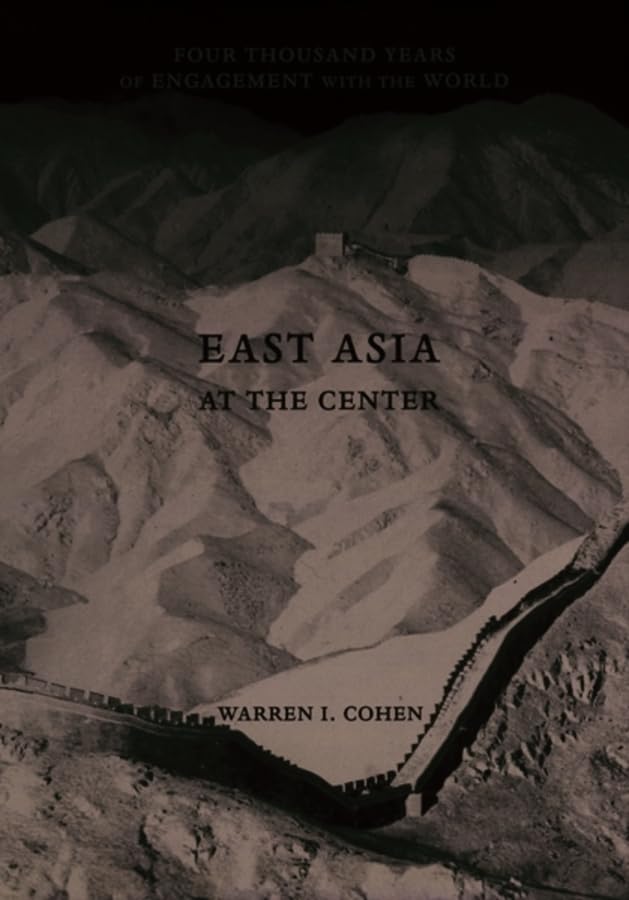
Title
East Asia At The Center
Sold by Ergodebooks, an authorized reseller.
Returns accepted within 30 days | support@ergodebooks.com
Shipping Information
- Free Standard Shipping — United States only
- Processing Time: 3–5 business days
- Estimated Delivery: 6–10 business days after dispatch
- Double-boxed, fully insured & discreetly packaged
- Tracking number sent via email once dispatched
Returns & Refund
Returns accepted within 30 days of delivery.
Damaged or Defective Item
Free return shipping + replacement or full refund
Wrong Item Received
Free return shipping + replacement or full refund
Change of Mind
Return shipping at customer's expense · 25% restocking fee applies
Payment Option

A Common Misconception Holds That Marco Polo Opened Up A Closed And Recalcitrant Orient To The West. However, This Sweeping History Covering 4,000 Years Of International Relations From The Perspective Of China, Japan, Korea, And Southeast Asia Shows That The Region'S Extensive Involvement In World Affairs Began Thousands Of Years Ago.In A Time When The Writing Of History Is Increasingly Specialized, Warren I. Cohen Has Made A Bold Move Against The Grain. In Broad But Revealing Brushstrokes, He Paints A Huge Canvas Of East Asia'S Place In World Affairs Throughout Four Millennia. Just As Cohen Thinks Broadly Across Time, So Too, He Defines The Boundaries Of East Asia Liberally, Looking Beyond China, Japan, And Korea To Include Southeast Asia. In Addition, Cohen Stretches The Scope Of International Relations Beyond Its Usual Limitations To Consider The Vital Role Of Cultural And Economic Exchanges.Within This Vast Framework, Cohen Explores The System Of Chinese Domination In The Ancient World, The Exchanges Between East Asia And The Islamic World From The Thirteenth To The Seventeenth Centuries, And The Emergence Of A Europeandefined International System In The Eighteenth And Nineteenth Centuries. The Book Covers The New Imperialism Of The 1890S, The Manchurian Crisis Of The Early 1930S, The Ascendancy Of Japan, The Trials Of World War Ii, The Drama Of The Cold War, And The Fleeting Asian Century From The Mid1970S To The Mid1990S.East Asia At The Center Is Replete With Oftenoverlooked Or Littleknown Facts, Such As: A Record Of Persistent Chinese Imperialism In The Region Tibet'S Status As A Major Power From The 7Th To The 9Th Centuries C.E., When It Frequently Invaded China And Decimated Chinese Armies Japan'S Profound Dependence On Korea For Its Early Cultural Development The Enormous Influence Of Indian Cuisine On That Of China Egyptian And Ottoman Military Aid To Their Muslim Brethren In India And Sumatra Against European Powers Extensive Chinese Sea Voyages To Arabia And East Africalong Before Such Famous Westerners As Vasco Da Gama And Christopher Columbus Took To The Seaseast Asia At The Center'S Expansive Historical View Puts The Trials And Advances Of The Past Four Millennia Into Perspective, Showing That East Asia Has Often Been Preeminent On The World Stageand Conjecturing That It Might Be So Again In The Notsodistant Future.
⚠️ WARNING (California Proposition 65):
This product may contain chemicals known to the State of California to cause cancer, birth defects, or other reproductive harm.
For more information, please visit www.P65Warnings.ca.gov.
- Q: What are the dimensions of the book 'East Asia at the Center'? A: The book measures five point twenty-five inches in length, one inch in width, and eight inches in height.
- Q: How many pages does 'East Asia at the Center' have? A: The book contains five hundred sixteen pages, providing an in-depth exploration of East Asian history.
- Q: What type of binding does this book have? A: East Asia at the Center is published in paperback binding, making it flexible and portable for readers.
- Q: Who is the author of 'East Asia at the Center'? A: The author of the book is Warren I. Cohen, a noted historian specializing in East Asian studies.
- Q: What is the genre of 'East Asia at the Center'? A: This book falls under the genre of historical non-fiction, focusing on international relations in East Asia.
- Q: How do I read 'East Asia at the Center' effectively? A: To read this book effectively, consider taking notes on key historical events and connections presented in the text.
- Q: Is 'East Asia at the Center' suitable for beginners in history? A: Yes, this book is suitable for beginners, as it provides a broad overview of four thousand years of East Asian history.
- Q: What themes are covered in 'East Asia at the Center'? A: The book explores themes of international relations, cultural exchanges, and the historical significance of East Asia.
- Q: What is the recommended age group for readers of this book? A: The book is suitable for adult readers and older students interested in history and international relations.
- Q: How should I store 'East Asia at the Center' to keep it in good condition? A: Store the book in a cool, dry place, away from direct sunlight to preserve its binding and pages.
- Q: Can I clean the book if it gets dirty? A: Yes, you can gently wipe the cover with a dry cloth to remove dust or smudges without damaging the surface.
- Q: What if the book arrives damaged? A: If the book arrives damaged, contact the retailer for their return policy and procedures for obtaining a replacement.
- Q: Is there a warranty for 'East Asia at the Center'? A: Typically, books do not come with a warranty, but check with the retailer for their specific policies.
- Q: How does this book compare to other histories of East Asia? A: This book provides a unique perspective by covering four thousand years, unlike many histories that focus on shorter timeframes.
- Q: Is 'East Asia at the Center' a good choice for academic studies? A: Yes, it is a great choice for academic studies, as it offers comprehensive insights into East Asia's historical significance.