If you have any questions, you are always welcome to contact us. We'll get back to you as soon as possible, withing 24 hours on weekdays.
Customer service
All questions about your order, return and delivery must be sent to our customer service team by e-mail at yourstore@yourdomain.com
Sale & Press
If you are interested in selling our products, need more information about our brand or wish to make a collaboration, please contact us at press@yourdomain.com
Help
If you have any questions, you are always welcome to contact us. We'll get back to you as soon as possible, withing 24 hours on weekdays.
Customer service
All questions about your order, return and delivery must be sent to our customer service team by e-mail at yourstore@yourdomain.com
Sale & Press
If you are interested in selling our products, need more information about our brand or wish to make a collaboration, please contact us at press@yourdomain.com
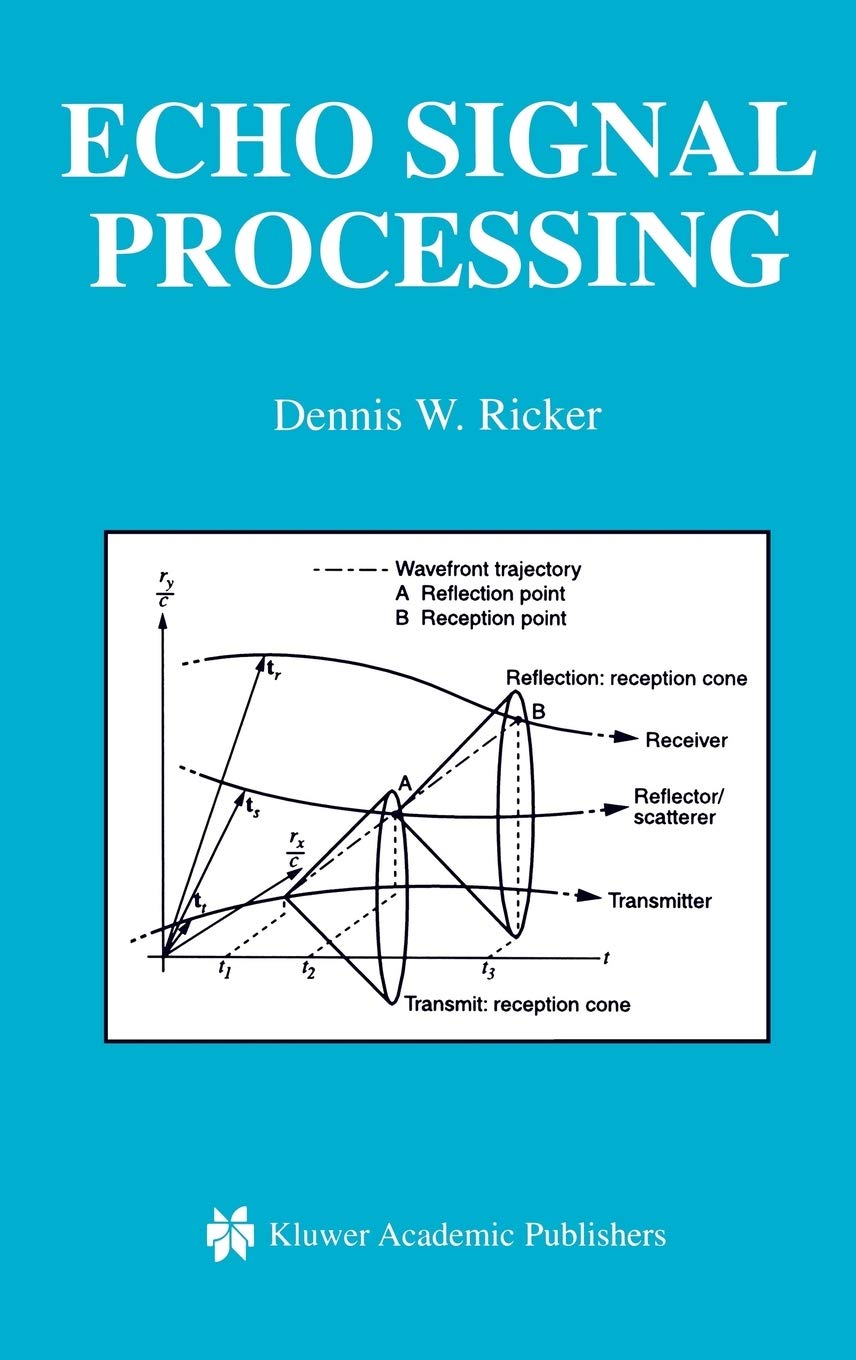
This book presents basic and advanced topics in the areas of sig nal theory and processing as applied to acoustic echolocation (sonar). It is written at the advanced undergraduate or graduate level, and as sumes that the reader is conversant with the concepts and mathematics associated with introductory graduate courses in signal processing such as linear and complex algebra, Fourier analysis, probability, advanced calculus, and linear system theory. The material is presented in a tuto rial fashion as a logical development starting with basic principles and leading to the development of topics in detection and estimation theory, waveform design, echo modeling, scattering theory, and spatial process ing. Examples are provided throughout the book to illustrate impor tant concepts and especially important relationships are boxed. The book addresses the practical aspects of receiver and waveform design, and therefore should be of interest to the practicing engineer as well as the student. Although much of the book is applicable to the general echolocation problem that includes radar, its emphasis is on acoustic echo location especially in regard to time mapping and the wideband or wavelet description of Doppler. Introductory signal theory material is included in the first chapter to provide a foundation for the material covered in the later chapters. A consistent notational convention is ob served throughout the book so that the various mathematical entities are readily identified. This is described in the glossary and symbol list.
⚠️ WARNING (California Proposition 65):
This product may contain chemicals known to the State of California to cause cancer,
birth defects, or other reproductive harm.
For MAP (Minimum Advertised Price) violations and Intellectual Property (IP) or Trademark concerns, please contact:
support@ergodebooks.com
⚠️ California Proposition 65 Warning: Some products sold on this website may expose you to chemicals known to the State of California to cause cancer, birth defects, or other reproductive harm. For more information, visit www.P65Warnings.ca.gov.