
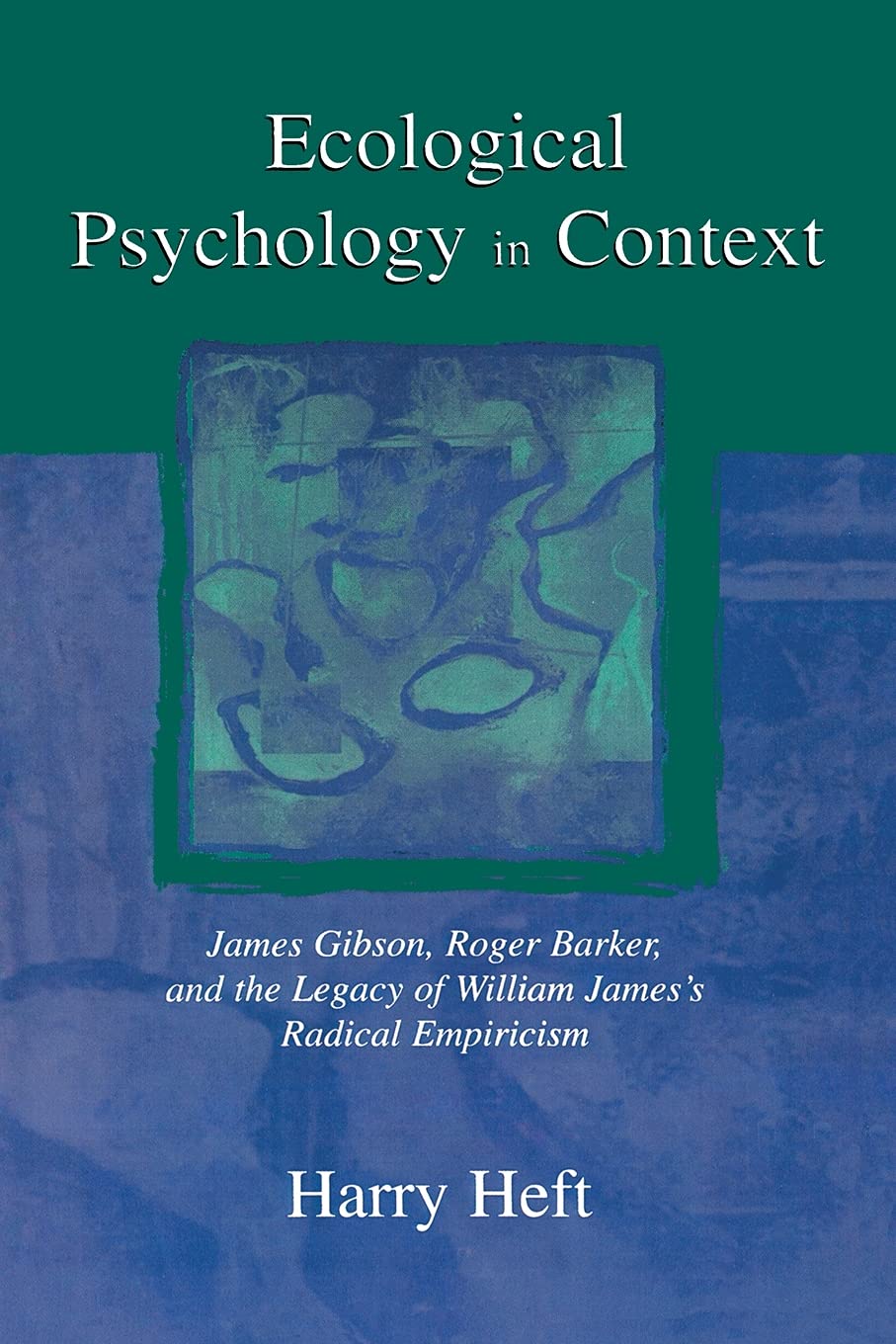
Title
Ecological Psychology In Context: James Gibson, Roger Barker, And The Legacy Of William James,Used
Sold by Ergodebooks, an authorized reseller.
Returns accepted within 30 days | support@ergodebooks.com
Shipping Information
- Free Standard Shipping — United States only
- Processing Time: 3–5 business days
- Estimated Delivery: 6–10 business days after dispatch
- Double-boxed, fully insured & discreetly packaged
- Tracking number sent via email once dispatched
Returns & Refund
Returns accepted within 30 days of delivery.
Damaged or Defective Item
Free return shipping + replacement or full refund
Wrong Item Received
Free return shipping + replacement or full refund
Change of Mind
Return shipping at customer's expense · 25% restocking fee applies
Payment Option

In this book Harry Heft examines the historical and theoretical foundations of James J. Gibson's ecological psychology in 20th century thought, and in turn, integrates ecological psychology and analyses of sociocultural processes. A thesis of the book is that knowing is rooted in the direct experience of meaningful environmental objects and events present in individualenvironment processes and at the level of collective, social settings.Ecological Psychology in Context:*traces the primary lineage of Gibson's ecological approach to William James's philosophy of radical empiricism;*illuminates how the work of James's student and Gibson's mentor, E.B. Holt, served as a catalyst for the development of Gibson's framework and as a bridge to James's work;*reveals how ecological psychology reciprocally can advance Jamesian studies by resolving some of the theoretical difficulties that kept James from fully realizing a realist philosophy;*broadens the scope of Gibson's framework by proposing a synthesis between it and the ecological program of Roger Barker, who discovered complex systems operating at the level of collective, social processes;*demonstrates ways in which the psychological domain can be extended to properties of the environment rendering its features meaningful, publicly accessible, and distributed across personenvironment processes; and*shows how Gibson's work points the way toward overcoming the gap between experimental psychology and the humanities.Intended for scholars and students in the areas of ecological and environmental psychology, theoretical and historical psychology, cognitive science, developmental psychology, anthropology, and philosophy.
⚠️ WARNING (California Proposition 65):
This product may contain chemicals known to the State of California to cause cancer, birth defects, or other reproductive harm.
For more information, please visit www.P65Warnings.ca.gov.