If you have any questions, you are always welcome to contact us. We'll get back to you as soon as possible, withing 24 hours on weekdays.
Customer service
All questions about your order, return and delivery must be sent to our customer service team by e-mail at yourstore@yourdomain.com
Sale & Press
If you are interested in selling our products, need more information about our brand or wish to make a collaboration, please contact us at press@yourdomain.com
Help
If you have any questions, you are always welcome to contact us. We'll get back to you as soon as possible, withing 24 hours on weekdays.
Customer service
All questions about your order, return and delivery must be sent to our customer service team by e-mail at yourstore@yourdomain.com
Sale & Press
If you are interested in selling our products, need more information about our brand or wish to make a collaboration, please contact us at press@yourdomain.com
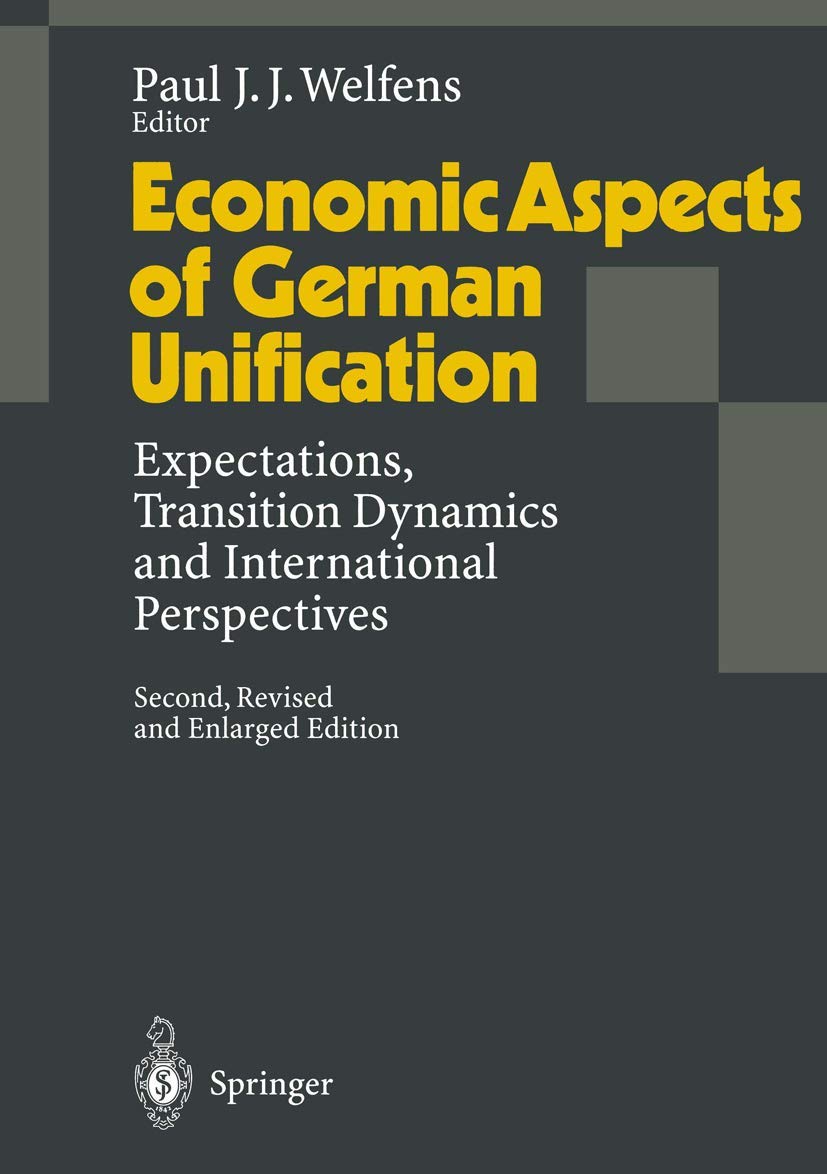
Paul J. J. Welfens The editor is pleased to present a second edition of Economic Aspects of German Unification which includes new chapters and several postscripts. Almost five years after unification output in the exGDR is back to its 1989 level. Due to a massive intraGerman resource transfer consumption per capita in eastern Germany has not fallen as much as output and employment which reduced by onefifth within three years. Given high West German transfers which represented about 5% of West German GDP and more than 50% of East German GDP the fall of industrial output could have been much stronger than had politically been feasible. Hence structural change necessary for productivity growth was dramatic in the exGDR where the goods producing sector (manufacturing, mining, energy and construction) strongly changed its proportions; within four years construction almost doubled, and the share of investment goods production reduced by 10 percentage points between 1990 and 1994 and is now down to 21. 1 %. Mining lost twothirds of its share in the producing sector which itself was reduced relative to GDP. The share of the services industry increased by 5 percentage points between 1991 and 1994, but with a share of 27. 7% in East Germany's GDP it was still about 9 percentage points lower than in western Germany. By contrast, government accounted for 20. 9% of GDP in eastern Germany, but for only 13. 2% in western Germany.
⚠️ WARNING (California Proposition 65):
This product may contain chemicals known to the State of California to cause cancer,
birth defects, or other reproductive harm.
For MAP (Minimum Advertised Price) violations and Intellectual Property (IP) or Trademark concerns, please contact:
support@ergodebooks.com
⚠️ California Proposition 65 Warning: Some products sold on this website may expose you to chemicals known to the State of California to cause cancer, birth defects, or other reproductive harm. For more information, visit www.P65Warnings.ca.gov.