
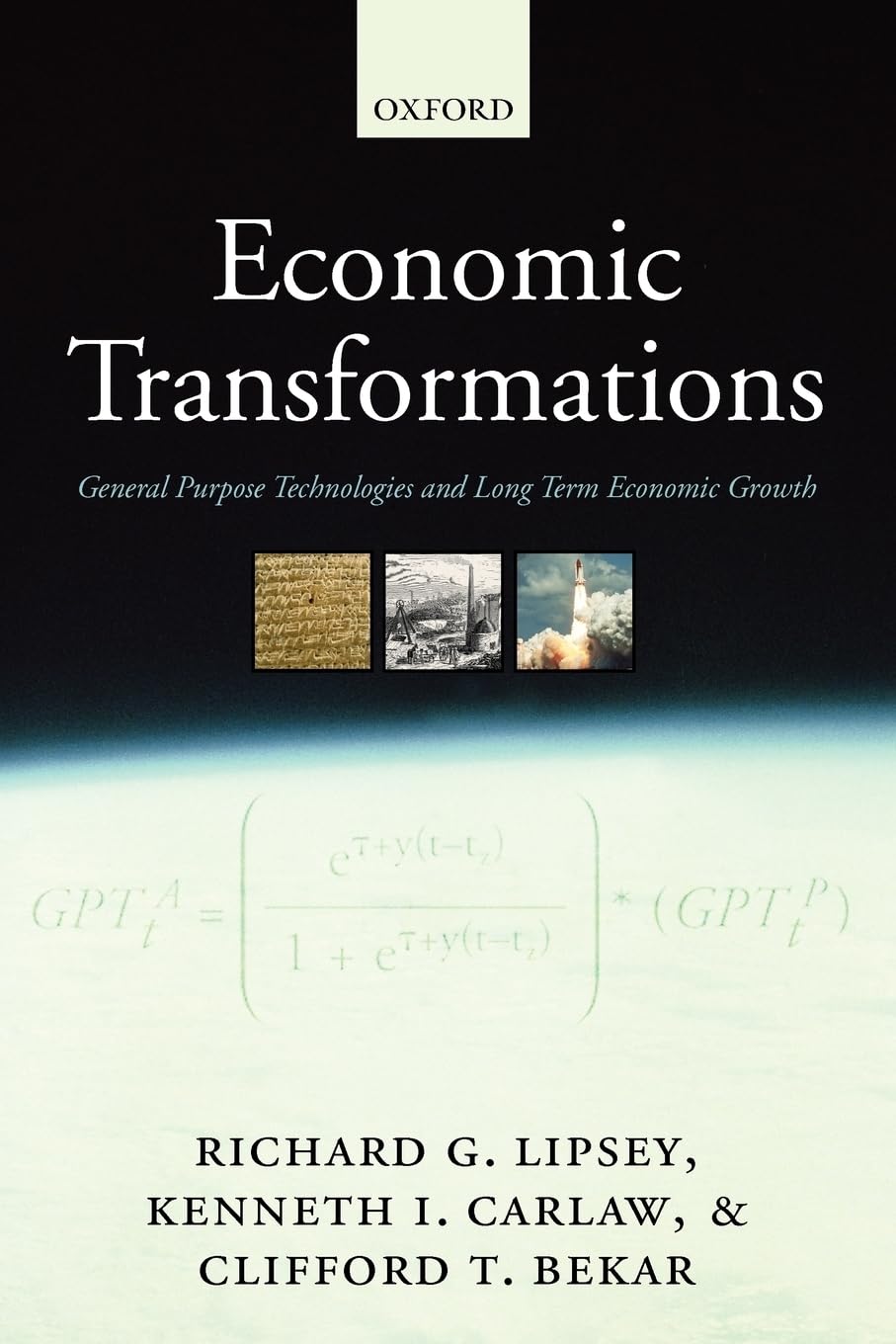
Title
Economic Transformations: General Purpose Technologies and Long Term Economic Growth,Used
Sold by Ergodebooks, an authorized reseller.
Returns accepted within 30 days | support@ergodebooks.com
Shipping Information
- Free Standard Shipping — United States only
- Processing Time: 3–5 business days
- Estimated Delivery: 6–10 business days after dispatch
- Double-boxed, fully insured & discreetly packaged
- Tracking number sent via email once dispatched
Returns & Refund
Returns accepted within 30 days of delivery.
Damaged or Defective Item
Free return shipping + replacement or full refund
Wrong Item Received
Free return shipping + replacement or full refund
Change of Mind
Return shipping at customer's expense · 25% restocking fee applies
Payment Option

This book examines the long term economic growth that has raised the West's material living standards to levels undreamed of by counterparts in any previous time or place. The authors argue that this growth has been driven by technological revolutions that have periodically transformed the West's economic, social and political landscape over the last 10,000 years and allowed the West to become, until recently, the world's only dominant technological force.Unique in the diversity of the analytical techniques used, the book begins with a discussion of the causes and consequences of economic growth and technological change. The authors argue that long term economic growth is largely driven by pervasive technologies now known as General Purpose (GPTs). They establish an alternative to the standard growth models that use an aggregate production function and then introduce the concept of GPTs, complete with a study of how these technologies have transformed the West since the Neolithic Agricultural Revolution. Early modern science is given more importance than in most other treatments and the 19th century demographic revolution is studied with a combination of formal models of population dynamics and historical analysis.The authors argue that once sustained growth was established in the West, formal models can shed much light on its subsequent behavior. They build nonconventional, dynamic, nonstationary equilibrium models of GPTdriven growth that incorporate a range of phenomena that their historical studies show to be important but which are excluded from other GPT models in the interests of analytical tractability. The book concludes with a study of the policy implications that follow from their unique approach.
⚠️ WARNING (California Proposition 65):
This product may contain chemicals known to the State of California to cause cancer, birth defects, or other reproductive harm.
For more information, please visit www.P65Warnings.ca.gov.
- Q: What is the main focus of 'Economic Transformations'? A: The book examines long-term economic growth in the West, attributing it to technological revolutions known as General Purpose Technologies (GPTs) that have transformed society over the last 10,000 years.
- Q: Who are the authors of 'Economic Transformations'? A: The book is authored by Richard G. Lipsey and his collaborators.
- Q: What topics does the book cover regarding economic growth? A: It discusses the causes and consequences of economic growth, the importance of GPTs, and presents alternative growth models that include historical analysis.
- Q: How many pages does 'Economic Transformations' have? A: The book contains 656 pages.
- Q: What type of binding is used for this book? A: The book is available in paperback binding.
- Q: When was 'Economic Transformations' published? A: The book was published on January 5, 2006.
- Q: What edition of the book is available? A: This book is available in its first edition.
- Q: What condition is the book in? A: The book is in new condition.
- Q: Does the book include historical analysis? A: Yes, it combines formal models with historical analysis to explore demographic changes and technological advancements.
- Q: Is 'Economic Transformations' suitable for those studying economic history? A: Yes, it is categorized under Economic History and addresses significant historical economic transformations.