
Title
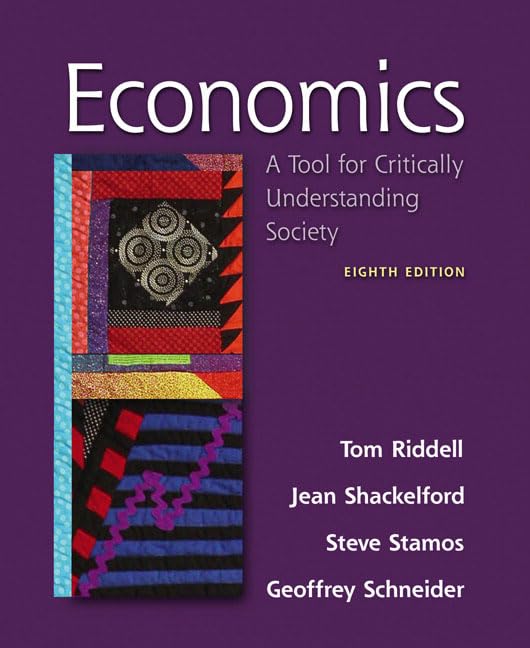
Economics: A Tool For Critically Understanding Society (8Th Edition),Used
Sold by Ergodebooks, an authorized reseller.
Returns accepted within 30 days | support@ergodebooks.com
Shipping Information
- Free Standard Shipping — United States only
- Processing Time: 1–3 business days
- Estimated Delivery: 3–5 business days after dispatch
- Double-boxed, fully insured & discreetly packaged
- Tracking number sent via email once dispatched
- Orders over $250 require signature upon delivery. Taxes calculated at checkout.
Returns & Refund
Returns accepted within 30 days of delivery.
Damaged or Defective Item
Free return shipping + replacement or full refund
Wrong Item Received
Free return shipping + replacement or full refund
Change of Mind
Return shipping at customer's expense · 25% restocking fee applies
Payment Option

Economics: A Tool For Critically Understanding Society Offers A Clear, Simple Introduction To Economic Analysis In A Style That Is Ideal For A Onesemester Introductory Course. The Authors Take A Historical Perspective, Presenting Economic Theories And Their Connections To To A Wide Variety Of Schools Of Thought. The Goal Is To Help Students Use Economic Concepts To Analyze Todays Issues, To Think About Everyday Decisions, And To Examine Their Preconceived Ideas And Beliefs. Economics As A Tool For Critical Thinking In A Changing Global Economy: Economics As A Social Science; Exploring The Emerging Global Economy. Economic History And The Development Of Modern Economic Thought: The Evolution Of Economic Systems; Adam Smith, Classical Liberalism, And The Division Of Labor; Karl Marx And The Socialist Critique Of Capitalism; The Rise And Fall Of Laissezfaire In The U.S. Economy. Microeconomics: Scarcity: You Can'T Always Get What You Want; The Theory Of Markets;Perfect Competition And Efficiency; Noncompetitive Markets And Inefficiency; Resource Markets And The Distribution Of Income; Corporations And Labor Unions; The Economic Role Of Government. Macroeconomics: Macroeconomics: Issues And Problems; Macroeconomic Theory: Classical And Keynesian Models; Fiscal Policy: Government Spending And Taxation; Financial Markets, Money, And Monetary Policy; Aggregate Demand And Aggregate Supply; Unemployment, Inflation, And Stabilization Policy In A Global Economy. International Economics And Finance: International Trade And Interdependence; International Finance; The Economics Of Developing Nations; Economies In Transition. For All Readers Interested In Onesemester Economics.
⚠️ WARNING (California Proposition 65):
This product may contain chemicals known to the State of California to cause cancer, birth defects, or other reproductive harm.
For more information, please visit www.P65Warnings.ca.gov.
- Q: How many pages does this book have? A: This book has six hundred forty-eight pages. It provides a comprehensive overview of economic concepts suitable for a one-semester course.
- Q: What is the binding type of this book? A: The binding type is paperback. This makes it lightweight and easy to carry for students.
- Q: What are the dimensions of this book? A: The dimensions are seven point three two inches in length, zero point nine four inches in width, and nine point one inches in height.
- Q: Who is the author of this book? A: The author is Tom Riddell. He presents economic theories in a clear and engaging manner.
- Q: What edition is this book? A: This is the eighth edition. It has been updated to include contemporary issues in economics.
- Q: What is the primary focus of this book? A: The primary focus is to teach critical thinking through economic analysis. It connects historical perspectives to modern economic challenges.
- Q: Is this book suitable for beginners in economics? A: Yes, this book is suitable for beginners. It offers a simple introduction to economic analysis for students new to the subject.
- Q: Can this book help with understanding global economics? A: Yes, it addresses issues in the emerging global economy. It explores international trade and finance, including economies in transition.
- Q: What topics are covered in the microeconomics section? A: The microeconomics section covers scarcity, market theory, and the role of government. It also discusses resource distribution and corporate impacts.
- Q: What main areas are explored in the macroeconomics section? A: The macroeconomics section explores fiscal policy, monetary policy, and macroeconomic theories. It discusses unemployment, inflation, and stabilization policies.
- Q: How can this book assist in everyday decision-making? A: This book helps readers apply economic concepts to analyze everyday issues. It encourages critical thinking about personal financial decisions.
- Q: What historical perspectives does this book include? A: It includes historical perspectives from Adam Smith to Karl Marx. The book outlines the evolution of economic thought and systems.
- Q: Does this book discuss economic theories from different schools of thought? A: Yes, it presents connections to various schools of thought. This broadens the reader's understanding of economic analysis.
- Q: Is this book appropriate for use in a classroom setting? A: Yes, it is appropriate for classroom use. Its structured content is designed for one-semester introductory courses.
- Q: How should I care for this paperback book? A: To care for this book, keep it stored in a dry place. Avoid exposing it to extreme temperatures to maintain its condition.
- Q: What if the book arrives damaged? A: If the book arrives damaged, you should contact the seller for a return or exchange. Most sellers have policies in place for such issues.
- Q: Is there any specialized support for this book? A: Yes, academic support may be available through your institution. Additionally, the publisher may offer resources for instructors.