If you have any questions, you are always welcome to contact us. We'll get back to you as soon as possible, withing 24 hours on weekdays.
Customer service
All questions about your order, return and delivery must be sent to our customer service team by e-mail at yourstore@yourdomain.com
Sale & Press
If you are interested in selling our products, need more information about our brand or wish to make a collaboration, please contact us at press@yourdomain.com
Help
If you have any questions, you are always welcome to contact us. We'll get back to you as soon as possible, withing 24 hours on weekdays.
Customer service
All questions about your order, return and delivery must be sent to our customer service team by e-mail at yourstore@yourdomain.com
Sale & Press
If you are interested in selling our products, need more information about our brand or wish to make a collaboration, please contact us at press@yourdomain.com
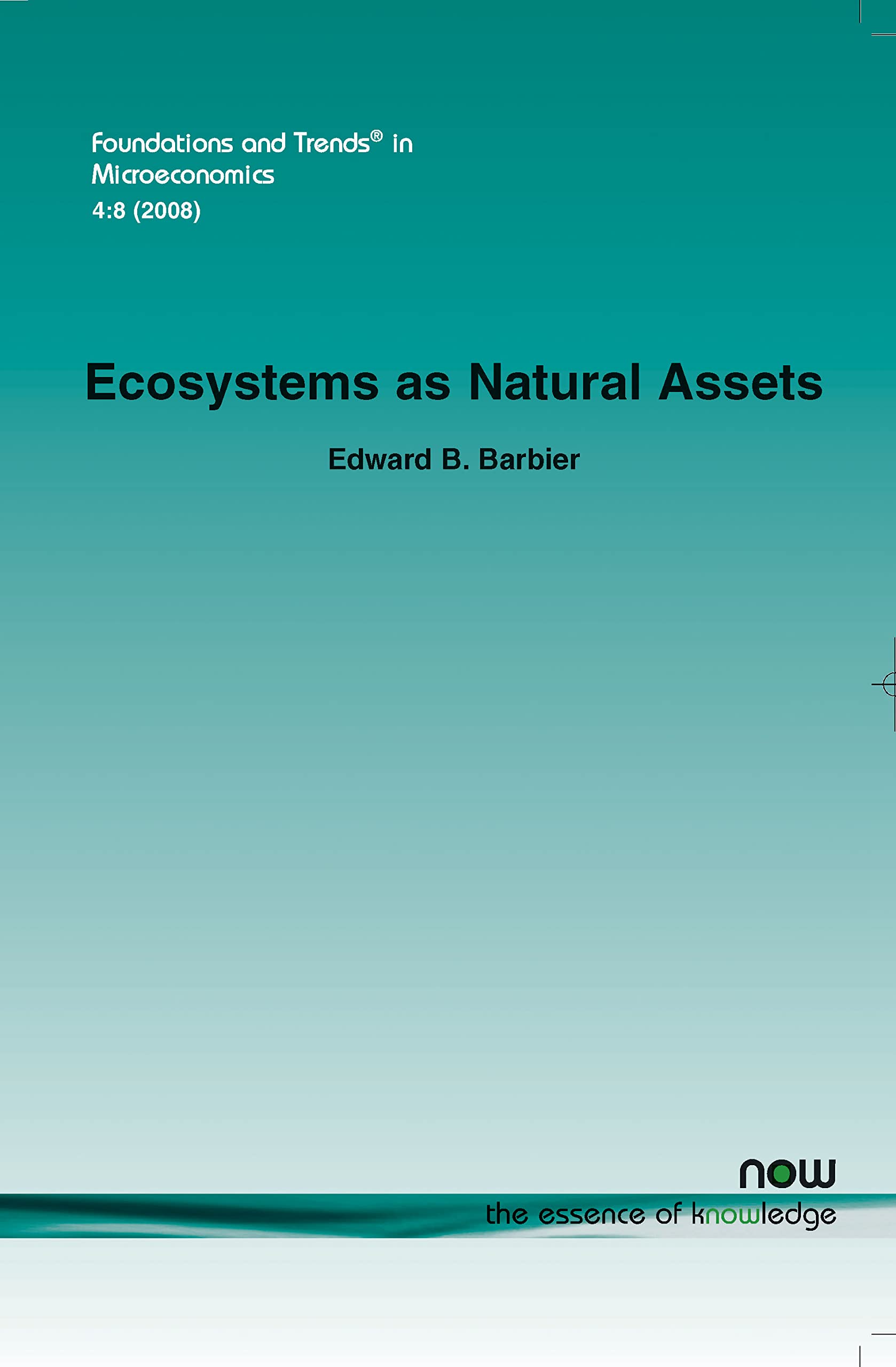
An important contribution of natural resource economics has been to treat the natural environment as a form of capital asset. The more recent literature on ecosystem services implies that these environmental systems can also be viewed as natural assets that produce a flow of beneficial goods and services over time. Ecosystems as Natural Assets explores this literature and related modeling to show explicitly how the concept of ecosystems as natural assets translates into the traditional 'natural capital' approach of resource economics. In Ecosystems as Natural Assets, the author uses ecological landscape, or land area, as the basic unit, therefore modeling the ecosystem as a natural asset is relatively straightforward. The approach is to adopt a much simpler model of land use change. Chapter 2 discusses ecosystem services and ecological landscapes as the basis of representing ecosystems as a natural asset. Chapter 3 develops the basic natural asset model of an ecosystem by employing the competing land use model. Chapter 4 begins by returning the example of coastal landscapes and discusses ecological evidence that the basic functions of these systems are spatially variable. Chapter 5 revisits the basic natural asset model of competing uses of an ecological landscape and extends it to an open economy setting. Chapter 6 extends the basic model to consider the problem of ecological collapse, and shows that more of the ecological landscape will be preserved compared to when the threat of collapse is absent. Chapter 7 presents the conclusions.
⚠️ WARNING (California Proposition 65):
This product may contain chemicals known to the State of California to cause cancer,
birth defects, or other reproductive harm.
For MAP (Minimum Advertised Price) violations and Intellectual Property (IP) or Trademark concerns, please contact:
support@ergodebooks.com
⚠️ California Proposition 65 Warning: Some products sold on this website may expose you to chemicals known to the State of California to cause cancer, birth defects, or other reproductive harm. For more information, visit www.P65Warnings.ca.gov.