

Title
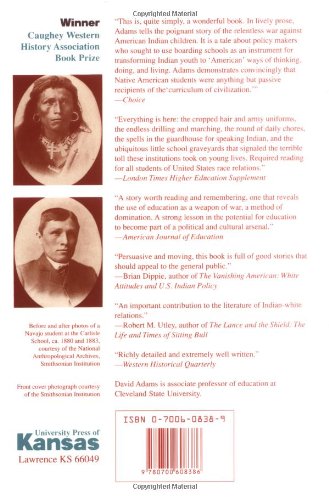
Education For Extinction: American Indians And The Boarding School Experience, 18751928,Used
Sold by Ergodebooks, an authorized reseller.
Returns accepted within 30 days | support@ergodebooks.com
Shipping Information
- Free Standard Shipping — United States only
- Processing Time: 3–5 business days
- Estimated Delivery: 6–10 business days after dispatch
- Double-boxed, fully insured & discreetly packaged
- Tracking number sent via email once dispatched
Returns & Refund
Returns accepted within 30 days of delivery.
Damaged or Defective Item
Free return shipping + replacement or full refund
Wrong Item Received
Free return shipping + replacement or full refund
Change of Mind
Return shipping at customer's expense · 25% restocking fee applies
Payment Option

The Last 'Indian War' Was Fought Against Native American Children In The Dormitories And Classrooms Of Government Boarding Schools. Only By Removing Indian Children From Their Homes For Extended Periods Of Time, Policymakers Reasoned, Could White 'Civilization' Take Root While Childhood Memories Of 'Savagism' Gradually Faded To The Point Of Extinction. In The Words Of One Official: 'Kill The Indian And Save The Man.'Education For Extinction Offers The First Comprehensive Account Of This Dispiriting Effort. Much More Than A Study Of Federal Indian Policy, This Book Vividly Details The Daytoday Experiences Of Indian Youth Living In A 'Total Institution' Designed To Reconstruct Them Both Psychologically And Culturally. The Assault On Identity Came In Many Forms: The Shearing Off Of Braids, The Assignment Of New Names, Uniformed Drill Routines, Humiliating Punishments, Relentless Attacks On Native Religious Beliefs, Patriotic Indoctrinations, Suppression Of Tribal Languages, Victorian Gender Rituals, Football Contests, And Industrial Training.Especially Poignant Is Adams'S Description Of The Ways In Which Students Resisted Or Accommodated Themselves To Forced Assimilation. Many Converted To Varying Degrees, But Others Plotted Escapes, Committed Arson, And Devised Ingenious Strategies Of Passive Resistance. Adams Also Argues That Many Of Those Who Seemingly Cooperated With The System Were More Than Passive Players In This Drama, That The Response Of Accommodation Was Not Synonymous With Cultural Surrender. This Is Especially Apparent In His Analysis Of Students Who Returned To The Reservation. He Reveals The Various Ways In Which Graduates Struggled To Make Sense Of Their Lives And Selectively Drew Upon Their School Experience In Negotiating Personal And Tribal Survival In A World Increasingly Dominated By White Men.The Discussion Comes Full Circle When Adams Reviews The Government'S Gradual Retreat From The Assimilationist Vision. Partly Because Of Persistent Student Resistance, But Also Partly Because Of A Complex And Sometimes Contradictory Set Of Progressive, Humanitarian, And Racist Motivations, Policymakers Did Eventually Come To View Boarding Schools Less Enthusiasticallybased Upon Extensive Use Of Government Archives, Indian And Teacher Autobiographies, And School Newspapers, Adams'S Moving Account Is Essential Reading For Scholars And General Readers Alike Interested In Western History, Native American Studies, American Race Relations, Education History, And Multiculturalism.
⚠️ WARNING (California Proposition 65):
This product may contain chemicals known to the State of California to cause cancer, birth defects, or other reproductive harm.
For more information, please visit www.P65Warnings.ca.gov.
- Q: How many pages does this book have? A: This book contains three hundred eighty-four pages. It offers a comprehensive account of the boarding school experience of American Indian children.
- Q: What is the binding type of this book? A: This book is a paperback edition. The soft cover makes it lightweight and easy to handle.
- Q: What are the dimensions of this book? A: The book measures six point two six inches in length, one point two six inches in width, and nine point two five inches in height. These dimensions make it a suitable size for reading.
- Q: Who is the author of this book? A: The author is David Wallace Adams. He provides a detailed historical account of the boarding school policies affecting Native Americans.
- Q: What genre does this book belong to? A: This book falls under the Native American genre. It explores significant themes related to education and cultural assimilation.
- Q: What is the main theme of the book? A: The main theme revolves around the forced assimilation of Native American children at boarding schools. It highlights the cultural and psychological impacts of these policies.
- Q: Is this book suitable for all ages? A: This book is intended for adults and older teens. It addresses complex historical issues that may not be suitable for younger children.
- Q: How does the author convey the student experiences? A: The author uses firsthand accounts, including autobiographies and school newspapers. This approach provides a vivid depiction of daily life in the boarding schools.
- Q: What kind of resistance did students show? A: Students displayed various forms of resistance, including escape attempts and passive resistance strategies. Their actions highlight their struggle against forced assimilation.
- Q: How can I take care of this book? A: To keep this book in good condition, store it in a dry place and avoid exposure to direct sunlight. Handling it with clean hands can also prevent wear.
- Q: What if the book arrives damaged? A: If the book arrives damaged, you should contact the retailer for a return or exchange policy. Most sellers provide options for returns within a specific timeframe.
- Q: Can I find this book in libraries? A: Yes, many libraries carry this book. It's advisable to check your local library catalog for availability.
- Q: Is this book based on real events? A: Yes, the book is based on real events and historical accounts. It details the actual experiences of Native American children in boarding schools.
- Q: What makes this book essential reading? A: This book is essential for understanding the historical context of Native American education policies. It provides insights into cultural identity and resistance.
- Q: Does this book include references or citations? A: Yes, the book includes extensive references and citations. This adds credibility to the author’s research and findings.