
Title
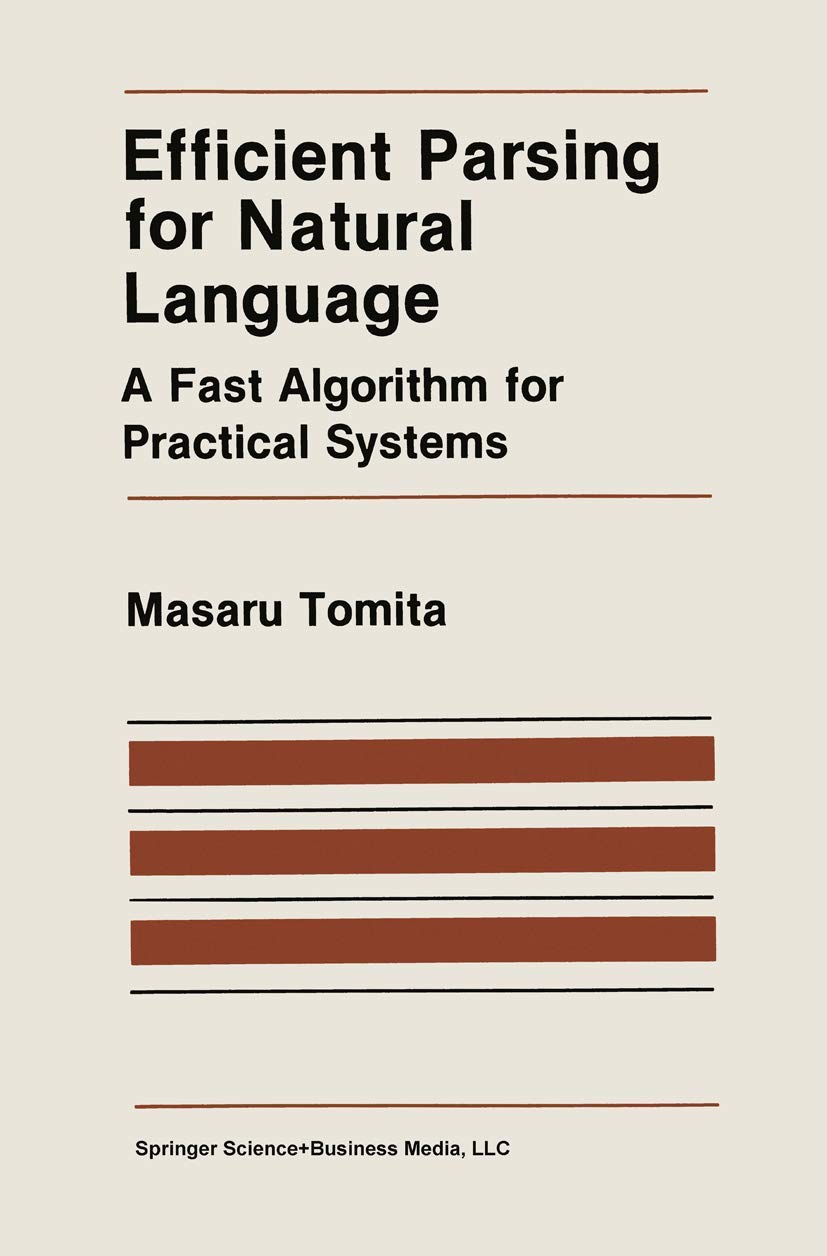
Efficient Parsing for Natural Language: A Fast Algorithm for Practical Systems (The Springer International Series in Engineering,Used
Sold by Ergodebooks, an authorized reseller.
Returns accepted within 30 days | support@ergodebooks.com
Shipping Information
- Free Standard Shipping — United States only
- Processing Time: 3–5 business days
- Estimated Delivery: 6–10 business days after dispatch
- Double-boxed, fully insured & discreetly packaged
- Tracking number sent via email once dispatched
Returns & Refund
Returns accepted within 30 days of delivery.
Damaged or Defective Item
Free return shipping + replacement or full refund
Wrong Item Received
Free return shipping + replacement or full refund
Change of Mind
Return shipping at customer's expense · 25% restocking fee applies
Payment Option

Parsing Efficiency is crucial when building practical natural language systems. 'Ibis is especially the case for interactive systems such as natural language database access, interfaces to expert systems and interactive machine translation. Despite its importance, parsing efficiency has received little attention in the area of natural language processing. In the areas of compiler design and theoretical computer science, on the other hand, parsing algorithms 3 have been evaluated primarily in terms of the theoretical worst case analysis (e.g. lXn, and very few practical comparisons have been made. This book introduces a contextfree parsing algorithm that parses natural language more efficiently than any other existing parsing algorithms in practice. Its feasibility for use in practical systems is being proven in its application to Japanese language interface at Carnegie Group Inc., and to the continuous speech recognition project at CarnegieMellon University. This work was done while I was pursuing a Ph.D degree at CarnegieMellon University. My advisers, Herb Simon and Jaime Carbonell, deserve many thanks for their unfailing support, advice and encouragement during my graduate studies. I would like to thank Phil Hayes and Ralph Grishman for their helpful comments and criticism that in many ways improved the quality of this book. I wish also to thank Steven Brooks for insightful comments on theoretical aspects of the book (chapter 4, appendices A, B and C), and Rich Thomason for improving the linguistic part of tile book (the very beginning of section 1.1).
⚠️ WARNING (California Proposition 65):
This product may contain chemicals known to the State of California to cause cancer, birth defects, or other reproductive harm.
For more information, please visit www.P65Warnings.ca.gov.