If you have any questions, you are always welcome to contact us. We'll get back to you as soon as possible, withing 24 hours on weekdays.
Customer service
All questions about your order, return and delivery must be sent to our customer service team by e-mail at yourstore@yourdomain.com
Sale & Press
If you are interested in selling our products, need more information about our brand or wish to make a collaboration, please contact us at press@yourdomain.com
Help
If you have any questions, you are always welcome to contact us. We'll get back to you as soon as possible, withing 24 hours on weekdays.
Customer service
All questions about your order, return and delivery must be sent to our customer service team by e-mail at yourstore@yourdomain.com
Sale & Press
If you are interested in selling our products, need more information about our brand or wish to make a collaboration, please contact us at press@yourdomain.com
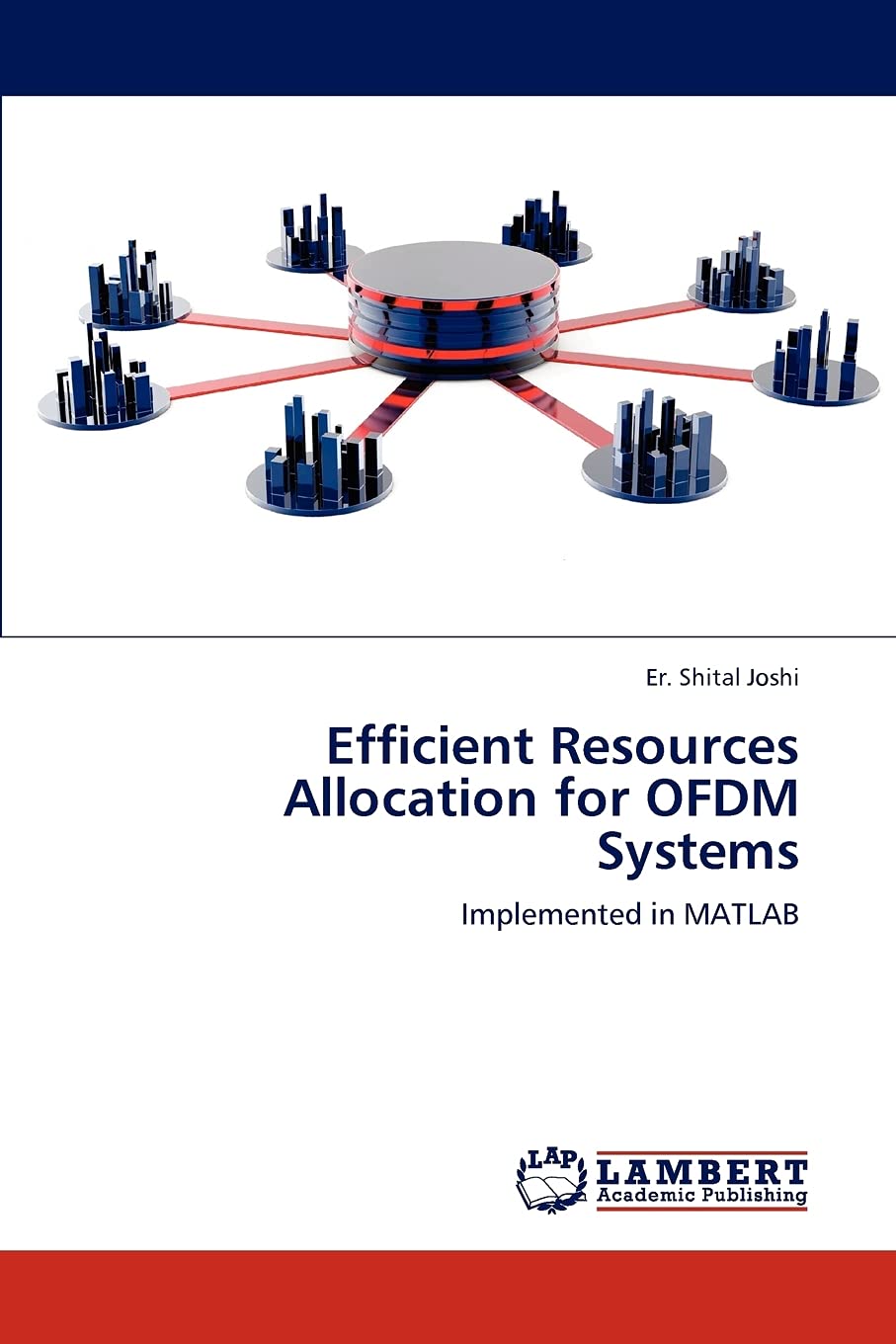
OFDM or Discrete Multitone with Cyclic Prefix is a multicarrier modulation scheme that provides high data rate transmission. It avoids both ISI and ICI by making use of a suitable cyclic extension of the transmitted data stream and allowing for a simple modulator structure. However, it leads to the loss of spectral efficiency. An alternative is OFDM based on OFDM/OQAM modulation that uses efficient pulse shaping instead of a guard interval, which leads to a gain in spectral efficiency. OFDMA base stations allow multiple users to transmit simultaneously on different subcarriers during the same symbol period. Various methods are used for assigning subcarriers and power to different users. The linear method used here, reduces the complexity of resource allocation. Here, to generate OFDM/OQAM symbol, Extended Gaussian function (EGF) and Square Root Raised Cosine (SRRC) pulse shapes are used. The frequency spectra are compared with rectangular pulse shape spectrum. Also in order to carry out the subcarrier allocation and power allocation in OFDMA, a low complexity algorithm is implemented.
⚠️ WARNING (California Proposition 65):
This product may contain chemicals known to the State of California to cause cancer,
birth defects, or other reproductive harm.
For MAP (Minimum Advertised Price) violations and Intellectual Property (IP) or Trademark concerns, please contact:
support@ergodebooks.com
⚠️ California Proposition 65 Warning: Some products sold on this website may expose you to chemicals known to the State of California to cause cancer, birth defects, or other reproductive harm. For more information, visit www.P65Warnings.ca.gov.