
Title
Einstein'S Clocks And Poincare'S Maps: Empires Of Time
Sold by Ergodebooks, an authorized reseller.
Returns accepted within 30 days | support@ergodebooks.com
Shipping Information
- Free Standard Shipping — United States only
- Processing Time: 3–5 business days
- Estimated Delivery: 6–10 business days after dispatch
- Double-boxed, fully insured & discreetly packaged
- Tracking number sent via email once dispatched
Returns & Refund
Returns accepted within 30 days of delivery.
Damaged or Defective Item
Free return shipping + replacement or full refund
Wrong Item Received
Free return shipping + replacement or full refund
Change of Mind
Return shipping at customer's expense · 25% restocking fee applies
Payment Option

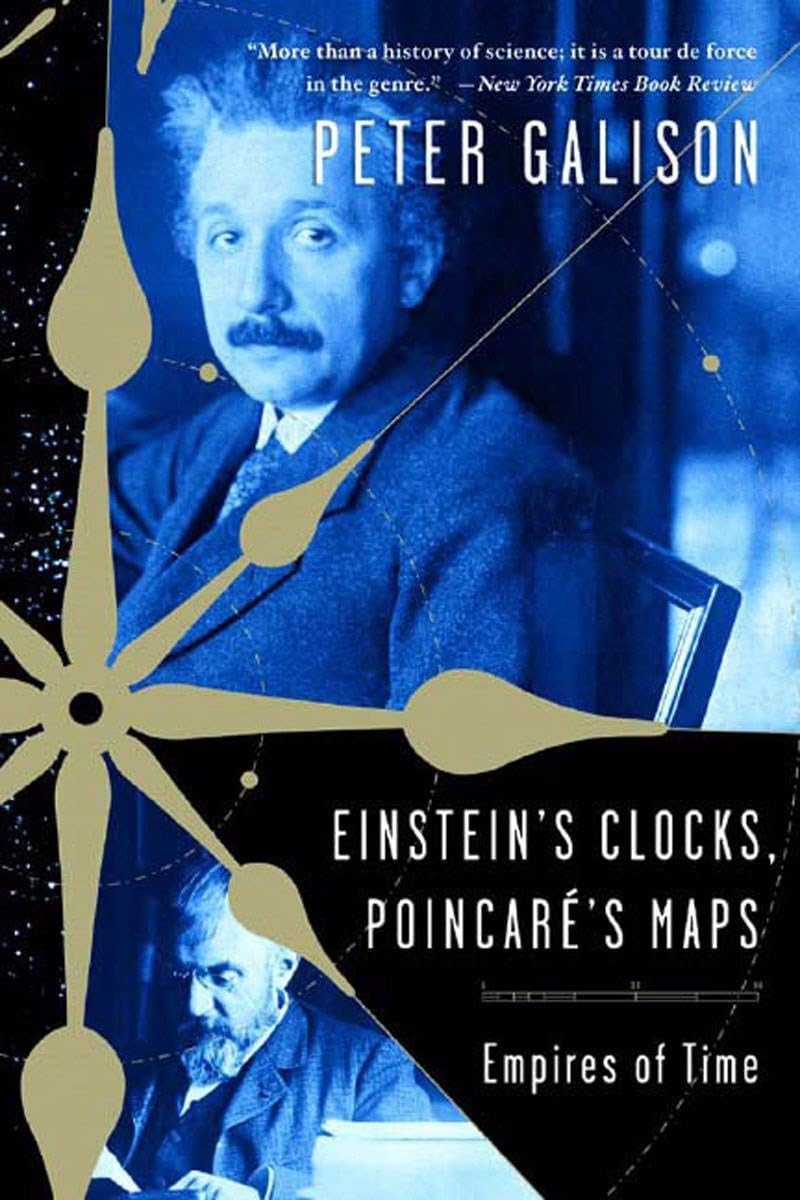
More than a history of science; it is a tour de force in the genre.' New York Times Book ReviewA dramatic new account of the parallel quests to harness time that culminated in the revolutionary science of relativity, Einstein's Clocks, Poincar's Maps is 'part history, part science, part adventure, part biography, part meditation on the meaning of modernity....In Galison's telling of science, the meters and wires and epoxy and solder come alive as characters, along with physicists, engineers, technicians and others.Galison has unearthed fascinating material' (New York Times).Clocks and trains, telegraphs and colonial conquest: the challenges of the late nineteenth century were an indispensable realworld background to the enormous theoretical breakthrough of relativity. And two giants at the foundations of modern science were converging, stepbystep, on the answer: Albert Einstein, an young, obscure German physicist experimenting with measuring time using telegraph networks and with the coordination of clocks at train stations; and the renowned mathematician Henri Poincar, president of the French Bureau of Longitude, mapping time coordinates across continents. Each found that to understand the newly global world, he had to determine whether there existed a pure time in which simultaneity was absolute or whether time was relative.Esteemed historian of science Peter Galison has culled new information from rarely seen photographs, forgotten patents, and unexplored archives to tell the fascinating story of two scientists whose concrete, professional preoccupations engaged them in a silent race toward a theory that would conquer the empire of time.
⚠️ WARNING (California Proposition 65):
This product may contain chemicals known to the State of California to cause cancer, birth defects, or other reproductive harm.
For more information, please visit www.P65Warnings.ca.gov.
- Q: How many pages does the book have? A: The book has three hundred ninety-two pages. This length provides an in-depth exploration of the history and science of time.
- Q: What is the binding type of this book? A: The book is available in paperback binding. This makes it lightweight and easy to handle for reading.
- Q: What are the dimensions of the book? A: The dimensions of the book are five point six inches by one point one inches by eight point two inches. These measurements make it a comfortable fit for most bookshelves.
- Q: How should I read this book? A: You can read this book at your own pace, as it is suitable for general audiences interested in science and history. It provides both narrative and analytical insights.
- Q: Is this book suitable for children? A: Yes, the book is suitable for older children and young adults interested in science. However, parental guidance may be beneficial for younger readers due to complex themes.
- Q: Can I use this book for research purposes? A: Yes, this book is a valuable resource for research. It includes historical accounts and scientific discussions that are well-cited and informative.
- Q: How do I keep this book in good condition? A: To maintain the book's condition, store it in a cool, dry place and avoid exposure to direct sunlight. Handle it carefully to prevent creasing and wear.
- Q: Is this book covered under any warranty? A: No, this book does not come with a warranty. However, you can return it if it arrives damaged or defective.
- Q: How should I clean the book if it gets dirty? A: You can clean the book by gently wiping the cover with a soft, dry cloth. Avoid using liquids that could damage the pages.
- Q: What if I receive a damaged copy of the book? A: If you receive a damaged copy, you should contact the seller for a return or exchange. Most sellers have policies in place for such issues.
- Q: Is this book appropriate for a beginner in science? A: Yes, this book is appropriate for beginners in science. It presents complex ideas in an accessible manner, making it engaging for newcomers.
- Q: Does this book compare to other science history books? A: Yes, this book offers unique insights and a narrative style that sets it apart from other science history books, focusing on time and relativity.
- Q: What themes are explored in this book? A: The book explores themes of time, scientific discovery, and the intersection of science and history through the lives of Einstein and Poincaré.
- Q: Is there a digital version of this book available? A: Yes, a digital version of this book is typically available for purchase on various platforms. Check the publisher's website for details.
- Q: What is the author's background? A: The author, Peter Galison, is an esteemed historian of science known for his work on the history of physics and technology. His expertise enriches the narrative.