If you have any questions, you are always welcome to contact us. We'll get back to you as soon as possible, withing 24 hours on weekdays.
Customer service
All questions about your order, return and delivery must be sent to our customer service team by e-mail at yourstore@yourdomain.com
Sale & Press
If you are interested in selling our products, need more information about our brand or wish to make a collaboration, please contact us at press@yourdomain.com
Help
If you have any questions, you are always welcome to contact us. We'll get back to you as soon as possible, withing 24 hours on weekdays.
Customer service
All questions about your order, return and delivery must be sent to our customer service team by e-mail at yourstore@yourdomain.com
Sale & Press
If you are interested in selling our products, need more information about our brand or wish to make a collaboration, please contact us at press@yourdomain.com
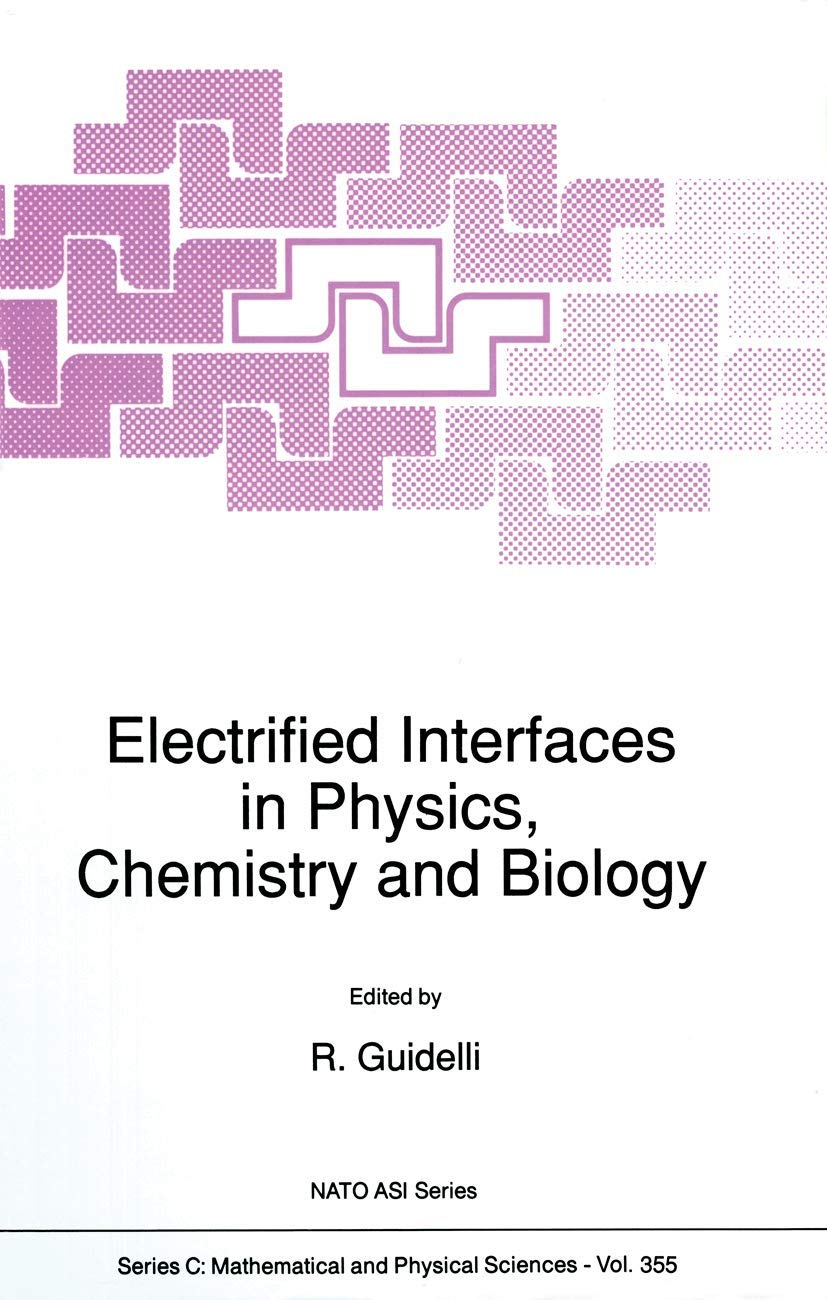
Electrified interfaces span from metaVsemiconductor and metaVelectrolyte interfaces to disperse systems and biological membranes, and are notably important in so many physical, chemical and biological systems that their study has been tackled by researchers with different scientific backgrounds using different methodological approaches. The various electrified interfaces have several common features. The equilibrium distribution of positive and negative ions in an electrolytic solution is governed by the same PoissonBoltzmann equation independent of whether the solution comes into contact with a metal, a colloidal particle or a biomembrane, and the same is true for the equilibrium distribution of free electrons and holes of a semiconductor in contact with a different conducting phase. Evaluation of electric potential differences across biomembranes is based on the same identity of electrochemical potentials which holds for a glass electrode and which yields the Nernst equation when applied to a metal/solution interface. The theory of thermally activated electron tunneling, which was developed by Marcus, Levich, Dogonadze and others to account for electron transfer across metaVelectrolyte interfaces, is also applied to light induced charge separation and proton translocation reactions across intercellular membranes. From an experimental viewpoint, the same electrochemical and in situ spectroscopic techniques can equally well be employed for the study of apparently quite different electrified interfaces.
⚠️ WARNING (California Proposition 65):
This product may contain chemicals known to the State of California to cause cancer,
birth defects, or other reproductive harm.
For MAP (Minimum Advertised Price) violations and Intellectual Property (IP) or Trademark concerns, please contact:
support@ergodebooks.com
⚠️ California Proposition 65 Warning: Some products sold on this website may expose you to chemicals known to the State of California to cause cancer, birth defects, or other reproductive harm. For more information, visit www.P65Warnings.ca.gov.