
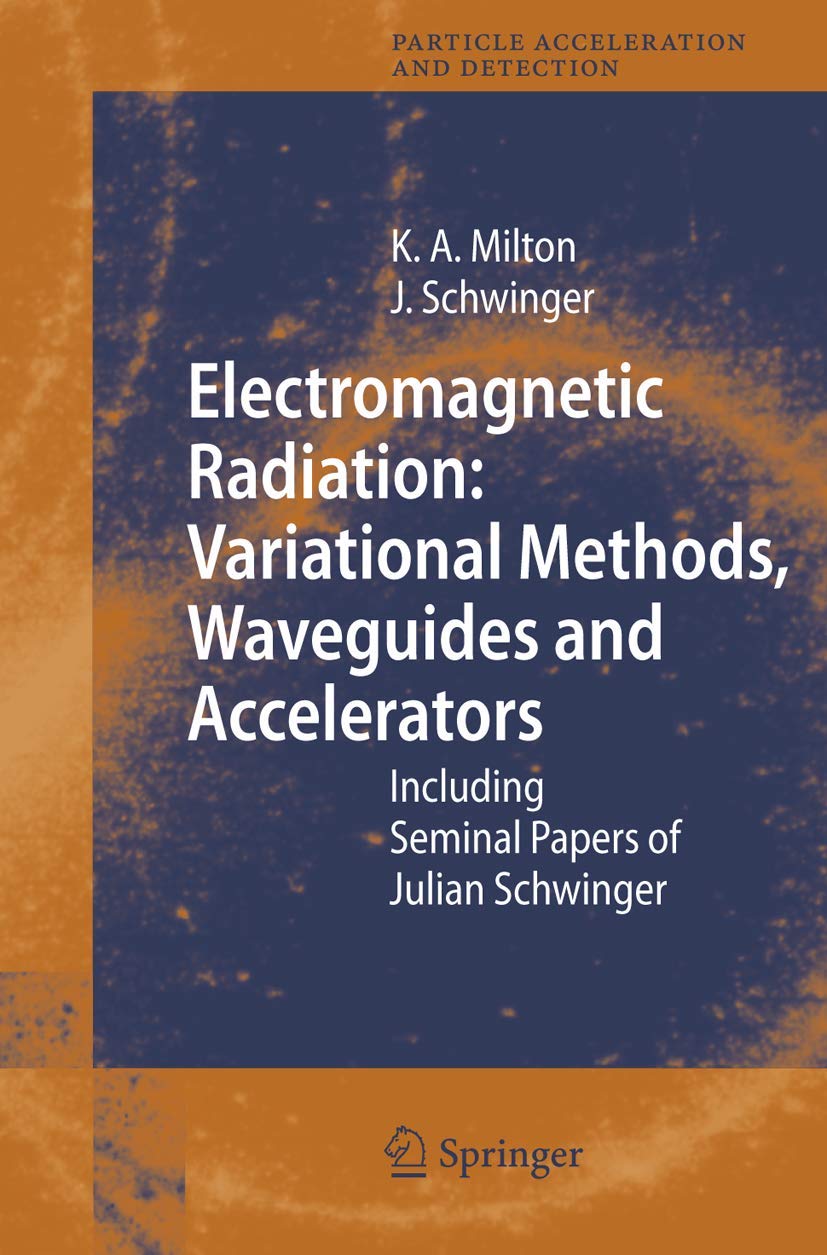
Title
Electromagnetic Radiation: Variational Methods, Waveguides and Accelerators: Including Seminal Papers of Julian Schwinger (Parti,Used
Sold by Ergodebooks, an authorized reseller.
Returns accepted within 30 days | support@ergodebooks.com
Shipping Information
- Free Standard Shipping — United States only
- Processing Time: 3–5 business days
- Estimated Delivery: 6–10 business days after dispatch
- Double-boxed, fully insured & discreetly packaged
- Tracking number sent via email once dispatched
Returns & Refund
Returns accepted within 30 days of delivery.
Damaged or Defective Item
Free return shipping + replacement or full refund
Wrong Item Received
Free return shipping + replacement or full refund
Change of Mind
Return shipping at customer's expense · 25% restocking fee applies
Payment Option

Julian Schwinger was already the worlds leading nuclear theorist when he joined the Radiation Laboratory at MIT in 1943, at the ripe age of 25. Just 2 years earlier he had joined the faculty at Purdue, after a postdoc with OppenheimerinBerkeley,andgraduatestudyatColumbia. Anearlysemester at Wisconsin had con?rmed his penchant to work at night, so as not to have to interact with Breit and Wigner there. He was to perfect his iconoclastic 1 habits in his more than 2 years at the Rad Lab. Despite its deliberately misleading name, the Rad Lab was not involved in nuclear physics, which was imagined then by the educated public as a esoteric science without possible military application. Rather, the subject at hand was the perfection of radar, the beaming and re?ection of microwaves which had already saved Britain from the German onslaught. Here was a technology which won the war, rather than one that prematurely ended it, at a still incalculable cost. It was partly for that reason that Schwinger joined this e?ort, rather than what might have appeared to be the more natural project for his awesome talents, the development of nuclear weapons at Los Alamos. He had got a bit of a taste of that at the Metallurgical Laboratory in Chicago, and did not much like it. Perhaps more important for his decision to go to and stay at MIT during the war was its less regimented and isolated environment.
⚠️ WARNING (California Proposition 65):
This product may contain chemicals known to the State of California to cause cancer, birth defects, or other reproductive harm.
For more information, please visit www.P65Warnings.ca.gov.