
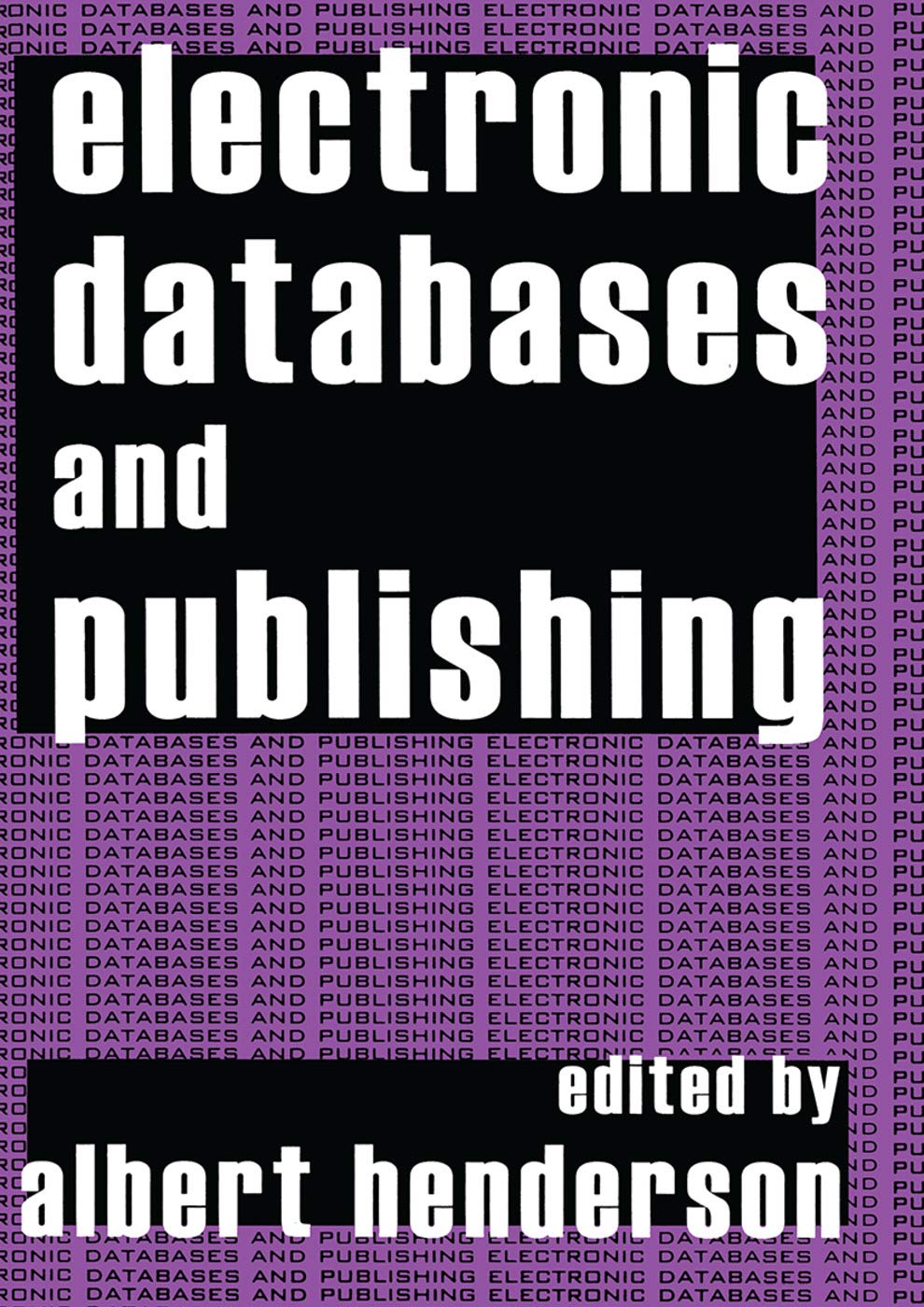
Title
Electronic Databases and Publishing,Used
Sold by Ergodebooks, an authorized reseller.
Returns accepted within 30 days | support@ergodebooks.com
Shipping Information
- Free Standard Shipping — United States only
- Processing Time: 3–5 business days
- Estimated Delivery: 6–10 business days after dispatch
- Double-boxed, fully insured & discreetly packaged
- Tracking number sent via email once dispatched
Returns & Refund
Returns accepted within 30 days of delivery.
Damaged or Defective Item
Free return shipping + replacement or full refund
Wrong Item Received
Free return shipping + replacement or full refund
Change of Mind
Return shipping at customer's expense · 25% restocking fee applies
Payment Option

The true pioneers in electronic publishing put their bibliographic databases on tape and online in the 1960s. Nearly all of them had long experience with compiling information for distribution in printed form and a strong market connection. As a result of Soviet advances in science and space technology, American government support for information science and academic libraries flowed freely for a little over a decade, making possible tremendous advances in technology, in retrieval techniques and in sophisticated coverage. Advances in information technology and market conditions have encouraged many more participants to underwrite the development of databases that now extend into the arts, social sciences, business, and popular interests. These essays show how production statistics accompanied by statements of editorial coverage provide a fairly accurate reflection of output of many of the major disciplinary bibliographic databases. The urgent priority of information resources in the 1960s has encouraged comprehensive servicing of the formal research literature as published in journals and monographs. Authors have counted subject words, languages, origins, types of publication, and so on over several decades. This volume also includes articles on some databases that are not strictly bibliographic, such as the CMG database of college courses, which illuminates some of the changes in college textbook publishing. Information seekers will find the many tables of practical use, as guidance to what and how much may be found within each database. Analysts of publishing, of science policy, and of higher education will find information relevant to expenditures, human resources, and other indicators of education, research, and technology activity.
⚠️ WARNING (California Proposition 65):
This product may contain chemicals known to the State of California to cause cancer, birth defects, or other reproductive harm.
For more information, please visit www.P65Warnings.ca.gov.
- Q: What is the page count of 'Electronic Databases and Publishing'? A: This book has two hundred seventy-eight pages. It provides comprehensive insights into electronic publishing and bibliographic databases.
- Q: What are the dimensions of this book? A: The book measures seven point twenty-five inches in length, one inch in width, and ten point twenty-five inches in height. These dimensions make it a manageable size for reading.
- Q: What type of binding does this book have? A: The book features a paperback binding. This makes it lightweight and easy to handle for reading or reference.
- Q: Who is the author of 'Electronic Databases and Publishing'? A: The author is Albert Henderson. He explores the history and advancements in electronic publishing throughout the years.
- Q: What category does this book fall under? A: This book is categorized under Storage and Retrieval. It focuses on the development of bibliographic databases in various fields.
- Q: How do I use this book for research purposes? A: You can use this book to gain insights into bibliographic databases and their applications in research. The essays provide valuable statistics and editorial coverage information.
- Q: Is this book suitable for beginners in information science? A: Yes, this book is suitable for beginners. It offers foundational knowledge on electronic publishing and the evolution of databases.
- Q: Can I refer to this book for academic studies? A: Yes, this book is an excellent resource for academic studies. It includes relevant data and analysis for students and researchers in information science.
- Q: What is the recommended age group for readers of this book? A: This book is intended for adult audiences. It discusses complex topics relating to information technology and publishing.
- Q: How should I store this book to keep it in good condition? A: Store this book in a cool, dry place away from direct sunlight. Keeping it upright can help maintain its shape and prevent damage.
- Q: What should I do if my book arrives damaged? A: If your book arrives damaged, contact the seller for a return or exchange. Most sellers have policies in place to address such issues.
- Q: Is there a warranty for this book? A: No, there is typically no warranty for books. However, check with the seller for specific return policies.
- Q: How can I clean this book if it gets dirty? A: To clean this book, gently wipe the cover with a soft, dry cloth. Avoid using water or cleaning solutions, as they may damage the pages.
- Q: Can I highlight or write notes in this book? A: Yes, you can highlight or write notes in this book. Many readers find this helpful for study and reference.
- Q: Is 'Electronic Databases and Publishing' relevant for professionals in the publishing industry? A: Yes, it is highly relevant for publishing professionals. The book discusses historical advancements and current practices in electronic publishing.