
Title
Electronic dissipation processes during chemical reactions on surfaces,Used
Sold by Ergodebooks, an authorized reseller.
Returns accepted within 30 days | support@ergodebooks.com
Shipping Information
- Free Standard Shipping — United States only
- Processing Time: 3–5 business days
- Estimated Delivery: 6–10 business days after dispatch
- Double-boxed, fully insured & discreetly packaged
- Tracking number sent via email once dispatched
Returns & Refund
Returns accepted within 30 days of delivery.
Damaged or Defective Item
Free return shipping + replacement or full refund
Wrong Item Received
Free return shipping + replacement or full refund
Change of Mind
Return shipping at customer's expense · 25% restocking fee applies
Payment Option

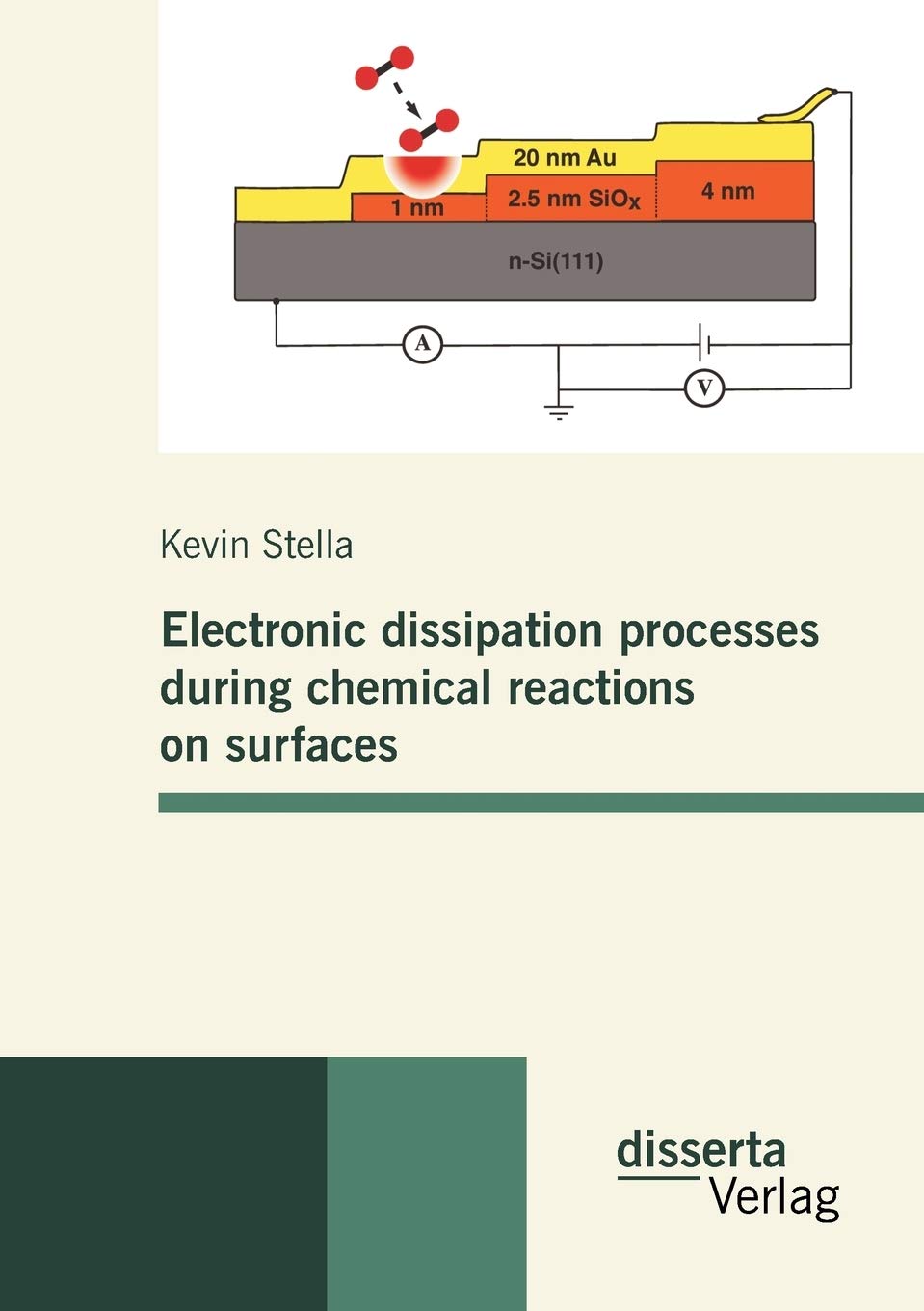
Product Description Every day in our life is larded with a huge number of chemical reactions on surfaces. Some reactions occur immediately, for others an activation energy has to be supplied. Thus it happens that though a reaction should thermodynamically run off, it is kinetically hindered. Meaning the partners react only to the thermodynamically more stable product state within a mentionable time if the activation energy of the reaction is supplied. With the help of catalysts the activation energy of a reaction can be lowered. Such catalytic processes on surfaces are widely used in industry. Around 90% of chemicals are produced via a heterogeneously catalyzed process where a reaction occurs on the surface of a catalyst. However, why is it generally possible that such reactions run off with the help of heterogeneous catalysis, meaning with lower activation energy than without presence of a catalyst? What happens with the energy which is released during a reaction of gas particles on surfaces? How is this energy released, when some part of the energy is transferred to the reactant and some to the chemically active surface? Which physical mechanisms play a key role in the energy transfer? These questions are summarized in the concept of the energy dissipation. To observe this energy dissipation phenomenon, we use a new method, the chemoelectronics. With this method we try to detect the released energy, induced by reactions on surfaces, via thinlayered electronic device elements. An aim of this work is to build up very sensitive chemoelectronic sensors to measure electronic excitations released during such simple reactions of molecules as adsorption and desorption and more complicated reactions as the water formation reaction. Therefore a new line of chemoelectronic sensors is developed and characterized in terms of internal photoemission and stability. Meaning the previously used aluminum (AlAlOxAg) and tantalum based (TaTaOxAu) metalinsulatormetal sensors (MIM) are tested and ne About the Author Kevin Stella (born 1984) studied chemistry at the University of DuisburgEssen and performed a research stay at the University of Liverpool (Electrochemistry project). He accumulated practical experiences in an analytic lab Celanese Chemicals Europe GmbH (Oberhausen). After his prediploma (sehr gut) his effort was awarded with a scholarship from the German National Academic Foundation (Studienstiftung des deutschen Volkes) and the prediploma prize of the chemistry department. After having earned his prediploma he started an extracurricular research project in the field of Physical Chemistry (with Prof. Dr. Eckart Hasselbrink and Dr. Detlef Diesing) which he researched on during his further studies. He finished his chemistry studies with the highest grade (Mit Auszeichnung) and was awarded with the diploma theses prize of the chemistry department. To perform his PhD theses in the lab of Prof. Dr. Eckart Hasselbrink on "Electronic dissipation processes during chemical reactions on surfaces" he was awarded with a scholarship of the German National Academic Foundation and a scholarship of the Fond of the German Chemical Industry (Fonds der Chemischen Industrie). Despite all his dedication for his research and extracurricular business lectures, he mastered to be head of the local chemistry graduate union (GDCh Jungchemikerforum EssenDuisburg), a competitive swimmer and being a swim coach for kids. To acquire more insight into business and its connection with science he joined an intensive MBA programme at the Collge des Ingnieurs in September 2011. In the remaining spare time he enjoys doing more sports, traveling around the world, juggling and playing the Scottish bagpipe.
⚠️ WARNING (California Proposition 65):
This product may contain chemicals known to the State of California to cause cancer, birth defects, or other reproductive harm.
For more information, please visit www.P65Warnings.ca.gov.