
Title
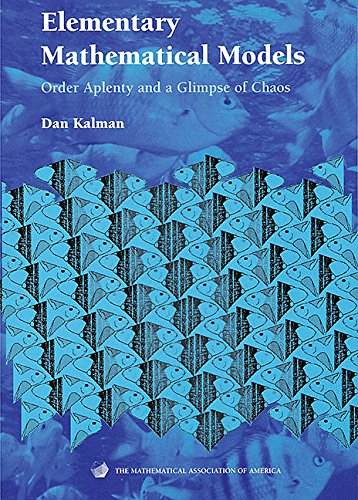
Elementary Mathematical Models: Order Aplenty And A Glimpse Of Chaos (Mathematical Association Of America Textbooks),Used
Sold by Ergodebooks, an authorized reseller.
Returns accepted within 30 days | support@ergodebooks.com
Shipping Information
- Free Standard Shipping — United States only
- Processing Time: 3–5 business days
- Estimated Delivery: 6–10 business days after dispatch
- Double-boxed, fully insured & discreetly packaged
- Tracking number sent via email once dispatched
Returns & Refund
Returns accepted within 30 days of delivery.
Damaged or Defective Item
Free return shipping + replacement or full refund
Wrong Item Received
Free return shipping + replacement or full refund
Change of Mind
Return shipping at customer's expense · 25% restocking fee applies
Payment Option

The Language Of Mathematics Has Proven Over Centuries Of Application To Be An Indispensable Tool For The Expression And Analysis Of Real Problems. With Numerical, Graphical, And Theoretical Methods, This Book Examines The Relevance Of Mathematical Models To Phenomena Ranging From Population Growth And Economics To Medicine And The Physical Sciences. In A Book Written For The Intelligent And Literate Nonmathematician, Kalman Aims At An Understanding Of The Power And Utility Of Quantitative Methods Rather Than At Technical Mastery Of Mathematical Operations. He Shows First That Mathematical Models Can Serve A Critical Function In Understanding The World, And He Concludes With A Discussion Of The Problems Encountered By Traditional Algebraic Assumptions In Chaos Theory. Though Models Can Often Approximate Future Events Based On Existing Data And Quantitative Relationships, Kalman Shows That The Appearance Of Regularity And Order Can Often Be Misleading. By Beginning With Quantitative Models And Ending With An Introduction To Chaos, Kalman Offers A Broad Treatment Of Both The Power And Limitations Of Quantitativelybased Predictions.
⚠️ WARNING (California Proposition 65):
This product may contain chemicals known to the State of California to cause cancer, birth defects, or other reproductive harm.
For more information, please visit www.P65Warnings.ca.gov.
- Q: How many pages are in 'Elementary Mathematical Models'? A: This book contains three hundred sixty-one pages. It offers a comprehensive exploration of mathematical modeling across various fields.
- Q: What is the binding type of this book? A: The binding of this book is paperback. This makes it lightweight and easy to handle for readers.
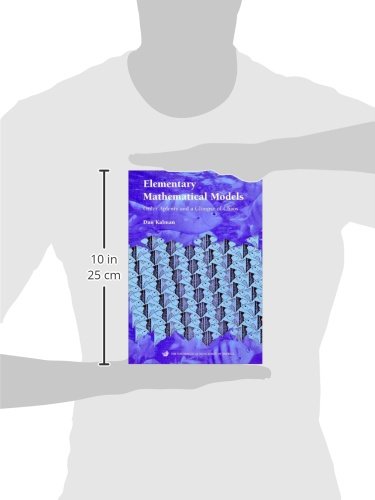
- Q: What are the dimensions of 'Elementary Mathematical Models'? A: The dimensions are seven point five two inches long, one inch wide, and ten point five one inches tall. These dimensions make it a convenient size for reading.
- Q: What age group is this book suitable for? A: This book is suitable for adults and literate teens. It is aimed at intelligent non-mathematicians who want to understand mathematical models.
- Q: Is this book appropriate for beginners in mathematics? A: Yes, it is appropriate for beginners. It emphasizes understanding over technical mastery, making it accessible for those new to the subject.
- Q: Can I use this book to help with real-world problems? A: Yes, it applies mathematical models to real-world phenomena. The book examines topics like population growth, economics, and medicine.
- Q: How should I store this book? A: Store this book in a cool, dry place away from direct sunlight. This will help preserve its condition over time.
- Q: Does this book contain any illustrations or graphs? A: Yes, it includes numerical, graphical, and theoretical methods. This enhances the understanding of mathematical concepts presented.
- Q: How do I clean this book if it gets dirty? A: To clean this book, gently wipe the cover with a dry cloth. Avoid using liquids to prevent damage to the pages.
- Q: What if I receive a damaged copy of the book? A: If you receive a damaged copy, you should contact the seller for a replacement or refund. Most sellers have return policies in place.
- Q: Are there any warranty details for this book? A: Typically, books do not come with a warranty. However, check the seller's policy for specific return options.
- Q: Is this book suitable for advanced mathematics students? A: While it is accessible to beginners, advanced students may find it less challenging. It focuses on understanding rather than advanced technical skills.
- Q: What topics are covered in the book? A: The book covers various topics including mathematical models in chaos theory, population dynamics, and economic analysis. It provides a broad overview of quantitative methods.
- Q: Who is the author of 'Elementary Mathematical Models'? A: The author is Dan Kalman. He is known for his work in mathematics education and modeling.
- Q: Is 'Elementary Mathematical Models' part of a series? A: No, it is a standalone text. It is published by the Mathematical Association of America.