If you have any questions, you are always welcome to contact us. We'll get back to you as soon as possible, withing 24 hours on weekdays.
Customer service
All questions about your order, return and delivery must be sent to our customer service team by e-mail at yourstore@yourdomain.com
Sale & Press
If you are interested in selling our products, need more information about our brand or wish to make a collaboration, please contact us at press@yourdomain.com
Help
If you have any questions, you are always welcome to contact us. We'll get back to you as soon as possible, withing 24 hours on weekdays.
Customer service
All questions about your order, return and delivery must be sent to our customer service team by e-mail at yourstore@yourdomain.com
Sale & Press
If you are interested in selling our products, need more information about our brand or wish to make a collaboration, please contact us at press@yourdomain.com
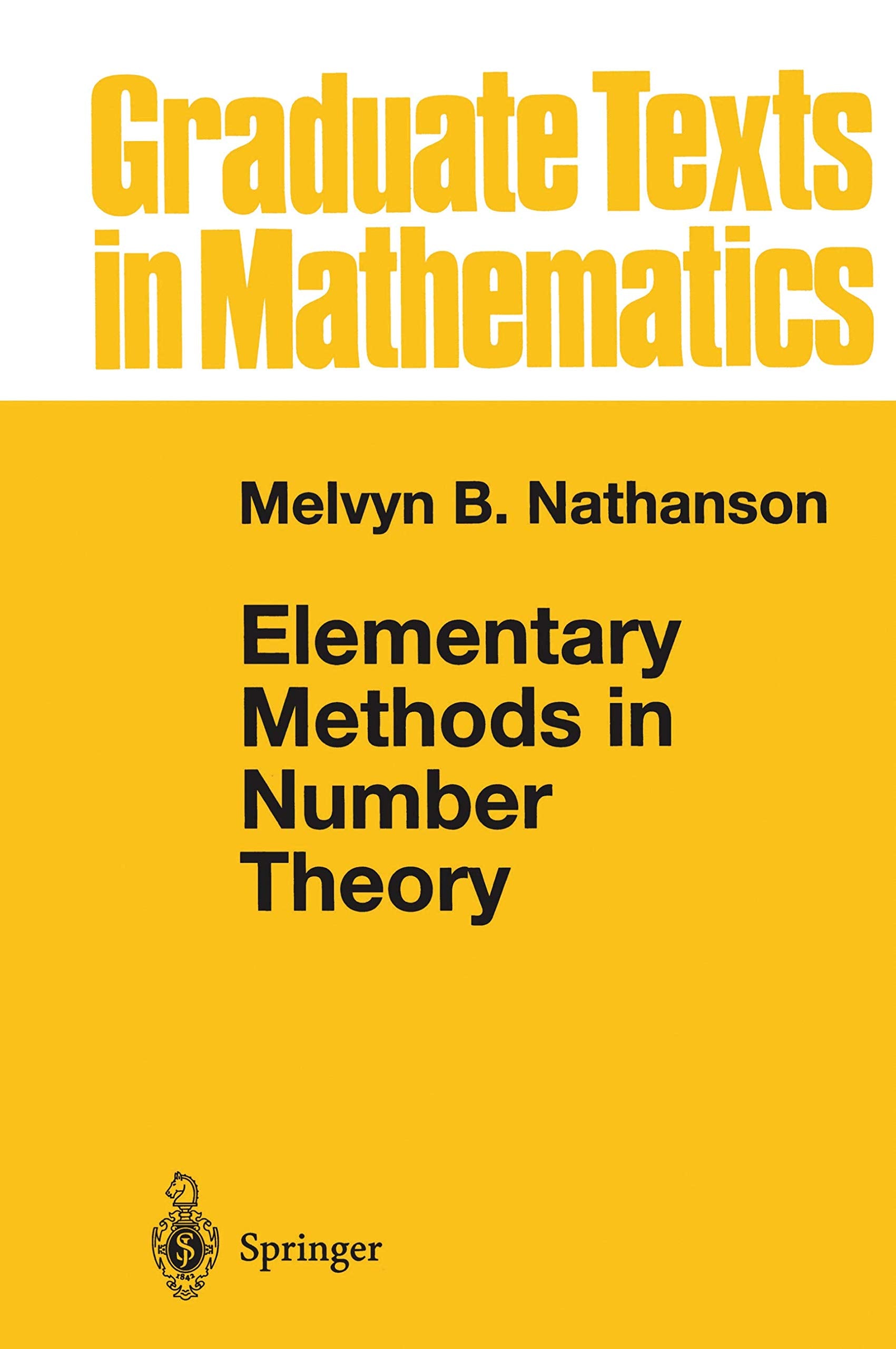
Elementary Methods in Number Theory begins with 'a first course in number theory' for students with no previous knowledge of the subject. The main topics are divisibility, prime numbers, and congruences. There is also an introduction to Fourier analysis on finite abelian groups, and a discussion on the abc conjecture and its consequences in elementary number theory. In the second and third parts of the book, deep results in number theory are proved using only elementary methods. Part II is about multiplicative number theory, and includes two of the most famous results in mathematics: the ErdsSelberg elementary proof of the prime number theorem, and Dirichlets theorem on primes in arithmetic progressions. Part III is an introduction to three classical topics in additive number theory: Warings problems for polynomials, Liouvilles method to determine the number of representations of an integer as the sum of an even number of squares, and the asymptotics of partition functions. Melvyn B. Nathanson is Professor of Mathematics at the City University of New York (Lehman College and the Graduate Center). He is the author of the two other graduate texts: Additive Number Theory: The Classical Bases and Additive Number Theory: Inverse Problems and the Geometry of Sumsets.
⚠️ WARNING (California Proposition 65):
This product may contain chemicals known to the State of California to cause cancer,
birth defects, or other reproductive harm.
For MAP (Minimum Advertised Price) violations and Intellectual Property (IP) or Trademark concerns, please contact:
support@ergodebooks.com
⚠️ California Proposition 65 Warning: Some products sold on this website may expose you to chemicals known to the State of California to cause cancer, birth defects, or other reproductive harm. For more information, visit www.P65Warnings.ca.gov.