
Title
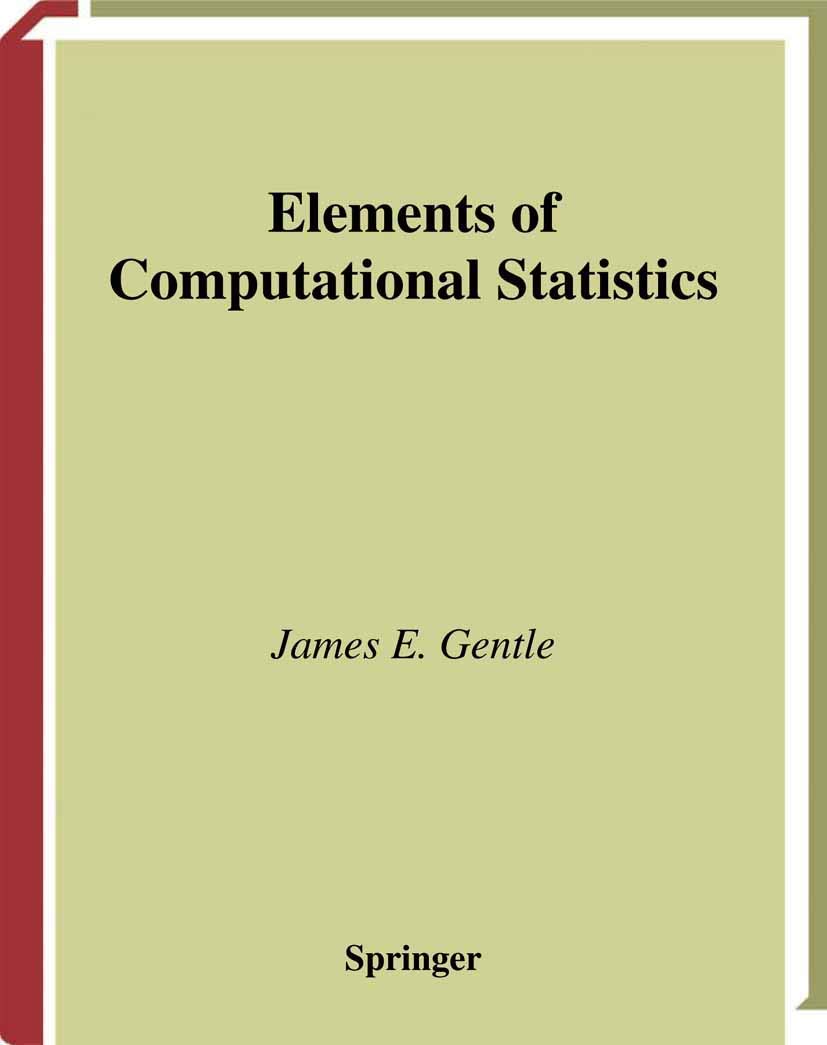
Elements of Computational Statistics (Statistics and Computing),Used
Sold by Ergodebooks, an authorized reseller.
Returns accepted within 30 days | support@ergodebooks.com
Shipping Information
- Free Standard Shipping — United States only
- Processing Time: 3–5 business days
- Estimated Delivery: 6–10 business days after dispatch
- Double-boxed, fully insured & discreetly packaged
- Tracking number sent via email once dispatched
Returns & Refund
Returns accepted within 30 days of delivery.
Damaged or Defective Item
Free return shipping + replacement or full refund
Wrong Item Received
Free return shipping + replacement or full refund
Change of Mind
Return shipping at customer's expense · 25% restocking fee applies
Payment Option

In recent years developments in statistics have to a great extent gone hand in hand with developments in computing. Indeed, many of the recent advances in statistics have been dependent on advances in computer science and techn ogy. Many of the currently interesting statistical methods are computationally intensive, eitherbecausetheyrequireverylargenumbersofnumericalcompu tions or because they depend on visualization of many projections of the data. The class of statistical methods characterized by computational intensity and the supporting theory for such methods constitute a discipline called com tational statistics. (Here, I am following Wegman, 1988, and distinguishing computationalstatisticsfromstatisticalcomputing, whichwetaketomean computational methods, including numerical analysis, for statisticians.) The computationallyintensive methods of modern statistics rely heavily on the developments in statistical computing and numerical analysis generally. Computational statistics shares two hallmarks with other computational sciences, such as computational physics, computational biology, and so on. One is a characteristic of the methodology: it is computationally intensive. The other is the nature of the tools of discovery. Tools of the scienti?c method have generally been logical deduction (theory) and observation (experimentation). The computer, used to explore large numbers of scenarios, constitutes a new type of tool. Use of the computer to simulate alternatives and to present the research worker with information about these alternatives is a characteristic of thecomputationalsciences. Insomewaysthisusageisakintoexperimentation. The observations, however, are generated from an assumed model, and those simulated data are used toevaluate and study the model.
⚠️ WARNING (California Proposition 65):
This product may contain chemicals known to the State of California to cause cancer, birth defects, or other reproductive harm.
For more information, please visit www.P65Warnings.ca.gov.