
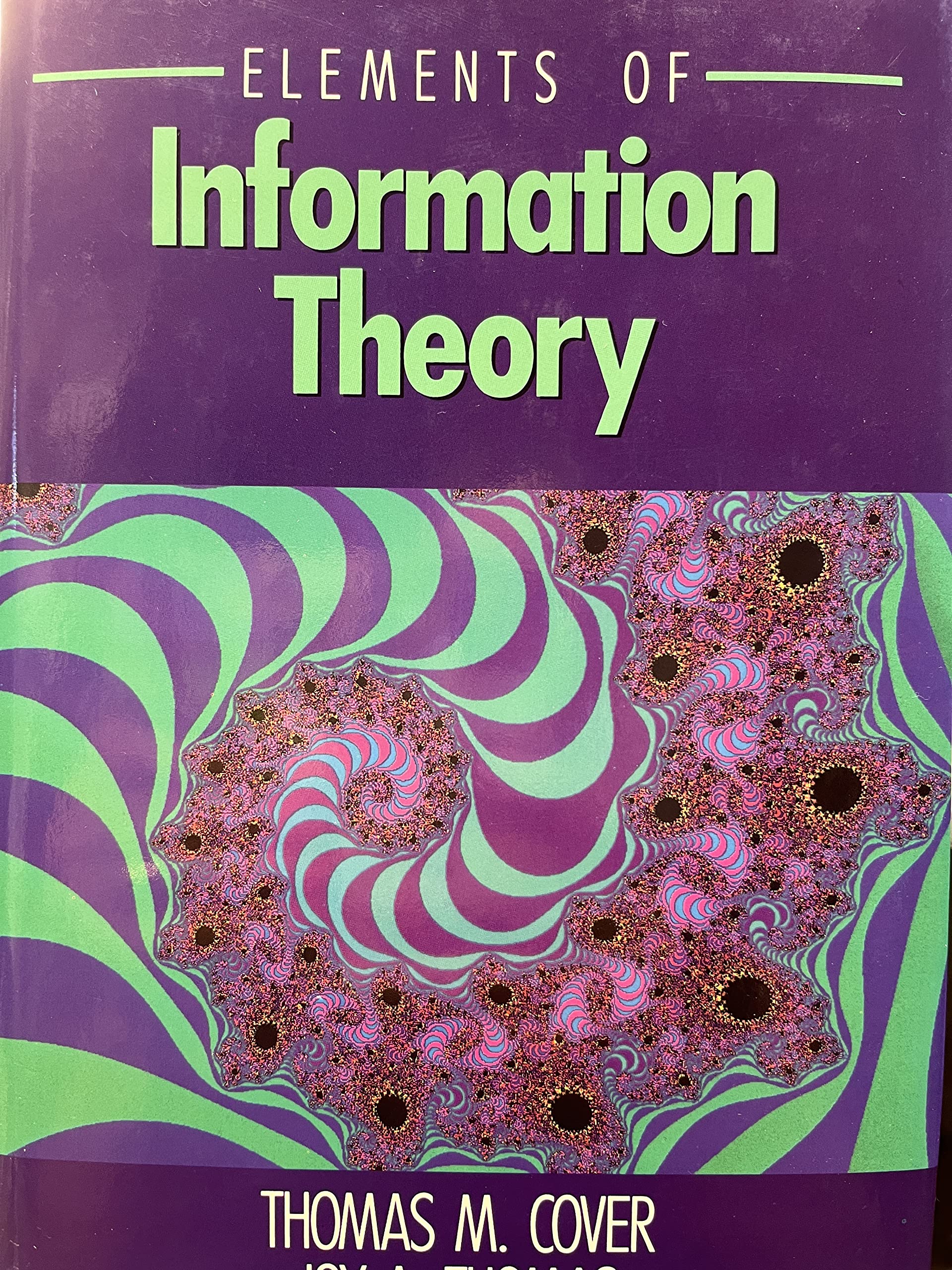
Title
Elements of Information Theory (Wiley Series in Telecommunications and Signal Processing),Used
Sold by Ergodebooks, an authorized reseller.
Returns accepted within 30 days | support@ergodebooks.com
Shipping Information
- Free Standard Shipping — United States only
- Processing Time: 3–5 business days
- Estimated Delivery: 6–10 business days after dispatch
- Double-boxed, fully insured & discreetly packaged
- Tracking number sent via email once dispatched
Returns & Refund
Returns accepted within 30 days of delivery.
Damaged or Defective Item
Free return shipping + replacement or full refund
Wrong Item Received
Free return shipping + replacement or full refund
Change of Mind
Return shipping at customer's expense · 25% restocking fee applies
Payment Option

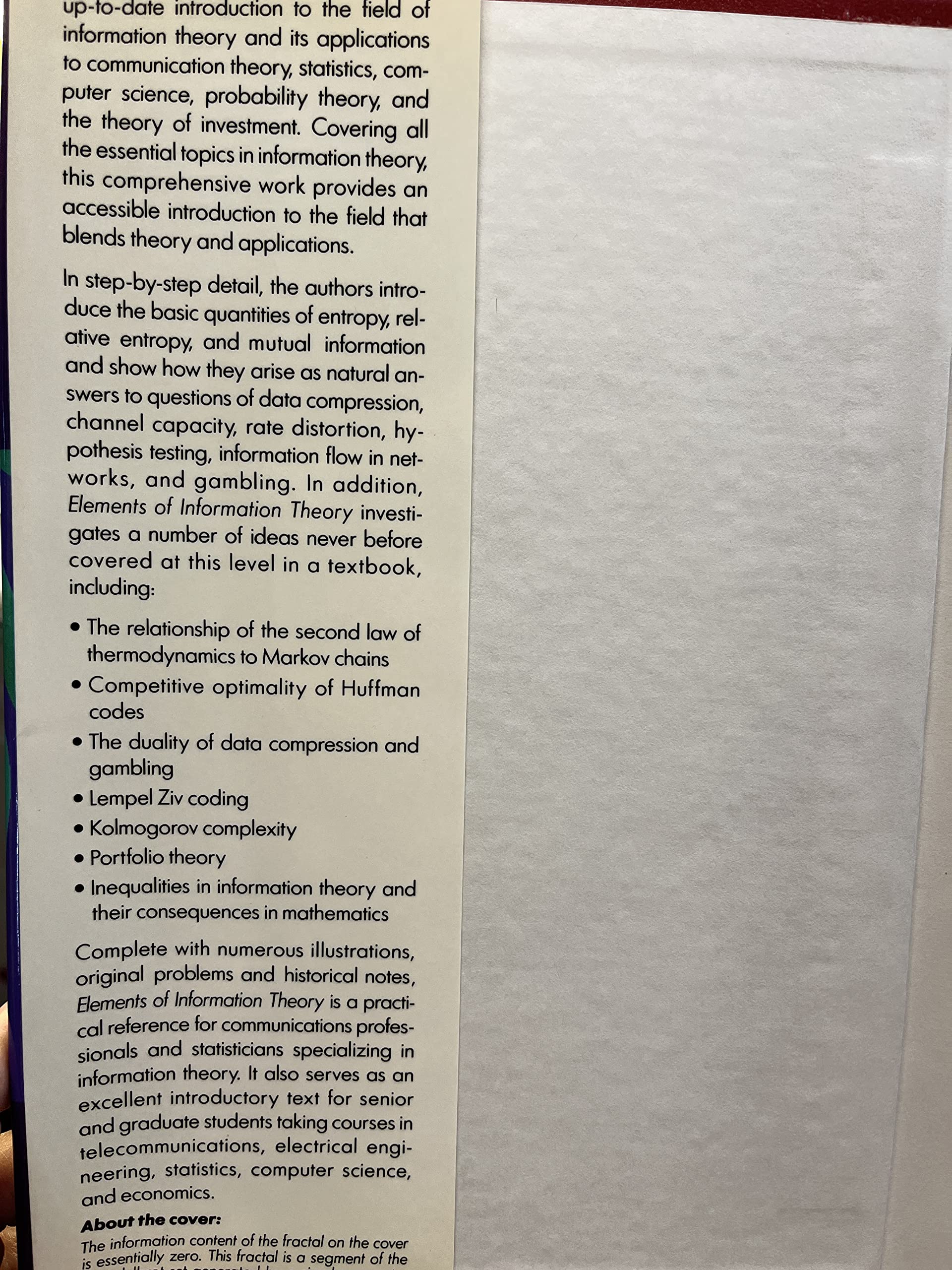
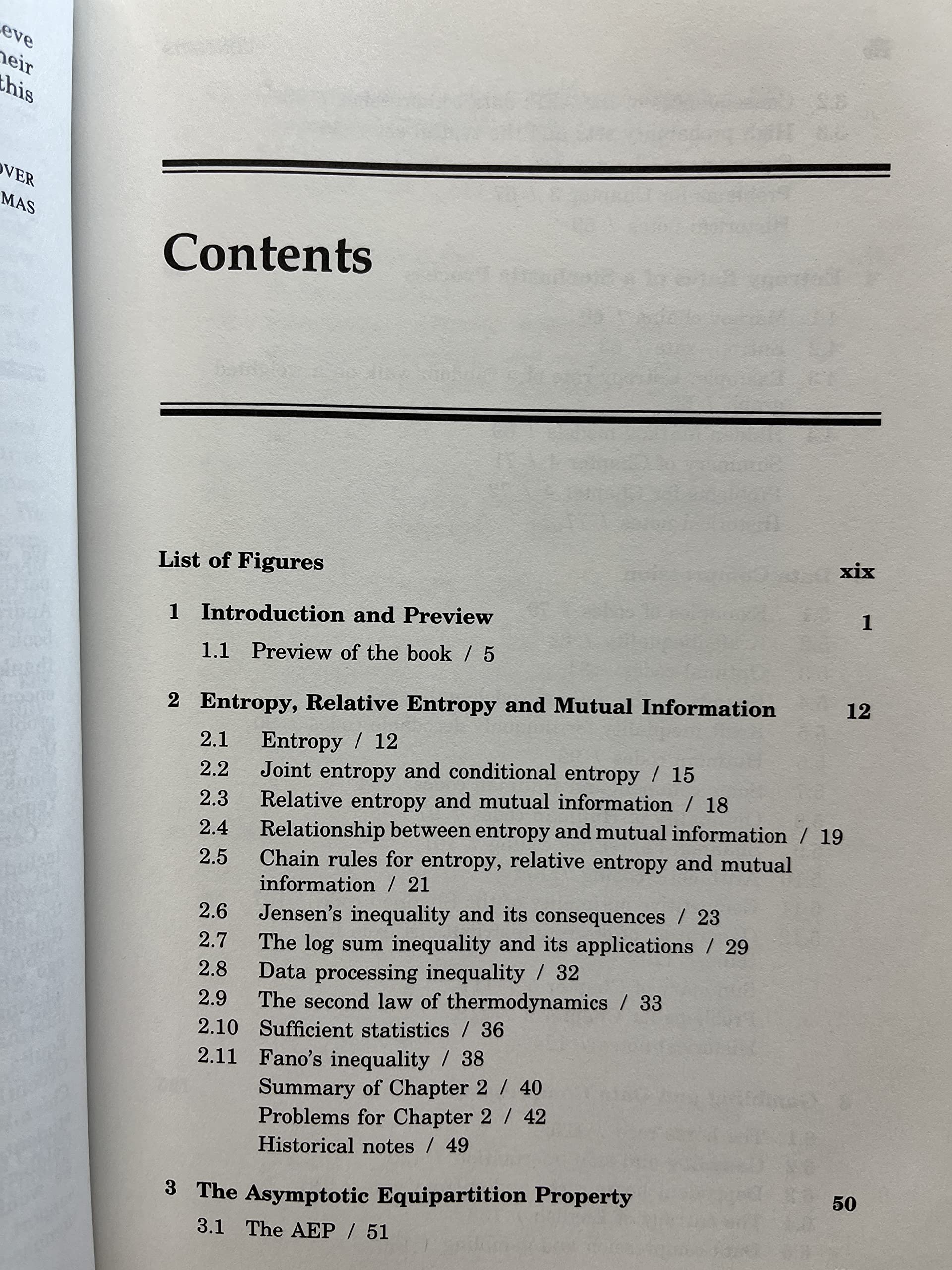
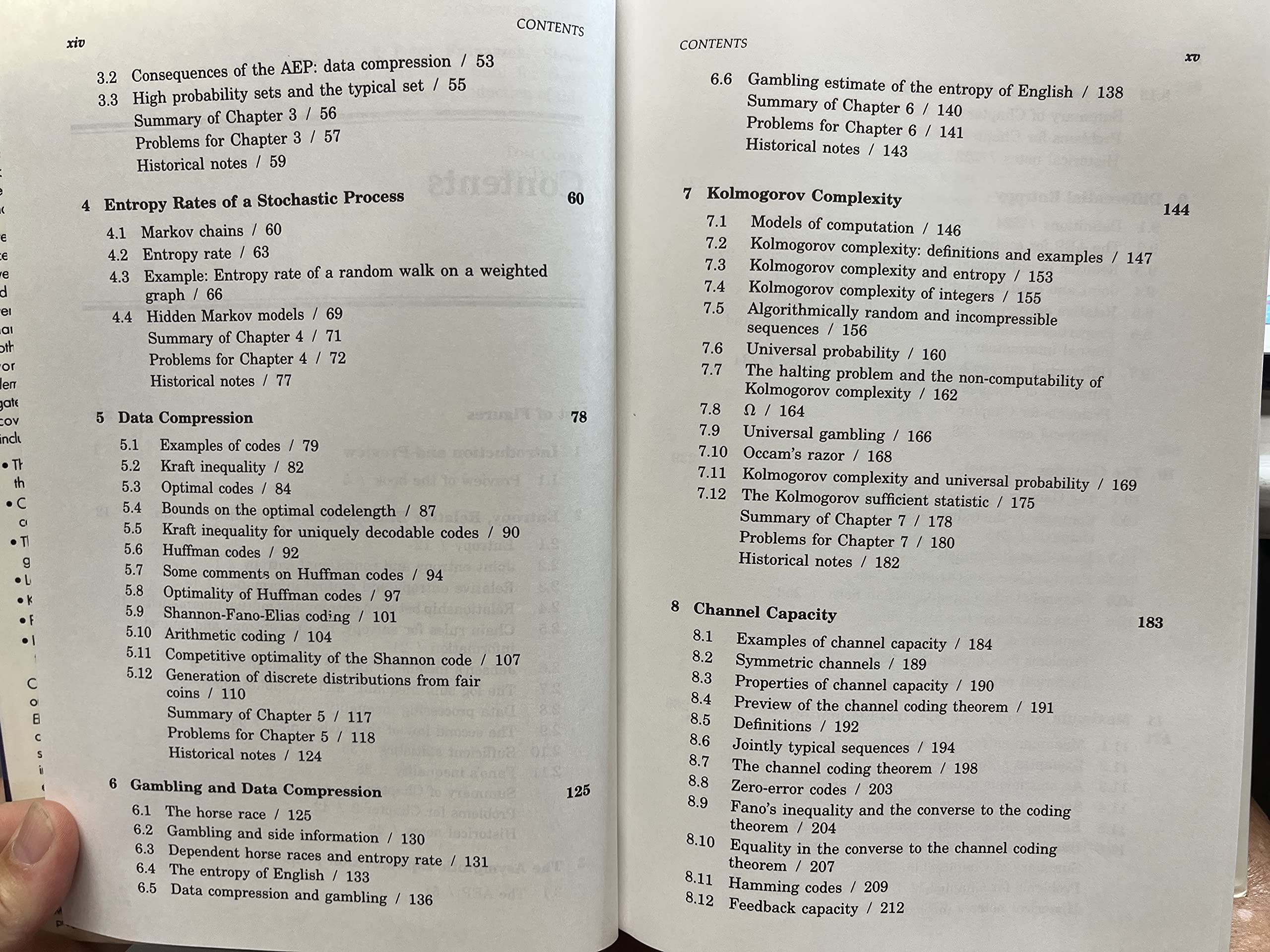
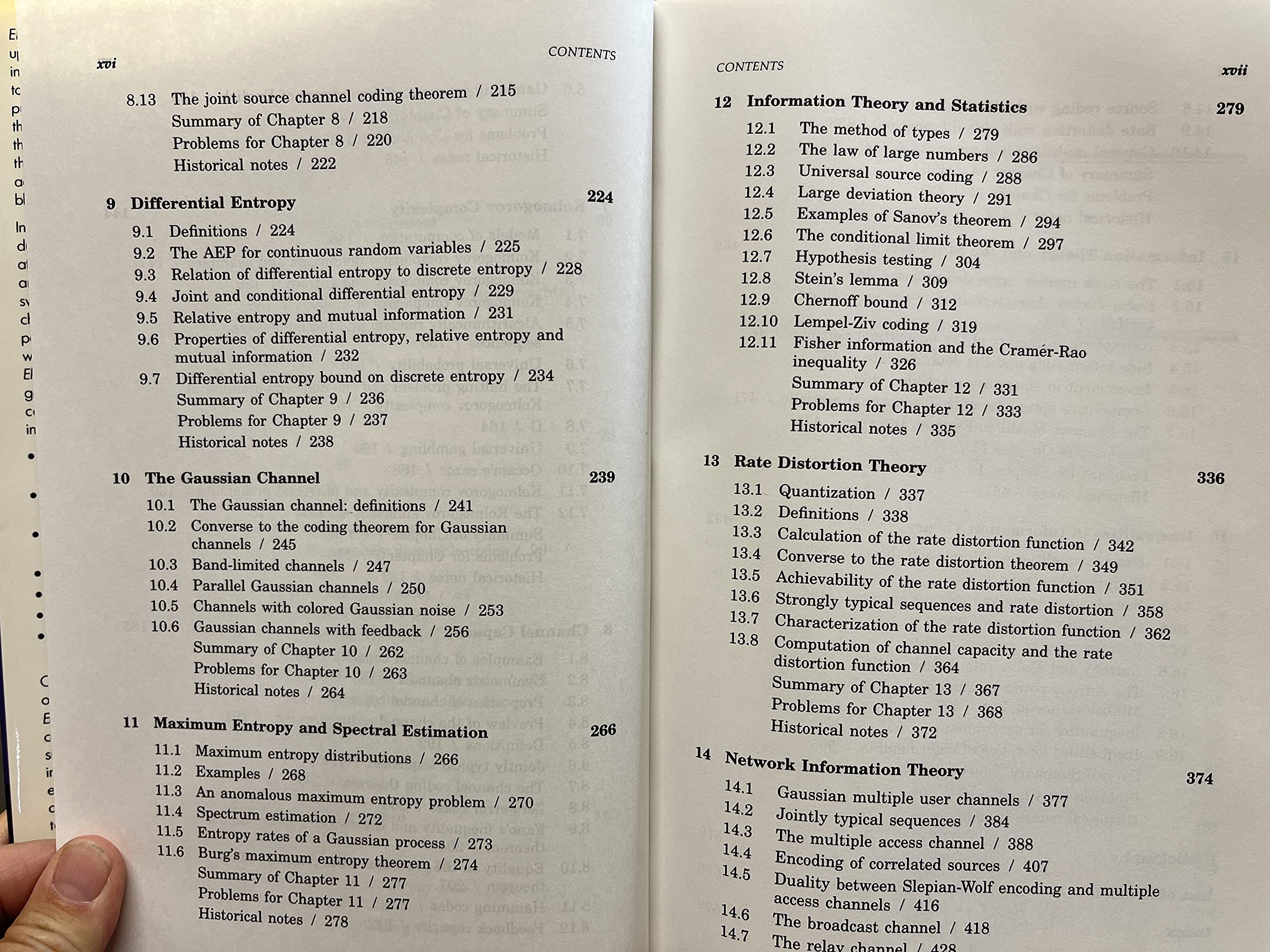
Following a brief introduction and overview, early chapters cover the basic algebraic relationships of entropy, relative entropy and mutual information, AEP, entropy rates of stochastics processes and data compression, duality of data compression and the growth rate of wealth. Later chapters explore Kolmogorov complexity, channel capacity, differential entropy, the capacity of the fundamental Gaussian channel, the relationship between information theory and statistics, rate distortion and network information theories. The final two chapters examine the stock market and inequalities in information theory. In many cases the authors actually describe the properties of the solutions before the presented problems.
⚠️ WARNING (California Proposition 65):
This product may contain chemicals known to the State of California to cause cancer, birth defects, or other reproductive harm.
For more information, please visit www.P65Warnings.ca.gov.
- Q: What is the page count of this book? A: This book contains five hundred seventy-six pages. It provides an in-depth exploration of various concepts in information theory.
- Q: What are the dimensions of this book? A: The book measures six point four six inches in length, one inch in width, and nine point five seven inches in height. These dimensions make it suitable for shelving and portability.
- Q: What binding type does this book have? A: This book is bound in hardcover. Hardcover bindings are durable and protect the pages effectively.
- Q: Who is the author of this book? A: The author of this book is Thomas M. Cover. He is well-known in the field of information theory.
- Q: What category does this book belong to? A: This book is categorized under Information Theory. It covers essential principles and applications in this academic field.
- Q: How do I read this book effectively? A: You can read this book by following the chapters sequentially, as each builds on the previous concepts. It is suitable for both students and professionals in related fields.
- Q: Is this book appropriate for beginners? A: Yes, this book is suitable for beginners with a basic understanding of mathematics. It starts with fundamental concepts before progressing to advanced topics.
- Q: Can I use this book for academic purposes? A: Yes, this book is an excellent resource for academic study. It covers both theoretical and practical aspects of information theory.
- Q: How should I store this book? A: Store this book in a cool, dry place, upright on a shelf to prevent warping. Avoid exposure to direct sunlight to protect the cover and pages.
- Q: Does this book require special care? A: No, this book does not require special care. Just handle it gently and keep it away from moisture to maintain its condition.
- Q: What if I receive a damaged book? A: If you receive a damaged book, contact the seller for a return or exchange policy. Most sellers will accommodate such requests.
- Q: Is there a warranty for this book? A: No, books typically do not come with a warranty. However, you can check the seller's return policy for any issues.
- Q: How do I troubleshoot if I can't find a topic in the book? A: If you can't find a topic, refer to the index at the back of the book. This will help you locate specific concepts quickly.
- Q: Are there any supplementary materials available for this book? A: Yes, there may be supplementary materials available online. Check the publisher's website for additional resources that complement this book.
- Q: What makes this book stand out in its category? A: This book stands out due to its comprehensive coverage of both foundational and advanced topics in information theory, making it suitable for various audiences.
- Q: Can this book be useful for professionals in the field? A: Yes, this book is beneficial for professionals seeking to deepen their understanding of information theory concepts and applications in real-world scenarios.